
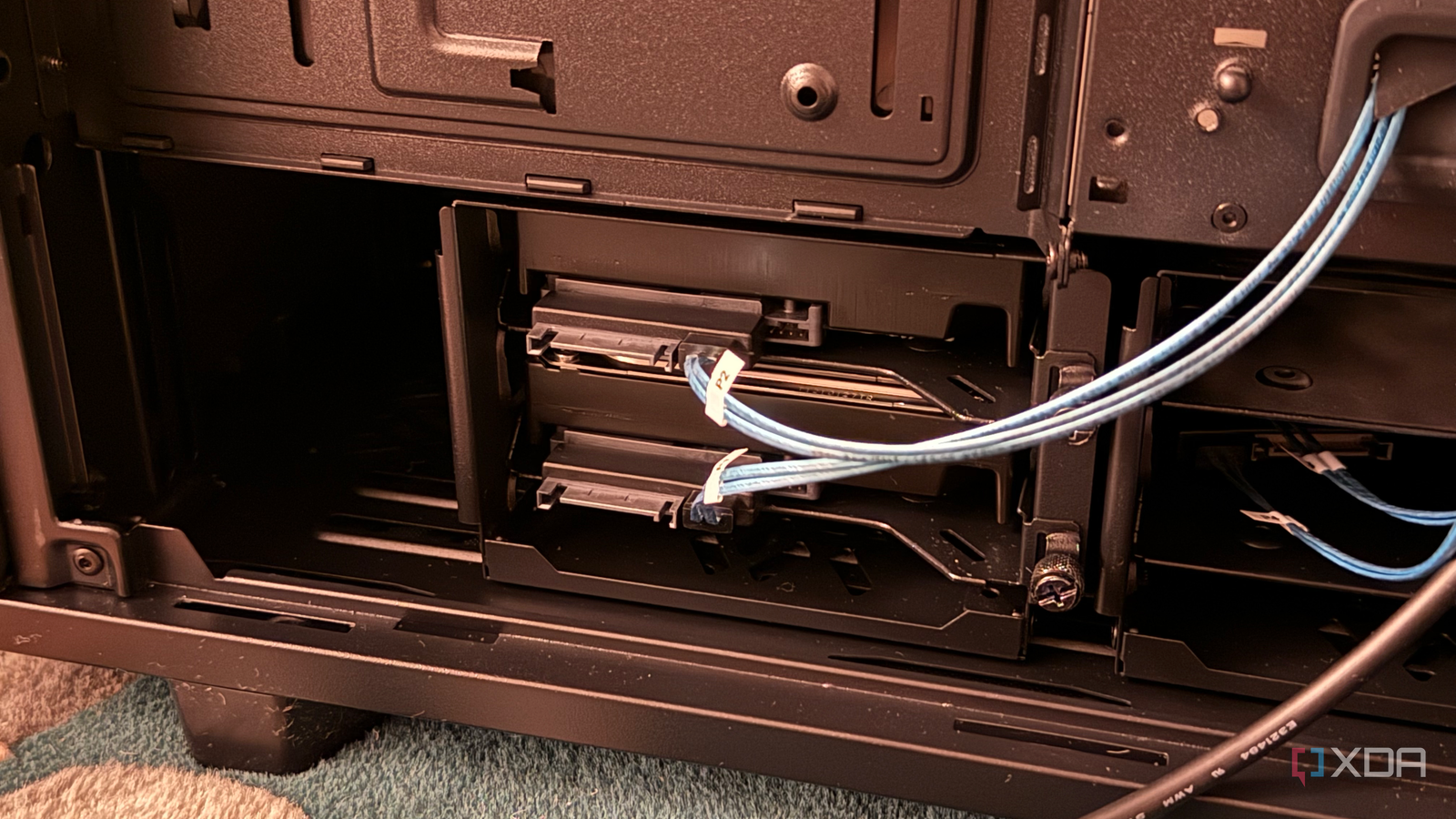
Published Aug 28, 2026, 1:00 PM EDT His love of PCs and their components was born out of trying to squeeze every ounce of performance out of the family computer. Tinkering with his own build at age 10 turned into building PCs for friends and family, fostering a passion that would ultimately take shape as a career path. Besides being the first call for tech support for those close to him, Ty is a computer science student, with his focus being cloud computing and networking. He also competed in semi-pro Counter-Strike for 8 years, making him intimately familiar with everything to do with peripherals. My NAS in my closet isn't just a NAS, but it's actually a full home lab that pulls double-duty for both file sharing and containerization. It has an RTX 3080 and two 8 TB SAS drives connected in a mirror, and to tell you the truth, I didn't arrive at this setup intentionally. I started with an old gaming PC and worked my way up to this, and while I think where I've ended up is great, I wish I could change these 5 things about it if I started from scratch. I'd start on a more robust platform ECC and PCIe lanes to spare would be nice The foundation my build sits on was used for gaming many moons ago: an i7-6700K and a Z170 board served me very well almost a decade ago, but now it's responsible for far more. The most obvious consequence to using a former gaming build as a home NAS is no ECC support, since consumer Skylake left that to the Xeon line. I do run ZFS, but the claim that doing so without ECC can be catastrophic is heavily overstated. ZFS checksums protect the data on the disk, but not the data corrupted in RAM before the checksum was calculated, and that's the real gap that non-ECC memory leaves. The bigger gap, to me, is PCIe lanes. This Skylake chip gives me sixteen CPU lanes, and my GPU and HBA eat those up instantly. Everything else gets chipset bandwidth. I'm also capped at 64 GB of DDR4, and I'm at half of that at the moment, though I can see myself picking up a couple more sticks very soon. My pool topology could've been better Redundancy be damned I currently run a two drive mirror, and while the redundancy isn't what I regret, the expansion mechanism is. Every time I want to expand my pool now, I have to put in two additional drives, because the shape of the first vdev shapes everything else that comes later. Mirrors resilver and handle random IO better, but something like RAIDZ gives you more usable capacity, and you can expand it easier, which is the key. It's not worth it for me to try and move all my data and revert to it now, but if I were to start over completely, that's where I'd go. I'd separate storage from tinkering hardware Right now, they live under the same roof I made the deliberate choice to turn my home lab into a home lab that houses a NAS, and while there are some great perks to that, there are also some serious potential headaches. For one thing, every time I reboot the hypervisor while tinkering, it also takes down my Samba and Immich shares, not to mention the other important services running in the box. That's the price you pay when everything runs on the same bare metal. Consolidation did do me a few favors: two always-on systems are a little more complex to manage than just the one, and doing full-on experiments inside VMs instead of containers helps with any potential breakage but still maintains access to the storage if I really need it, so it's not all negative. I would still prefer a hard separation between the two if I were to do this again from scratch. I'd mirror my boot drive Can't do it now without a full reinstall My storage pool might be redundant, but the boot drive isn't. The thing that actually imports the pools lives on a single Samsung SSD that has already pulled duty as my main boot drive in my workstation previously, so it's got some wear on it. If it were to fail, I could move the HBA and drives to a different machine, but there's a big difference between the data surviving an event like that and being able to access it. Proxmox will install to a ZFS mirror straight from the installer, but unfortunately, doing so after the fact means a reinstall is necessary. I would've diversified my drives a bit more I bought from the same brand One of the minor rules of thumb when it comes to buying storage is to avoid buying from a single manufacturer. That way, you avoid correlated failures that come from that particular brand's manufacturing in a given time period. Drive failures typically follow a bathtub curve, meaning most of them happen at the beginning and end of a drive's existence, and if you diversify a bit, you give yourself the best chance at dodging a cascade of failures. Both of the drives in my mirror are Seagate Exos 7E8 SAS drives, and my cold backup also happens to be a Seagate. I don't have any brand loyalty here, and was just purchasing what I thought was the best deal, but if I were to start over, I'd probably buy from at least 2 different parties. My NAS isn't perfect, but it works While there are certainly things I would change, I really like my current half-enterprise half-consumer setup. Running SAS took a lot of troubleshooting to get going, but the storage savings are genuinely there. As far as missed opportunities in the initial setup, like mirroring boot drive or diversifying tasks, that can be done in due time, and for now, everything works as well as it can given its humble beginning as a gaming PC.
5 things I'd change about my custom NAS if I were to build it again from scratch
Full Article
Original Source
Read the full article at Xda-developers →KhanList aggregates and links to publicly available news content. We do not host full articles from third-party sources. Always verify important information with original sources.