
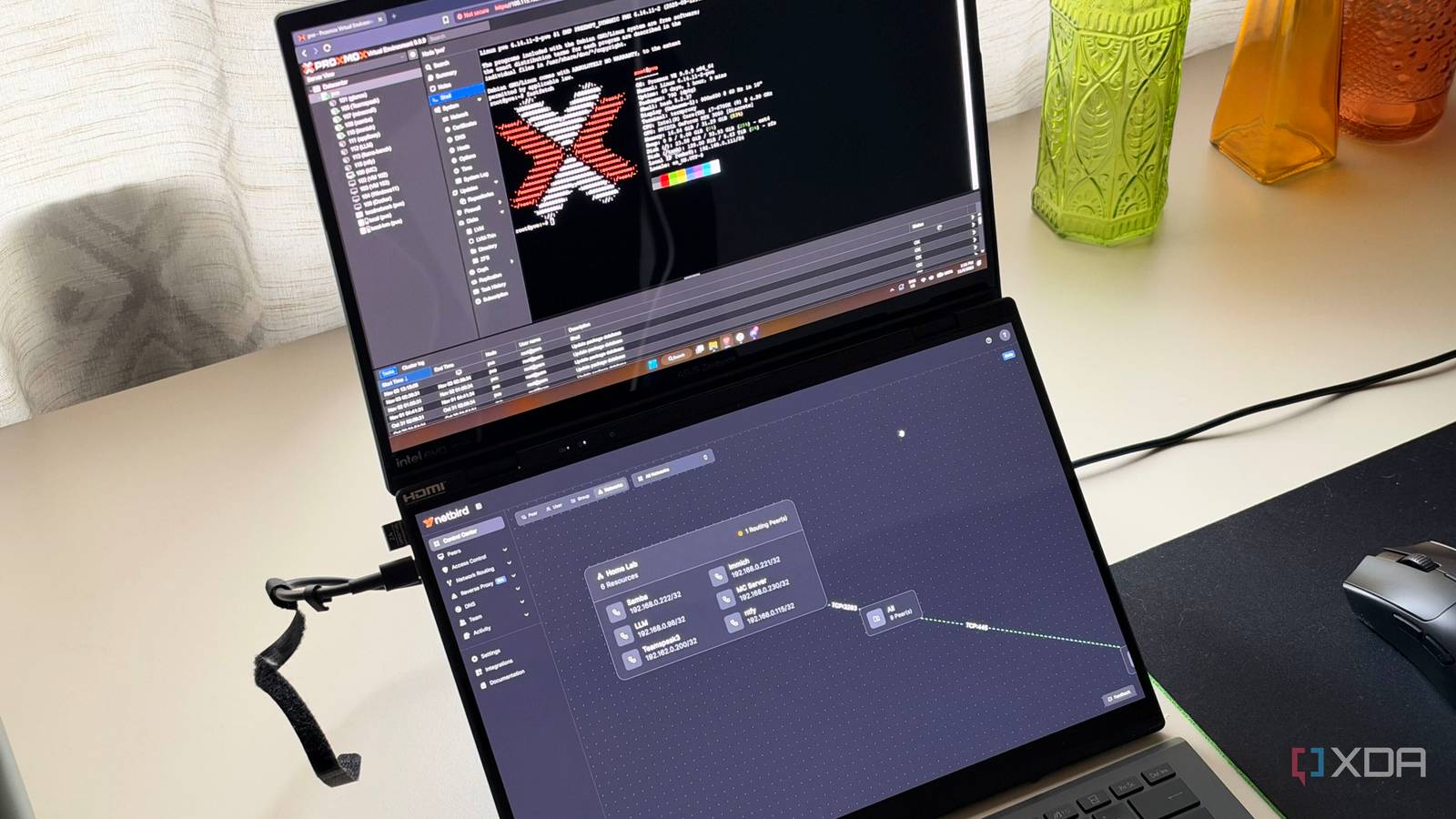
Published Nov 4, 2026, 8:00 AM EST His love of PCs and their components was born out of trying to squeeze every ounce of performance out of the family computer. Tinkering with his own build at age 10 turned into building PCs for friends and family, fostering a passion that would ultimately take shape as a career path. Besides being the first call for tech support for those close to him, Ty is a computer science student, with his focus being cloud computing and networking. He also competed in semi-pro Counter-Strike for 8 years, making him intimately familiar with everything to do with peripherals. Until this year, most of my digital life was spread across multiple data centers and systems that belonged to other people. My bulk storage was on Google Drive, my photos were on iCloud, my questions went to ChatGPT, and my friends and I paid for game server rentals that got used once a month. But once I set up my old gaming PC as a home lab, the number of subscriptions that I maintained began to fall precipitously. With just an old i7, retired gaming card and some pre-owned enterprise HDDs, I ditched these 6 cloud services for ones that exist on my home network, and I haven't missed them since. iCloud and Google Photos got ditched for Immich Highest upfront cost, but the payoff has been worth it If you only try one thing on this list, make it Immich, because it's the one app that can replace its first-party counterpart most convincingly without much fuss. The mobile app backs up your camera roll in the background just like Google Photos and iCloud would, so once it was set up and synced once, I never had to look at it again. Face recognition and smart search run on my own hardware, too. My RTX 3080 sped up the initial scan of my large photo library significantly, but a GPU isn't necessarily required for that. You can run the same systems on your CPU, it'll just take a bit longer. Getting the library off of those paid services and onto my Immich share meant leaving my phone with the app open overnight, since iOS doesn't let the Immich app perform a large background sync indefinitely. It's fine for a day's worth of photos and videos, but your entire library will need some dedicated time to sync. The more expensive part was the storage, as I landed on using two Seagate Exos 7E8 SAS drives along with an HBA card to handle all the storage in my lab, though that's a bit overkill for a simple photo backup. If you have a mini PC with some space or even just a spare 1 TB SATA drive, that'll be more than enough for a photo backup for you and a few others. As much storage as fits in my case Photos were only half of the equation in terms of pure storage. I relied on the other part of my Google One plan in Drive to take care of documents, game backups, and general clutter that accumulated on my drives that I needed access to elsewhere. All of that lives on a Samba share now, which uses the SMB protocol. SMB can be used across Windows, macOS and Linux easily, since all three can map the share as a network drive. No extra apps to access means very little stands between me and my files, no matter what system I'm working from. The share runs in its own lightweight Proxmox LXC, and on my 2.5GbE home network, moving a large folder between other 2.5GbE-capable systems is just as quick as it would be downloading from Google Drive. The only caveat here is that this setup doesn't have a backup at this time; the two mirrored drives add redundancy, but if both kick the bucket, my files don't live anywhere else. ChatGPT became a local AI stack I didn't ditch all my AI subscriptions, but GPT was the first to go On the same RTX 3080, I'm running Ollama with Open WebUI as the chat interface. Day to day, that means Google’s Gemma 4 running on the RTX 3080’s 10GB of video memory, and when I need something bigger, I run larger models on my gaming desktop with llama.cpp. Local models on consumer cards don't provide frontier-level capabilities, but for what I was using ChatGPT for, they're good enough. Claude continues to be the service I use for more serious requests, and the subscription cost still makes sense there, but for general summaries, small code reviews, and other stuff I wouldn't want leaving my machine, the mid-sized models are excellent. Rented game servers moved into containers The easiest swap I had been paying monthly for Minecraft and Counter-Strike 1.6 servers for my friends and me to play on once a month or so, and that cost didn't make any sense to me after I had started my home lab. Hosting plans tend to cap memory, player counts, or mod support by tier, but on my own hardware, the only limit is the hardware itself. The 32GB of total RAM in the box as well as the 6700K is more than enough to handle both of these servers in addition to everything else. Discord turned into TeamSpeak 3 I ditched Nitro for my private server To be upfront, I still use Discord all the time for general communications with friends, but in a more competitive setting, TeamSpeak is much better. It's much lighter on hardware, and in situations where every frame counts, trading one for the other makes a lot of sense. Besides that, though, TeamSpeak also allows for file sharing with no size limit, which is where the true savings were found. I am trusting my friends not to upload massive files, but when it's usually just a screenshot here and maybe a map file there, not having any limit and being able to store it all locally beats paying for Nitro. I don't miss any of these services Although I'm now responsible for keeping everything online myself, the trade-offs have been worth it. I still need to implement a UPS and some sort of offsite backup scheme for my Samba storage, but having control over these services and axing the monthly payment has been a big win. If you want to set up similar services, start with an old PC you already have first, because it's way more capable than you think.
5 things I moved off the cloud and onto my home network this year, and I don't miss any of them
Full Article
Original Source
Read the full article at Xda-developers →KhanList aggregates and links to publicly available news content. We do not host full articles from third-party sources. Always verify important information with original sources.