
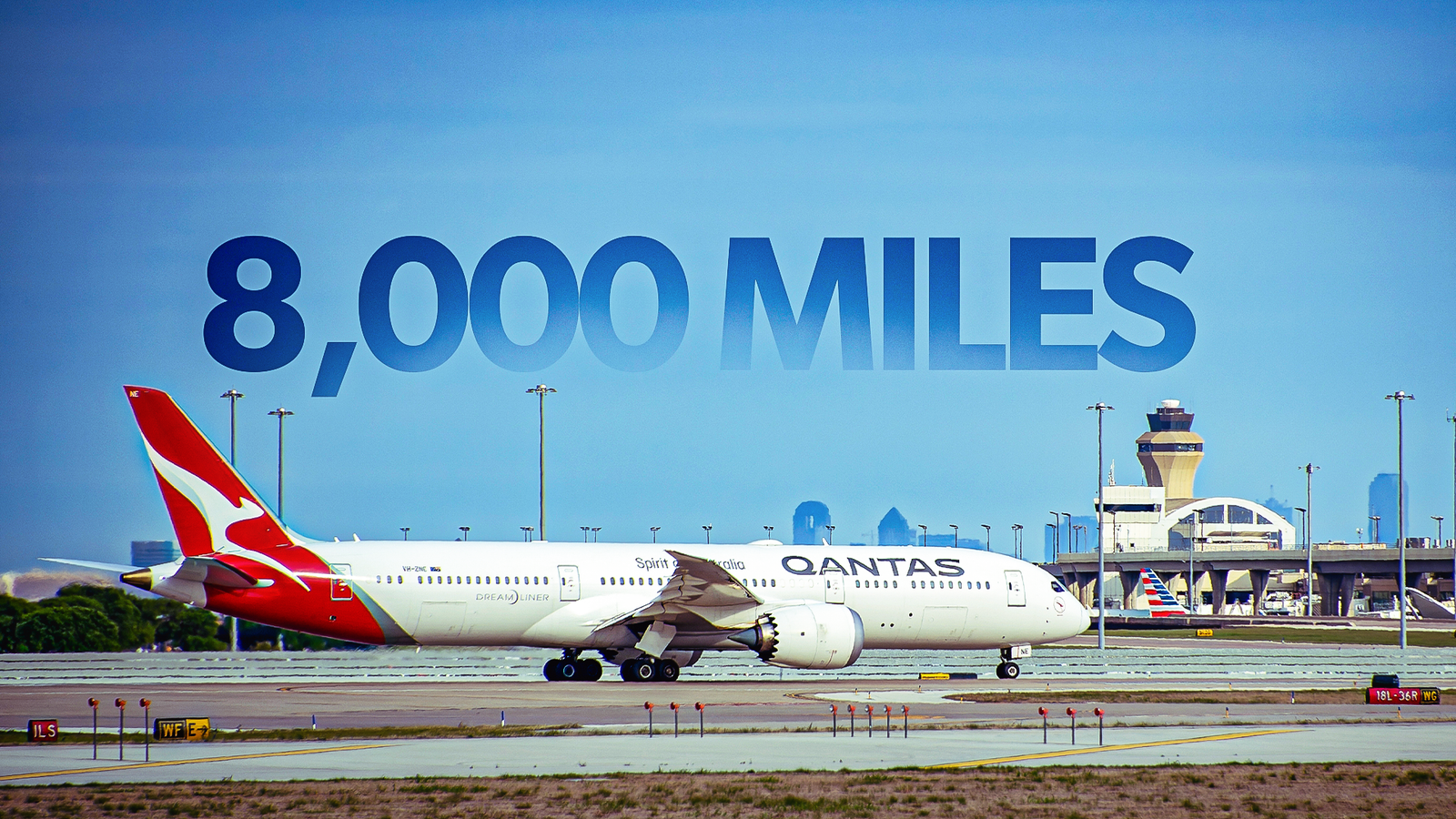
Credit: Leena Robinson | Shutterstock, Simple Flying Published Nov 6, 2026, 7:00 PM EST Luke Diaz is a freelance military writer with experience with active duty experience in the US Navy as well as defense and industrial engineering. He is a former Naval Flight Officer who performed tactical air control on the carrier-based E-2 Hawkeye. Sign in to your Simple Flying account Qantas runs the most demanding Boeing 787-9 Dreamliner network in the world today. Five routes flown by the airline's Dreamliners stretch beyond 8,000 miles, and the longest of them, Perth to London, has needed a Singapore fuel stop westbound since Middle East airspace closures forced longer flight paths. This countdown ranks the five by great circle distance, from Perth to Rome at about 8,300 miles (13,357 km) up to Perth to London at 9,010 miles (14,500 km). The jet's originally published range is 8,706 miles (14,010 km), and by simple conversion four of the five routes exceed it. Qantas closes the gap by flying only 236 seats on each aircraft, according to Airways, roughly 50 fewer than a typical two-class layout, and by building schedules around the wind. This countdown examines how the Dreamliner successfully redefined the iconic Kangaroo Route thanks to the ultra-long-haul 787-9. 5 Perth To Rome Fiumicino 8,300 miles (13,357 km) Credit: Qantas Qantas flight QF5 took off from Perth on the night of June 22, 2022. Qantas had not flown to Rome since 2003, back when it operated multi-stop Boeing 747 services via cities like Singapore and Bangkok. While initially launched in response to surging post-pandemic summer holiday crowds, the business profile of QF5/QF6 has evolved into a highly resilient asset. The route covers about 8,300 miles (13,357 km), and the westbound leg lasts 16 hours and 25 minutes. It is roughly 700 miles (1,126 km) shorter than Perth to London, and thus is the only route on this list that allows the 787-9 to carry a truly full load of passengers and cargo. QF5 has also remained fully nonstop in both directions despite other long-haul itineraries being forced to use layovers since Russia closed its airspace in 2022. The flying season spans roughly six months from Spring to Fall and, thanks to exceptional demand, the service has carried well over 70,000 passengers since its inception. Qantas relies on connections in Perth to allow travelers from the east coast of Australia to step off a domestic flight and board a Rome-bound Dreamliner. More than 50% of the route’s passengers come from Australia's eastern cities: Sydney, Melbourne, and Brisbane. 4 Auckland – New York-JFK 8,828 miles (14,207 km) Credit: Qantas The Auckland (AKL) to New York (JFK) corridor is one of the most intensely contested and economically vital battlegrounds in modern ULH aviation. It operates over a distance of 8,828 miles (14,207 km). Historically, traffic connecting Australia and New Zealand to the East Coast of the US relied on multi-stop journeys via West Coast gateways like Los Angeles (LAX) or San Francisco (SFO). Today, the route operates as a fierce, high-stakes duopoly between Qantas (QF3/QF4) and its cross-Tasman rival, Air New Zealand (NZ2/NZ1). Air New Zealand initially pioneered the nonstop air bridge in 2022. Qantas launched New York flights on June 14, 2023, after a gap of more than three years, using Auckland as the stop in place of LAX, meeting Air New Zealand head-on. Spanning nearly 14,200 kilometers, the flight time regularly stretches between 16 hours and 17.5 hours, heavily dictated by severe high-altitude jet streams shifting across the Pacific Ocean. This extreme distance places intense operational constraints on Qantas’ 787-9. Route Flight Numbers Distance Average Annual Travelers Season Frequency Perth Airport (PER) – Rome Fiumicino Airport (FCO) QF5 / QF6 8,300 miles (13,357 km) 32,500 May 3 – October 23 3x Weekly Auckland Airport (AKL) – John F. Kennedy International Airport (JFK) QF3 / QF4 8,828 miles (14,207 km) 72,000 Year-Round 5x Weekly Perth Airport (PER) – Paris Charles De Gaulle Airport (CDG) QF33 / QF34 8,863 miles (14,263 km) 32,500 Year-Round 3x Weekly Melbourne Airport (MEL) – Dallas/Fort Worth International Airport (DFW) QF21 / QF22 8,992 miles (14,471 km) 50,000 Year-Round 4x Weekly Perth Airport (PER) – London Heathrow Airport (LHR) QF9 / QF10 9,010 miles (14,500 km) 155,000 Year-Round 7x Weekly (Daily) Data shows that only 33% of the flight’s total passenger load originates in Sydney. The remaining two-thirds of the cabin is dynamically fed by passengers funneling from other Australian hubs, predominantly Brisbane and Melbourne, alongside local New Zealand flyers. The route relies heavily on top-tier premium business travel during the week, capturing finance, technology, and corporate executives moving between the financial districts of Sydney, Melbourne, and Manhattan. On weekends, the traffic shifts toward high-end premium leisure travelers. In order to safely undertake the long trans-Pacific sortie, the 787-9 must trade some of its payload for fuel before taking off. That requires the Qantas business model to maximize appeal to higher-paying customers like business travelers and drop some of its seating capacity in the economy section. It has proven to be a highly lucrative asset, capturing an exceptionally high average load factor of 84% for Qantas. Owing to its popularity, QF3/QF4 operates Monday to Friday with weekend service during surges. 3 Perth – Paris Charles de Gaulle 8,863 miles (14,263 km) Credit: Qantas Qantas began nonstop flying from Perth to Paris in July 2024, making history by establishing the first nonstop twinjet service between Australia and France. Australian Aviation reported that the inaugural QF33 flight was scheduled for 17 hours and 20 minutes. The route covers 8,863 miles (14,263 km), a little shorter than London but well past the 787-9's full payload range. The route immediately injected 75,000 annual seats into the Europe–Australia market. Prior to this service, Qantas had not touched down in the French capital since 2004, when it retired its aging Boeing 747-400 multi-stop service via Singapore. In the years that passed, like its sister route to London (QF9), the Perth–Paris sector has become a major case study in adapting to complex international geopolitics. In response to volatile Middle East airspace closures, Qantas had to dynamically reroute flights to ensure absolute passenger safety. While the route was initially engineered to be a strict nonstop, Qantas shifted its operational strategy for the westbound Perth-to-Paris leg to include a technical and commercial stopover at Singapore Changi Airport (SIN). Rather than treating the Singapore detour as a pure operational penalty, Qantas masterfully converted it into a commercial victory. QF33 relies on capturing top-tier 'Kangaroo Route' market share away from Middle Eastern airlines. By permanently re-routing the service via Singapore, Qantas expanded overall Paris network frequencies from three weekly flights up to five. Exactly like the Rome service, this flight officially originates at Sydney Kingsford Smith Airport (SYD), but concurrently, Qantas boosted feeder flights between Perth and Singapore. The air bridge has thrived in spite of obstacles and commands premium prices from travelers eager to avoid a middle-of-the-night stopover in the Gulf. 2 Melbourne – Dallas/Fort Worth 8,992 miles (14,471 km) Credit: Qantas Melbourne Airport's chief executive called it the longest route ever flown from the city when Qantas started Melbourne to Dallas/Fort Worth flights in December 2022. It was also the fourth longest in the world at the time, according to Airways. The airline framed the mission as a companion to its existing Sydney to Dallas flights, and it even flies the same 787-9 with 236 seats, split into 42 business, 28 premium economy, and 166 economy. The route covers 7,862 nautical miles, nearly as far as Perth to London, and the schedule shows how much the wind matters. QF21 from Melbourne is scheduled for 16 hours and 10 minutes, while QF22 from Dallas runs 17 hours and 40 minutes because it flies into headwinds across the Pacific. The massive one-and-a-half-hour time difference between the eastbound and westbound flights is caused by high-altitude jet streams. On the return flight, the aircraft faces severe, sustained headwinds. As one of the longest commercial flight routes in the world, this segment acts as a vital strategic bridge, linking Australia to the heart of American Airlines' network in North America. Melbourne is one of Qantas' strongholds, while DFW is the top mega-hub for AA. This pairing allows the two airlines to function as a single network, harmonizing flight schedules. The route operates on a stable, year-round schedule of four weekly flights with an average load factor of approximately 81.9%. 1 Perth – London Heathrow 9,010 miles (14,500 km) Credit: Qantas The Perth to London Heathrow (QF9/QF10) route is the crown jewel of Qantas’ international network. Covering 9,010 miles (14,500 km), it is Australia’s flagship 'Kangaroo Route' and famously became the first nonstop passenger service between Australia and the United Kingdom when it launched on March 24, 2018. Melbourne Airport also declared that QF9 was the longest route ever flown from the city. For nearly seven decades, traveling between Australia and Britain required multiple stops, spawning the affectionate nickname for the journey 'down under.' When Qantas deployed the 787-9 Dreamliner to link Western Australia directly with London, it upended the entire concept. Today, travelers are willing to pay an incredible 20% to 30% price premium for a nonstop flight compared to one-stop itineraries from competitors. The scheduled block time is 17 hours and 30 minutes outbound and 16 hours and 50 minutes on the return. Following volatile Middle East airspace closures, flying entirely nonstop from Perth to London became too fuel-intensive on the outbound leg. Qantas introduced a brief layover in Singapore just as it did on the Paris route in order to overcome the obstacle. Even so, the demand for QF9/QF10 remains robust, with cabins regularly clearing 94% to 95% load factors on a permanent, daily year-round schedule.
5 Qantas Boeing 787-9 Routes Longer Than 8,000 Miles
Full Article
Original Source
Read the full article at Simpleflying →KhanList aggregates and links to publicly available news content. We do not host full articles from third-party sources. Always verify important information with original sources.