
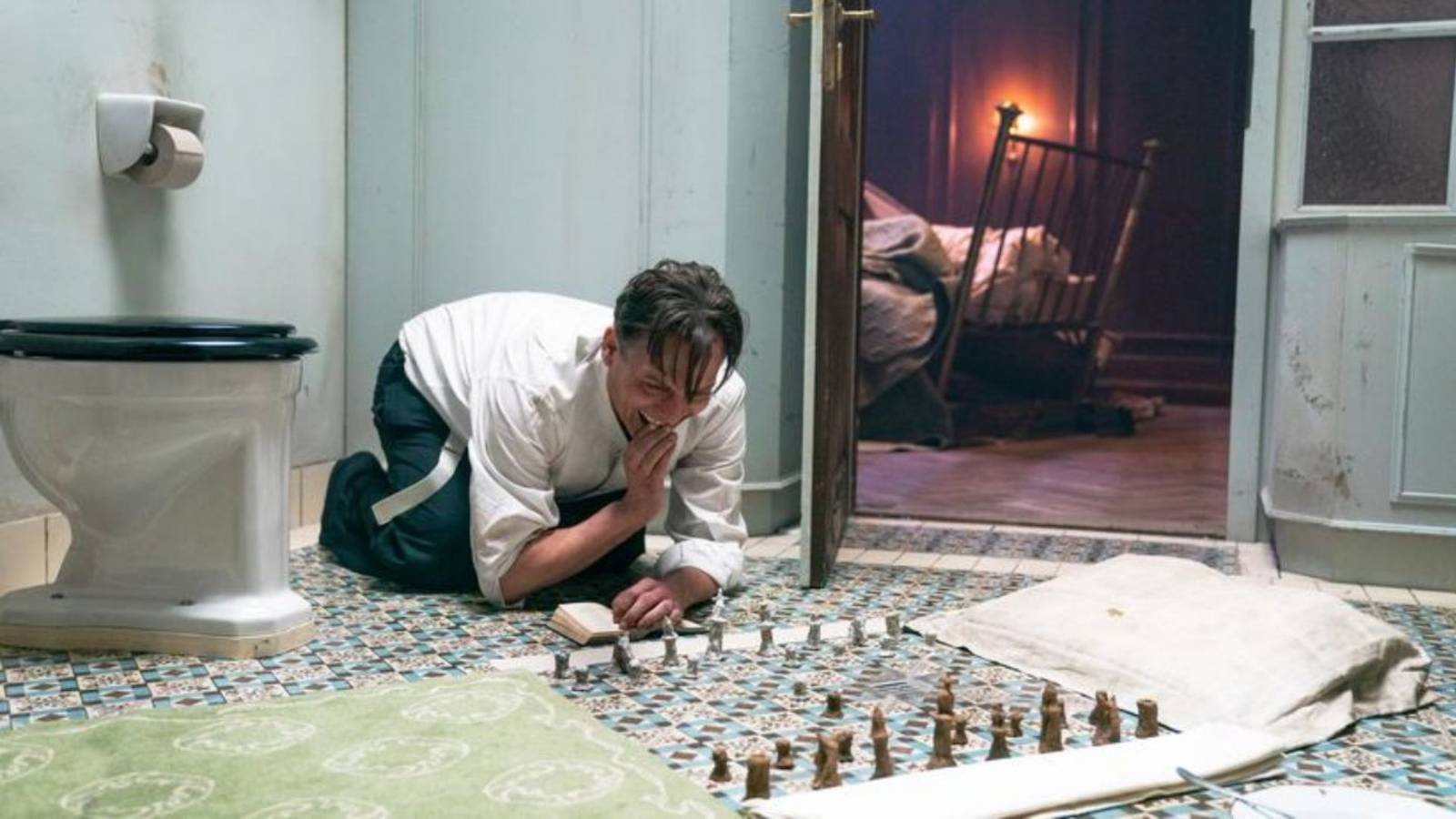
Published Nov 21, 2026, 9:05 AM EST At any given moment, Scott Simone has at least three books jockeying for his attention. He’ll never turn down a campus novel with a literary bent, nor will he hesitate to add yet another mystery to his Leaning Tower of Pisa-inspired to-be-read pile — which is built upon the bedrocks of too many short story collections, how-are-these-real true crime books, and classics waiting to be cracked open again. Topics that have him ripping through pages the fastest include closed-circle murders, unhappy professors, life-questioning philosophical deep dives, so long as they feature sharp sentences, a dark sense of humor, and at least a little malice. He’s spent so much time in book shops over the years he is, to his wife’s chagrin, continuing to build a library that doesn’t quite respect the dimensions of the apartment meant to contain it. A great thriller doesn't necessarily have to fool you. You know exactly who's lying, and you can see a bad decision coming long before a character makes it. You might even know who's dead before the story properly begins. But still you keep turning pages. You want to understand it all — how a character became who they are, how they’ll handle insurmountable odds. You want to put yourself in the situation to know if, with the same set of options, you’d fare any better. A good twist can catch a reader off guard. But a great thriller makes them dread what they’ve already worked out. And there's usually a lot of machinery involved. Witnesses change their stories, suspects trade places, an old photograph turns up just when the investigation has gone cold. Half the pleasure is having a writer lead us around by the nose. But try doing all that in fewer than 100 pages. There's barely time to properly introduce characters, never mind give each of them a convincing reason to lie. And when there's so little room to hide the truth, a writer has to find another way to make us dread finding it. 1 'Rock Crystal' by Adalbert Stifter (1845) Image via NYRB Classics Most of the time, a writer who spends this long describing local footpaths is asking to be skimmed. But Adalbert Stifter bucks that trend. In Rock Crystal, he makes us intimately familiar with two Alpine villages and the route between them, then puts two children on that same route in a snowstorm. Conrad and his younger sister, Sanna, have gone to see their grandparents on Christmas Eve. They know the way back; after Stifter's patient geography lesson, so do we. A little snow doesn't worry them. They've made this walk plenty of times, and even as the path becomes harder to make out, they're sure they'll recognize something familiar soon enough. But the ground keeps rising when they ought to be going down, and before long they're on a glacier. Stifter lets the danger register with us long before the children understand what's happening. When they're exhausted, stopping to rest seems like a sensible idea. We know it could kill them. The extraordinary thing is how little Stifter needs to make their predicament so frightening. He doesn't dispatch a wolf or send a boulder crashing down the mountainside. He lets it snow. And snow. The children have walked this path before, which is precisely why they keep trusting it. After all those pages spent learning the way home, we'd like to give them directions. By then, we'd probably be guessing ourselves. 2 'The Dry Heart' by Natalia Ginzburg (1947) Image via New Directions The least mysterious thing in The Dry Heart is the murder. Natalia Ginzburg tells us at the outset that a woman has shot her husband, Alberto, between the eyes. No painstaking investigation follows; instead, we're taken back through a marriage in which the warning signs were so plain it's maddening to watch everyone ignore them. The narrator, a lonely schoolteacher, wants a husband and a home. Alberto admits that he's in love with somebody else. She marries him anyway, hoping that time and proximity might make him reconsider. It sounds like spectacularly bad judgment. Then Ginzburg shows us how easily a person can build a whole future out of one or two encouraging moments. Alberto barely needs to lie to his wife. He goes away, comes back, offers the occasional scrap of affection. Then he leaves her to work out what it all means. She gets skilled at finding hopeful interpretations, even as their life together gives her less and less reason to expect anything better. Ginzburg doesn't make her an innocent martyr, nor does she turn Alberto's indifference into some grand, romantic torment. She dissects exactly how a marriage can be miserable without either of them ever delivering a speech about it. Knowing where this all leads makes you examine every small interaction and eat up every morsel of mundanity, but you’re always left hungry, which keeps you at the table in anticipation of more — much like the narrator. Collider Exclusive · 8 Questions · 2 Minutes Which Iconic Detective Should Solve Your Case? Columbo · Benoit Blanc · Jessica Fletcher · Marlowe Answer eight quick questions and we will tell you who should be assigned to your murder. Four of the most famous detectives ever put on screen, and four completely different ways of getting somebody to admit what they did. 🕵Columbo(Columbo) 🧣Benoit Blanc(Knives Out) 🖨Jessica Fletcher(Murder, She Wrote) 🚬Philip Marlowe(The Big Sleep) FIND YOUR DETECTIVE → 01 What do people assume about you when they meet you? Pick the one that sounds most like you. AThat I am a bit of a mess. BThat I am putting it on. CThat I am completely harmless. DThat I gave up a while ago. NEXT QUESTION → 02 Pick a coat. No wrong answers here. AA beige raincoat I never take off. BSomething loud and very well cut. CSomething practical in a nice colour. DA trench coat with the collar up. NEXT QUESTION → 03 How do you get information out of people? One answer only. AKeep asking one more question. BLet them perform and watch closely. CJust be genuinely lovely to them. DWait until they slip. NEXT QUESTION → 04 How would your friends describe you? Be honest. AScruffy and oddly brilliant. BTheatrical, in a good way. CWarm, and a little bit nosy. DCynical, and loyal underneath. NEXT QUESTION → 05 Pick a drink. Pick the closest answer. ACoffee, from whatever is nearest. BSomething fancy with a garnish. CTea, with somebody who needs it. DWhisky, no ice, on my own. NEXT QUESTION → 06 Where do you do your best thinking? Pick the closest answer. AHalfway out of the door. BOut loud, in front of everybody. COver the garden fence. DIn the car at two in the morning. NEXT QUESTION → 07 What is your car like? Think about the one on your drive. AOld, battered, and still going. BSomething nobody expected. CSensible, and I would rather walk. DIt has seen some things. NEXT QUESTION → 08 What makes you good at reading people? Last one. This is the one that decides it. AI never stop asking questions. BI enjoy the performance of it. CPeople simply tell me things. DI expect everybody to lie. REVEAL MY DETECTIVE → The Case Is Assigned Your Detective Is…A great detective is really just a personality with a method attached, which is why we keep remaking the same four of them. Here is yours, what it says about you, and the case for them being the best in the business. ColumboYou let people think you are not a threat and then you simply never go away. Columbo is the only major detective show that tells you who did it in the first ten minutes, because the pleasure was never the puzzle, it was watching a rich man slowly realise he is in trouble. You are underestimated constantly, and you have stopped minding because it keeps working. The show invented the inverted detective format for television and nobody has bettered it since. Peter Falk won four Emmys for the part and played him across five decades. Your flaw is that one more question is rarely one more question. Benoit BlancYou are the most interesting person in the room and you know exactly how to use it. Rian Johnson built Blanc as a gentleman detective who is also an outsider everywhere he goes, which lets him be charming at people who would never otherwise talk to him. You read a room in seconds and you are not above performing a little to speed things up. Rian Johnson was nominated for the Best Original Screenplay Oscar for Knives Out in 2020. Wake Up Dead Man arrived on Netflix in December, making three Blanc films in six years. Your risk is enjoying the performance so much that people stop taking the point seriously. Jessica FletcherEverybody tells you everything, and you have never once asked them to. Jessica Fletcher is a crime novelist from a small town in Maine who is so warm and so obviously trustworthy that suspects confess to her essentially as a social courtesy. You are the person friends call first, and you have a frankly alarming amount of information about everybody. Angela Lansbury was nominated for the Emmy twelve times for this role and never won once. The show ran twelve seasons, and Jamie Lee Curtis is now bringing the character back. Your flaw is that being told everything is only a gift if you know what to do with it. Philip MarloweYou expect to be lied to and you are almost never disappointed. Chandler wrote Marlowe as a man with a rigid private code in a city that has none, which is why he takes the case, solves it, gets nothing out of it and takes the next one. You are the most cynical person your friends know and the one they would call at four in the morning. Bogart played him in The Big Sleep in 1946 and the plot is famously impossible to follow, which matters not at all. Elliott Gould, Robert Mitchum and Liam Neeson have all taken the part, and every version says something about its decade. Your weakness is a code so strict that it mostly punishes the person holding it. ↻ RETAKE THE QUIZ 3 'An Untouched House' by Willem Frederik Hermans (1951) Image via Pushkin Pres War gives people plenty of excuses for behaving badly. Willem Frederik Hermans explores how quickly they'll find some more. His unnamed Dutch narrator in An Untouched House stumbles into a well-preserved home amid the destruction of World War II. There's a bath, clean clothing, a decent bed. After what he's endured, it doesn't seem unreasonable to enjoy them. Then German soldiers arrive and assume he's the owner — and he lets them believe it. It's a lie that could keep him alive, and for a little while we're quite willing to excuse it ourselves. The real owners could return. His comrades could retake the town and find him hosting the enemy. There's an upstairs room he can't open. But Hermans doesn’t rely solely on these factors to create suspense; the largest portion comes from the soldier's growing attachment to things that were never his. He doesn't abandon his principles in one sweeping act — he makes a little exception, grows used to it, then makes another. Hermans lays out a pretty convincing argument for how fighting for the right cause doesn't exempt a man from becoming a horrible person. 4 'A Chess Story' by Stefan Zweig (1942) Image via Pushkin Press Classics Being able to think 10 moves ahead sounds like a hell of an advantage. That is, until you can't stop doing it. That's the trap Stefan Zweig sets in A Chess Story, where two men sitting across a table manage to create more tension than an entire room full of armed criminals. On an ocean liner, world chess champion Mirko Czentovic encounters Dr. B., a stranger whose grasp of the game appears almost supernatural. But Dr. B. didn't acquire his skill through patient afternoons at a chess club. The Gestapo held him in isolation, denying him practically anything that might occupy his mind. When he managed to steal a book of recorded chess games, he learned them all. Then he began playing against himself, imagining both sides until his mind nearly gave out. So when Dr. B. sits across from Czentovic, winning isn't quite the point. He's risking the return of an obsession that once helped him survive and then came close to destroying him. Czentovic, who is hardly anybody's idea of pleasant company, is content to spend ages considering a move. Dr. B. grows restless. He sees possibilities the moment the pieces shift, then has to endure the other man's deliberations while his thoughts keep racing. Zweig doesn't need Czentovic to behave cruelly; the champion is simply doing what he always does. For the reader, each pause starts to resemble the long hours Dr. B. spent alone with his imaginary opponents. 5 'Fatale' by Jean-Patrick Manchette (1977) Image via NYRB Classics The wealthy residents of Bléville are pleased with themselves. They've made fortunes and amassed influence. They’ve mastered getting what they want, usually at someone else's expense. So it’s only natural that they're convinced nobody could pull the same trick on them. Jean-Patrick Manchette sees how much fun can be had with that assumption in Fatale. We meet a woman who shoots a man during a hunting outing, then celebrates with champagne and sauerkraut on a train. She arrives in Bléville under the name Aimée Joubert, and the local rich people are falling over themselves to get to know her. She's attractive, sure, but she’s an excellent ear. And so everybody ends up confiding a grievance or passing along a nasty rumor about a neighbor. They've met their match, but they're too pleased with themselves to notice. Manchette describes a killing with about as much ceremony as he does a dinner party. Somebody winds up dead, and everyone goes on counting their money, planning their next move, and maintaining their reputations. And Aimée is no different. She likes the money and the fine living. She finds pleasure knowing she's more clever than the people she's exploiting. But she also gets carried away. She's so good at recognizing what other people want that she pays much less attention to her own appetites. At first it's fun watching these supposedly important people make fools of themselves — then it’s a bit harrowing seeing how much Aimée has bought into their world.
5 Perfect Thriller Books Under 100 Pages
Full Article
Original Source
Read the full article at Collider →KhanList aggregates and links to publicly available news content. We do not host full articles from third-party sources. Always verify important information with original sources.