
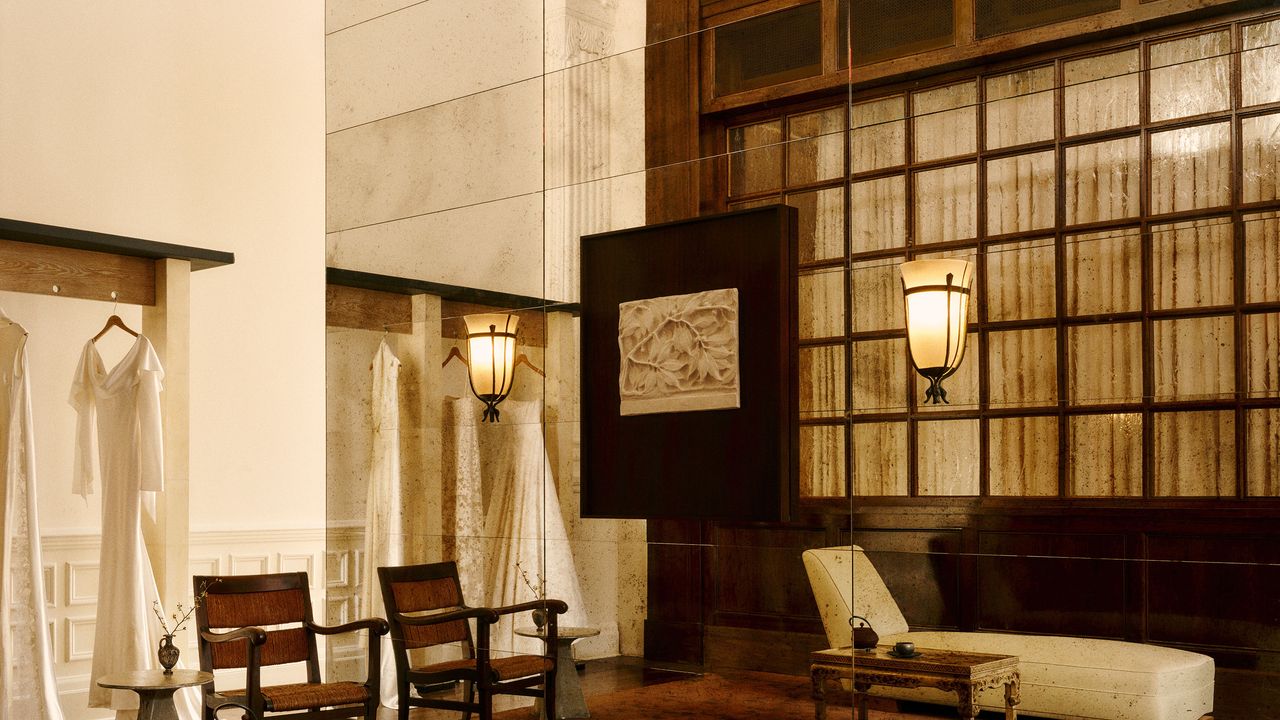
How do you design a store enticing enough to lure people off their sofas and through the door? The creatives behind some of the world's buzziest shops reveal their strategiesWhen nearly anything can be bought with a few taps on a screen, brick-and-mortar stores have to work harder—and smarter—to earn a visit. What e-commerce can't replicate, even with the cleverest algorithms, is the thrill of stepping into a beautifully conceived space—and discovering something you didn't know you wanted. From side-by-side jewel-box fashion boutiques in Paris to a palatial bridal studio set in a 19th-century building in downtown New York, AD PRO highlights the big ideas shaping today’s most engaging retail environments.Design for Desire, Not Just FunctionThe first goal for any new retail space is obvious: Make people want to be there.Fashion designer Danielle Frankel Hirsch just opened a 12,000-square-foot studio in Tribeca, collaborating with Studio Partners Architecture and AD PRO Directory designer Augusta Hoffman to create a gasp-worthy dress boutique worthy of any bride's fantasies. Located in a 19th century edifice originally built to house the New York Mercantile Exchange, the shop, says Frankel Hirsch, is designed as a transportive experience. After guests enter the space through its unassuming Tribeca storefront entrance, they ascend a grand carpeted staircase to a large gallery boasting over 30-foot floor-to-ceiling windows. Hoffman worked with artist Miriam Ellner to create églomisé paneling surrounding the staircase, and outfitted the spaces to the height of elegance, with Fortuny fabrics, furniture sourced from Paris, and handpainted ceiling murals.The 30-foot ceilings at New York City's Danielle Frankel guarantee a wedding dress shopping experience that's hard to equal Photo: Clement PascalIn Paris, Rubirosa's two petite boutiques, designed by Louis Charles Aka, deliver a similar sense of occasion on a much smaller scale. The original 500-square-foot shop, which opened in June 2025, was joined this past August by a second location just next door. Rather than simply duplicate the first boutique's nostalgic formality, Aka has given its new neighbor a distinct personality. The lacquered shelving remains, displaying cashmere sweaters, crisp poplin shirts, and soft leather slippers in a rainbow of colors. But where the original featured tall bookcases, the new shop has floor-to-ceiling arches whose cubbies become bands of color when filled with garments of cashmere, cotton, and silk.In the original boutique, the defining gesture was a dense, velvety red wall-to-wall carpet from La Maison Bineau. “I spent everything on the red carpet,” Aka declares. “People criticized, ‘You will have to change it in three months.’ I said, ‘We don’t care. We want people to feel special.’” In the second shop, the color drama comes courtesy of vivid Yves Klein blue—a knowing wink to the fashion set. Voluminous white balloon drapery heightens the theatricality, suggesting a salon for elegant grand dames even as the boutique attracts a younger crowd of influencers and trendsetters.Lacquered walls hung with portraits of Pope John Paul II and Mobutu Sese Seko at Rubirosa’s Photo: Magnus BachThe exterior of Rubirosa’s on Rue de Grenelle in Paris Photo: Magnus BachAD100 designer Brigette Romanek took a more subtle approach to creating desire at Catherine Bloom for Nordstrom, an appointment-only shop in Los Angeles where Bloom, the department store’s Director of Luxury Styling, works with private clients. “I want to make people feel something,” says Romanek. “A store should be a destination you look forward to.” Her use of paneled walls in camel, khaki, and rose suede, plus her signature mix of elements both edgy (the angular leather sofa) and delicate (the plasterwork ceiling) creates what she calls “a protected feeling” that makes the space feel worth seeking out.Suede-paneled walls and ornate plasterwork at Catherine Bloom for Nordstrom Courtesy NordstromA punchy red-orange “wallop” moment at Big Night’s West Village outpost Photo: Julie GoldstoneWhere Romanek’s space whispers intimacy, Katherine Lewin’s Big Night shouts joy. The New York City shop Big Night, which sells brightly hued kitchen and entertaining goods, trades old-world refinement for modern exuberance. “People tell me they get a shot of serotonin walking into the store,” she says. Her brand’s signature color of punchy red-orange provides what she calls a “wallop”—an immediate sensory experience that registers before customers even process what they’re looking at. Handmade tiles from Smink Studio, screen-printed with bold geometric patterns, are mixed in unexpected color combinations throughout the West Village store.Build Spaces That Encourage LingeringFoundRae’s Aspen boutique, complete with velvety chairs, books, and intriguing display cases lined with handwritten letters, old photos, and found objects Photo: Megan WynnOnce you’ve lured customers in, the next challenge is keeping them there. “If someone is waiting for their partner to try on 50 things, they need to be comfortable,” says Romanek, who installed upholstered chairs from her collection for Crate & Barrel inside individual dressing rooms. Meanwhile, curtains at the store stay closed at all times, enhancing the protected atmosphere that encourages clients to relax and take their time.Beth Hutchens, founder of fine jewelry line FoundRae, has turned lingering into an art form. The average customer stay at her fine jewelry boutiques—which include locations in New York, Miami, Los Angeles, Dallas, Palm Beach, and Aspen—is an hour and a half. It makes sense when you consider the cozy reading nooks well stocked with books and a rotating menu of complimentary snacks and wine.Make Discovery Part of the ExperienceThe maze-like layout of Big Night’s West Village Photo: Julie GoldstoneIn the age of algorithmic shopping recommendations, physical retail can offer something genuinely different: the pleasure of stumbling upon the unexpected. When Lewin found Big Night’s West Village location, for instance, it was a warren of small spaces and hidden corners that defied traditional notions of retail design. Rather than optimizing for efficient shopping (and increasing her renovation costs), she embraced the pre-existing layout and discovered that it primed shoppers’ sense of exploration and surprise. “The store feels like a house party with different things happening in different corners,” Lewin explains.At Fishs Eddy's Brooklyn location, deliberately cluttered displays add to the sense of discovery At Fishs Eddy, the beloved New York City housewares shop founded in 1986, the thrill of the hunt has always been part of the appeal. Now, four decades after opening its original Manhattan location, the retailer has expanded with two new outposts, at Chelsea Market and in Brooklyn's Dumbo neighborhood. The latter, an ambitious 3,800-square-foot space, deliberately preserves the cheerfully cluttered, homespun aesthetic that has become the brand's calling card. Rather than give the larger store a slick makeover, founder Julie Gaines embraced the same informal, decidedly human approach to retail design: Vintage-style dishes, deadstock dinnerware, and offbeat glassware are piled high on reclaimed-wood displays and mismatched vintage furniture, evoking the warehouses where the original merchandise was discovered. Gaines describes her merchandising philosophy as “very direct: the way we found it in the warehouse.” But that seemingly improvised look takes effort. “We spend a lot of time looking like we don’t spend time,” she admits. An old-fashioned soda fountain serving egg creams and inexpensive drip coffee adds to the new store's convivial atmosphere.FoundRae takes discovery to remarkable lengths. Hutchens installed fully realized miniature vignettes behind unmarked cupboard doors—doll-size rooms that include recreations of her own home and FoundRae boutiques, complete with furniture and art. Display cases feature what Hutchens calls a “menagerie of the ephemeral”—handwritten letters, old photos, and evocative found items loosely pinned behind the jewelry. Then there are the “Discovery Drawers”—wood-fronted, glass-topped compartments that hold one-of-a-kind pieces unique to each location (never photographed or featured online).At Sézane’s new 2,800-square-foot boutique on New York’s Upper East Side, designer Pierre Lacroix has created a similar element of surprise through a dramatic shift in mood. Dubbed L’Appartement on Madison Avenue, the space evokes a Parisian home crossed with an art gallery, with books, artwork by William Klein, and vintage furniture. Most of the boutique feels light and airy, with creamy walls, cerused oak parquet floors, and parchment light fixtures. But tucked off to one side is a small shoe salon, drenched in dark chocolate tones and moodily lit. The intimate, after hours lounge-like space offers an unexpected counterpoint to the rest of the shop.Sézane’s newest shop, aka L’Appartement on Madison Avenue, designed by Pierre Lacroix Photo: Adrien GautThe shoe salon at Sézane’s L’Appartement offers an unexpected change of atmosphere Photo: Adrien GautEven in Rubirosa’s tiny space, Aka has created moments of discovery. He’s filled the walls with oil portraits of Luciano Pavarotti, Pope John Paul II, and various international dictators—a quirky mix of imagery that gives the space a distinctive personality. Visual layers invite clients to continuously notice new details, rewarding repeat visits.Design for the CameraWes Anderson calling! A particularly Instagrammable corner of Rubirosa’s Photo: Magnus BachAka admits that Rubirosa’s Instagram-friendly storefront serves as what he calls “a lure”—beautiful enough that people stop to photograph it even if they don’t come inside. “Some people come just to take pictures in front,” he says. The combination of the crimson carpet, dark lacquered millwork, and those quirky framed portraits creates an irresistibly photogenic and TikTok-friendly environment. Romanek’s thoughtful color palette and material mix at the Nordstrom boutique creates a similarly camera-ready backdrop. The social media effect, says Romanek, is simply a natural byproduct of creating a distinctive space. “When a space feels different, conversations about it happen,” she explains. “And that’s what we like. We like people talking about the experience.”At the Danielle Frankel bridal studio, the sheer spectacle reaches another level entirely. From the soaring ceilings to the grand staircase with its shimmering églomisé panels, the interiors offer no shortage of photo opportunities. But for a boutique devoted to dressing brides for what is, ideally, a once-in-a-lifetime occasion, perhaps a little over-the-top grandeur is exactly the point.Hoffman worked with the artist Miriam Ellner to create églomisé paneling surrounding the staircase. “The eglomise is one of my favorite things,” says Danielle Frankel designer Frankel Hirsch. The result is staircase that not creates a heightened emotional atmosphere for in-store shoppers but also provides a dramatic backdrop for photography. Embrace Site-Specificity Over ScalabilityHutchens believes retail design isn’t inextricably tied to scalability. “Ask yourself, if every store was your only store, what would you do and how would you invest in it and change it?” she says. “You evolve faster when you think that way.”While all seven FoundRae stores share some design DNA—Hutchens embeds her signature mythological symbols in floors, ceilings, and furniture throughout—each reflects its location. The Aspen boutique is swathed in green, alluding to the town’s namesake aspen trees, with a large marquetry sunburst as its centerpiece. The Palm Beach shop features gilded verre églomisé, while in Miami, a vintage Steinway grand piano with hand-applied gold symbols anchors the room. As a result, the stores feel both part of a cohesive brand while rooted in their specific communities.Big Night’s location in Brooklyn’s Greenpoint Photo: Laura S. WilsonBig Night’s Upper East Side outpost Photo: McGuire McManusEven Lewin’s three Big Night locations—Brooklyn, West Village, and the Upper East Side, which she calls “sisters, not twins”—each have distinct personalities while maintaining the brand’s joyful, color-saturated identity. Lewin likens the Upper East Side shop to a Classic Six apartment and notes that the new millwork was designed to reflect an upscale, elevated home. Her cash desk placement in the West Village location, situated in the center of the largest room rather than tucked away, came from understanding that specific space and how her team could best interact with customers there.The thread connecting these diverse approaches is a fundamental understanding that physical retail can no longer compete with e-commerce on convenience or selection. But the best retail spaces offer atmosphere, discovery, community, and the experience of being somewhere that feels genuinely special. As Aka puts it, “Like a good movie, when it ends...if you don’t have the feeling you want to see it again, it was not that good.”The back room of Rubirosa’s is painted in a pale baby blue, “like a boy’s little bedroom,” says Aka. “So when you take out your credit card, it doesn’t bother you. It’s like you’re on a pillow.” Photo: Magnus BachA leather, steel, and palmwood sofa by Pacific Green at Catherine Bloom for Nordstrom, designed by AD100 talent Brigette Romanek Courtesy NordstromRead More87 Home Decor Stores to Shop Now and AlwaysFrom decades-old destinations in New York City to up-and-coming shops in California, discover America’s best home stores that are open for businessBy Benjamin Reynaert, Kelsey Mulvey, and Lila AllenHow to Spend Your Marketing Budget NowThe marketing landscape has changed. Here’s your roadmap to smarter spending, better client acquisition, and growth in 2027By Lila Allen, Stefanie Waldek, Jennifer Hunter, Meaghan O'Neill, and Julia MitchemReady, Style, Shoot: AD PRO’s Ultimate Guide to Styling and Photographing ProjectsThe industry’s top stylists and photographers share how to hire the right team, refine every detail, and capture images worthy of publicationBy Kyle Hoepner, Mel Studach, Jennifer Fernandez, Diana Budds, Jennifer Bradley Franklin, Kaitlin Madden, and Alyssa GiacobbeHigh Point Market Report: Emerging Design Trends From Fall 2026 MarketThese materials, finishes, and colors palettes were all over the industry's largest North American furniture fairLegends Only: Inside Andrée Putman Studio and AD PRO’s Toast to Design LongevityBacked by a New York skyline sunset, members gathered at the NoHo penthouse gallery for the closing reception of AD PRO Design DialoguesDesigners Are Rethinking These 8 Home Renovation IdeasLeading architects and designers reveal their home remodel no-gos—and what they suggest insteadDesigner Debate: Should You Remodel a Vintage Bathroom?Ripping out a historic bath has become a surefire path to social media notoriety. Design pros discuss if new is always better—or if history and function can live in harmony.Is the Open Floor Plan Really Dead?New demands on our homes—more multiuse than ever—have increased the desire for separation, but connected living is still very much in playInside AD PRO Directory’s LA Summer Social at Thús HumaAD PRO Directory members across Southern California and beyond gather for an evening of networking and exceptional craft at designer Huma Sulaiman’s new West Hollywood galleryClients Want to Age in Place. These 8 Innovations Let Them Do So BeautifullyRenovating a home so clients can stay in the place they love is one of the most meaningful projects a designer can take on. Here, experts share eight thoughtful ways to prepare homeowners for the years aheadAt High Point Market, Designers Celebrate a Major Theodore Alexander Milestone With ADThe industry toasts to furniture manufacturer Theodore Alexander’s 30 years of top-caliber craftsmanship10 AD-Approved Millworkers to Perfect Your Next Project’s Built-InsDesign pros trust these industry favorites add finesse, function, and flexibility to any home interior
5 New Retail Design Rules, According to Experts
Full Article
Original Source
Read the full article at Architecturaldigest →KhanList aggregates and links to publicly available news content. We do not host full articles from third-party sources. Always verify important information with original sources.