
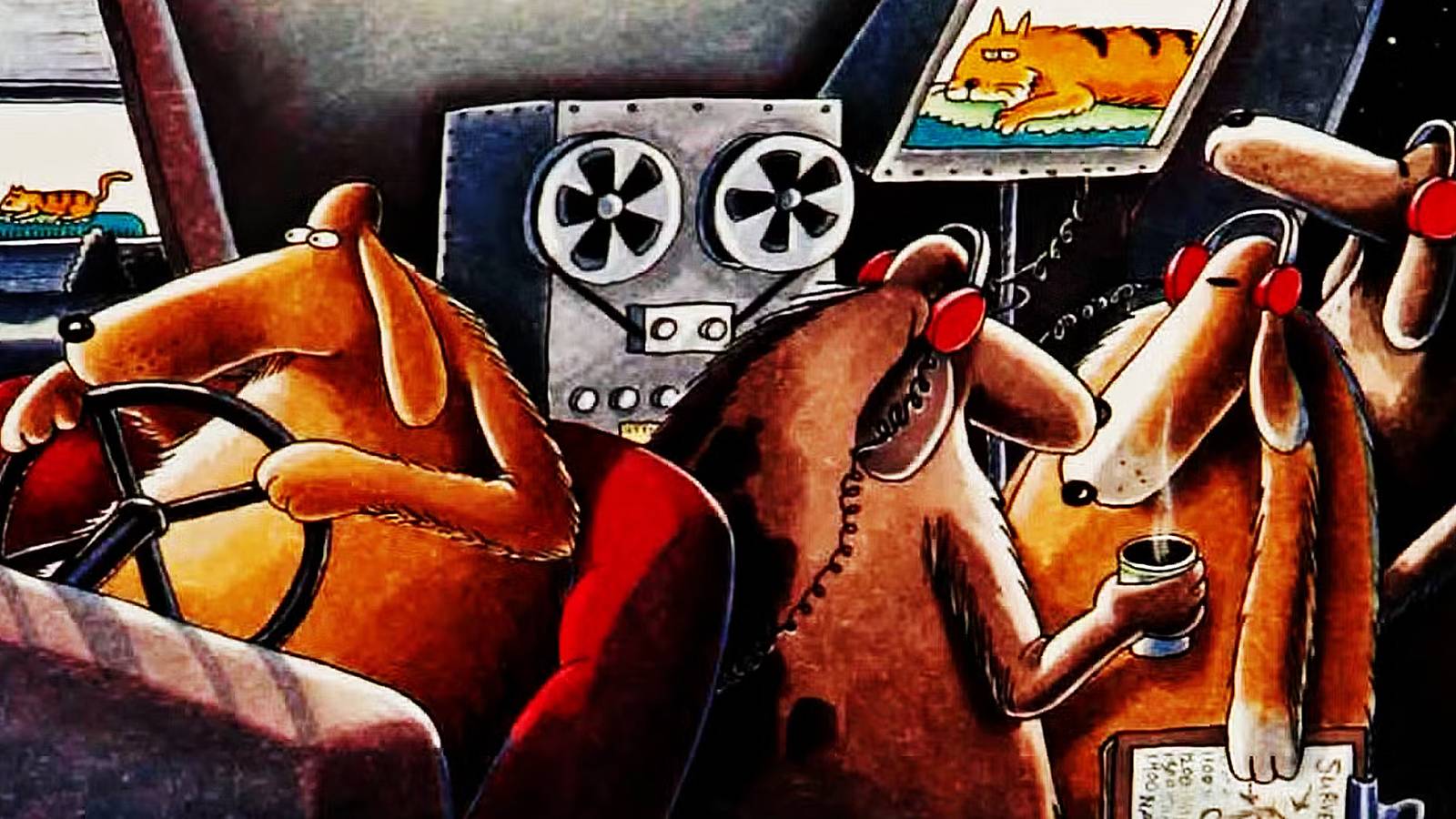
Published Sep 19, 2026, 5:18 AM EDT Shawn Van Horn is a Senior Author for Collider. He's watched way too many slasher movies over the decades, which makes him an aficionado on all things Halloween and Friday the 13th. Don't ask him to choose between Michael Myers and Jason Voorhees because he can't do it. He grew up in the 90s, when Seinfeld, Everybody Loves Raymond, and TGIF were his life, and still watches them religiously to this day. Larry David is his spirit animal. His love for entertainment spreads to the written word as well. He has written two novels and is neck deep in the querying trenches. He is also a short story maker upper and poet with a dozen publishing credits to his name. He lives in small town Ohio, where he likes to watch professional wrestling and movies. Sign in to your Collider account Throughout the '80s and the first half of the '90s, Gary Larson's The Far Side ruled the comics section of the newspaper. While others strips, such as Peanuts and Calvin and Hobbes, used several panels to tell quick stories with the same characters, The Far Side took satirical jabs at everything with just one panel to tell it all. Although the characters changed in each comic, Larson often returned to familiar themes, whether it be dinosaurs, talking animals, or bizarre kids and their families. Then there's what he did with sci-fi, from goofy scientists to aliens from outer space. These five comic strips showed how much Larson could do with so little. 5 'Professor Schwartzman's Canine Decoder' (1991) Dogs are man's best friend. For centuries, they've been by our sides as loyal companions who are always excited to see us, even if we've only been gone for five minutes. They sit at our feet, welcome our attention, and sleep in our beds. Humans and canines have a close connection. Two species so far apart need each other, and if you've ever had a dog, you've often wondered what they were thinking. Could they say "I love you" and tell us how much they care? Maybe they have the same fears we do. In The Far Side, Gary Larson answered the question with Professor Schwartzman, who came up with a brilliant invention which could decode what dogs are saying when they bark and translate it to English. The results are disappointing. Whether they're barking at each other, at us, or chasing cars, all dogs have to say is "Hey!" Perhaps it's better that they can't speak after all. 4 'The Dog Spaceship Arrives' (1984) Gary Larson often turned to dogs as a source of material in The Far Side. In this comic, they don't need to be decoded by a professor. Instead, they can speak full English to their owners. At night, one dog is tied up outside of its dog house when a spaceship arrives filled with other canines. If you've often wondered if dogs were some sort of loyal gift from the heavens, sorry, but they're from outer space. Sick of how they're being treated by humans, it looks like a lot of them have decided to go back to their home planet. Before this dog goes, all he wants his owner to do is roll over. Let her see how it feels to be commanded to do things for the entertainment of others. As the flying saucers float overhead, will something violent occur if she doesn't listen? 3 'Earth Is a Balloon' (1980) In 2026, despite so many photos of Earth having been out there for decades, there are still "flat Earthers," the conspiracy theorists who reject science and, for some reason, insist Earth is not round but flat. Even in 1980, the wild theory existed, along with those who think the government faked the moon landing. In this Far Side comic, Gary Larson takes a jab at both. As astronauts on a ship return to Earth, they see something shocking. The Earth isn't round. It's not flat either. Nope, we're all hanging on a balloon floating in the nothingness, a long string tailing into space. An astronaut deciding to keep it quiet is just what the government would do in real life, eh! Here, Larson uses over-the-top absurdity to make his point. But what if it's true, and we really are on a giant balloon? Be careful where you step out there! Collider Exclusive · Sci-Fi Survival Quiz Which Sci-Fi World Would You Survive? The Matrix · Mad Max · Blade Runner · Dune · Star Wars Five universes. Five completely different ways the future went wrong — or sideways, or up in flames. Only one of them is the world your instincts were built for. Eight questions will figure out which dystopia, galaxy, or desert wasteland you'd actually make it out of alive. 💊The Matrix 🔥Mad Max 🌧️Blade Runner 🏜️Dune 🚀Star Wars TEST YOUR SURVIVAL → 01 You sense something is deeply wrong with the world around you. What do you do? The first instinct is often the truest one. APull on every thread until I understand the system — then figure out how to break it. BStop asking questions and start stockpiling — food, fuel, weapons. Questions don't keep you alive. CKeep my head down, observe carefully, and trust no one until I know who's pulling the strings. DStudy the patterns. Every system has a rhythm — learn it, and you learn how to survive it. EFind the people fighting back and join them. You can't fix a broken galaxy alone. NEXT QUESTION → 02 In a world of scarcity, what resource do you guard most fiercely? What we protect reveals what we believe survival actually requires. AKnowledge. If you understand the system, you don't need resources — you can generate them. BFuel. Everything else — movement, power, escape — runs on it. CTrust. In a world of fakes and informants, a truly reliable ally is rarer than any commodity. DWater. And after water, information — the two things empires are truly built on. EShips and credits. The galaxy is big — you survive it by being able to move through it freely. NEXT QUESTION → 03 What kind of threat keeps you up at night? Fear is useful data — if you're honest about what you're actually afraid of. AThat reality itself is a lie — that everything I experience has been constructed to keep me compliant. BA raid. No warning, no mercy — just the roar of engines and then nothing left. CBeing identified. Once someone with power decides you're a problem, you're already out of time. DBeing outmanoeuvred — losing a political game I didn't even know I was playing. EThe Empire tightening its grip until there's nowhere left to run. NEXT QUESTION → 04 How do you deal with authority you don't trust? Every dystopia has a power structure. Your approach to it determines everything. ASubvert it from the inside — learn its rules well enough to weaponise them against it. BIgnore it and stay out of its reach. The further from any power structure, the better. CAppear to comply while doing exactly what I need to do. Visibility is the enemy. DManoeuvre within it carefully. You can't beat a system you refuse to understand. EResist openly when I have to. Some things are worth the risk of being seen. NEXT QUESTION → 05 Which environment could you actually endure long-term? Survival isn't just tactical — it's physical, psychological, and very much about where you are. AUnderground bunkers and server rooms — cramped, artificial, but with access to everything that matters. BOpen wasteland — brutal sun, no shelter, constant movement. At least the threat is honest. CA dense, rain-soaked city where you can disappear into the crowd and nobody asks questions. DMerciless desert — extreme heat, no water, and something enormous living beneath the sand. EThe fringe — backwater planets and busy spaceports where the Empire's attention rarely reaches. NEXT QUESTION → 06 Who do you want in your corner when things fall apart? The company you keep is the clearest signal of who you actually are. AA tight crew of believers who've seen behind the curtain and have nothing left to lose. BOne or two people I'd trust with my life. Any more than that and someone talks. CNobody, ideally. Alliances are liabilities. I work alone unless I have no choice. DA community bound by shared hardship and mutual survival — people who need each other to last. EA ragtag team with wildly different skills and total commitment when it counts. NEXT QUESTION → 07 Where do you draw the line — if you draw one at all? Every survivor eventually faces a moment that tests what they're actually made of. AI won't harm the innocent — even the ones who'd report me without hesitation. BI do what I have to to protect the people I've chosen. Everything else is negotiable. CThe line shifts depending on who's asking and what's at stake. DI draw a long-term line — nothing that compromises my people's future, even if it'd help now. ESome lines, once crossed, can't be uncrossed. I know which ones they are. NEXT QUESTION → 08 What would actually make survival worth it? Staying alive is one thing. Having a reason to is another. AWaking others up — dismantling the illusion so no one else has to live inside it. BFinding somewhere — or someone — worth protecting. A reason to keep moving. CAnswers. Understanding what I am, what any of this means, before time runs out. DLegacy — shaping the future in a way that outlasts me by generations. EFreedom — for myself, for others, for every world still living under someone else's boot. REVEAL MY WORLD → Your Fate Has Been Calculated You'd Survive In…Your answers point to the world your instincts were built for. This is the universe your temperament, your survival instincts, and your particular brand of stubbornness were made for. The MatrixYou took the red pill a long time ago — probably before anyone offered it to you. You're a systems thinker who can't help but notice the seams in things. You're drawn to understanding how the system works before figuring out how to break it. You'd find the Resistance, or it would find you — your instinct for spotting constructed realities is the machines' worst nightmare. You function best when you have access to information and the freedom to act on it. The Matrix built an airtight prison. You'd be the one probing the walls for the door. Mad MaxThe wasteland doesn't reward the clever or the well-connected — it rewards those who are hard to kill and harder to break. That's you. You don't need comfort, community, or a cause larger than the next horizon. You need a vehicle, a clear threat, and enough fuel to outrun it — and you're good at all three. You are unsentimental enough to survive that world, and decent enough — just barely — to be something more than another raider. In the wasteland, that distinction is everything. Blade RunnerYou'd survive here because you know how to exist in moral grey areas without losing yourself completely. You read people accurately, keep your circle small, and ask the questions others prefer not to answer. In a city where humanity is a legal designation rather than a feeling, you hold onto something that keeps you functional. You're not a hero. But you're not lost, either. In Blade Runner's world, that distinction is everything. DuneArrakis is the most hostile environment in the known universe — and you are precisely the kind of person it rewards. Patience, discipline, and political awareness are your core strengths — and on Arrakis, they're survival tools. You understand that the long game matters more than any single victory. Others come to Dune and are consumed by it. You'd learn its logic and earn its respect. In time, you wouldn't just survive Arrakis — you'd begin to reshape it. Star WarsThe galaxy far, far away is vast, loud, and in a constant state of violent political upheaval — and you wouldn't have it any other way. You find meaning in being part of something larger than yourself — a cause, a crew, a rebellion. You'd gravitate toward the Rebellion, or the fringes, or whatever pocket of the galaxy still believes the Empire's grip can be broken. You fight — not because you have to, but because standing aside isn't something you're capable of. In Star Wars, that willingness is what makes all the difference. ↻ RETAKE THE QUIZ Many junior high and high schoolers have taken some sort of technology class, whether it be something like wood shop or, in the case of this Far Side strip, metal shop. In those classes, we built contraptions which often don't come together right. This writer struggled mightily with making a miniature house out of popsicle sticks and glue. Meanwhile, some teacher who was thought not to be smart enough to teach other classes watched over us and judged our every move. In this panel, one kid has had enough. The boy hasn't struggled at all in metal shop. He's built a giant, sophisticated robot with tank-like feet, mandible claws, and sharp rows of teeth. Presumably, the kid has been harassed by his uncaring teacher one too many times. Revenge has created a mad scientist origin story and Mr. Big Nose will be the first victim. 1 'Xenomorph Birthday Cake' (1983) In 1979, Ridley Scott created a sci-fi horror masterpiece with Alien. Gone were hokey sci-fi movies with bad acting and silly-looking men in suits. With Alien, an all-time badass heroine was born in Sigourney Weaver's Ellen Ripley. And the monster she fought, a lone Xenomorph designed by H.R. Giger, was absolutely terrifying. Alien has one of the most iconic jump scares in film history, when the baby Xenomorph is born by shooting out of the chest of poor Kane (John Hurt). The scene was so effective that Hurt parodied it in a cameo for Spaceballs years later. In 1983, four years after the release of Alien, Gary Larson gave the comic world this hilarious tribute to the classic. In it, we see a Xenomorph birthday party. With a cake in the center of the table, it's not a beautiful woman who pops out but a baby alien. As it bursts forth, the older aliens throw up their scraggly arms and open their jaws wide with excitement. It's a great tip of the hat to a legendary movie and its monster.
5 Near-Perfect 'Far Side' Comics That Took Sci-Fi to Completely Absurd Places
Full Article
Original Source
Read the full article at Collider →KhanList aggregates and links to publicly available news content. We do not host full articles from third-party sources. Always verify important information with original sources.