
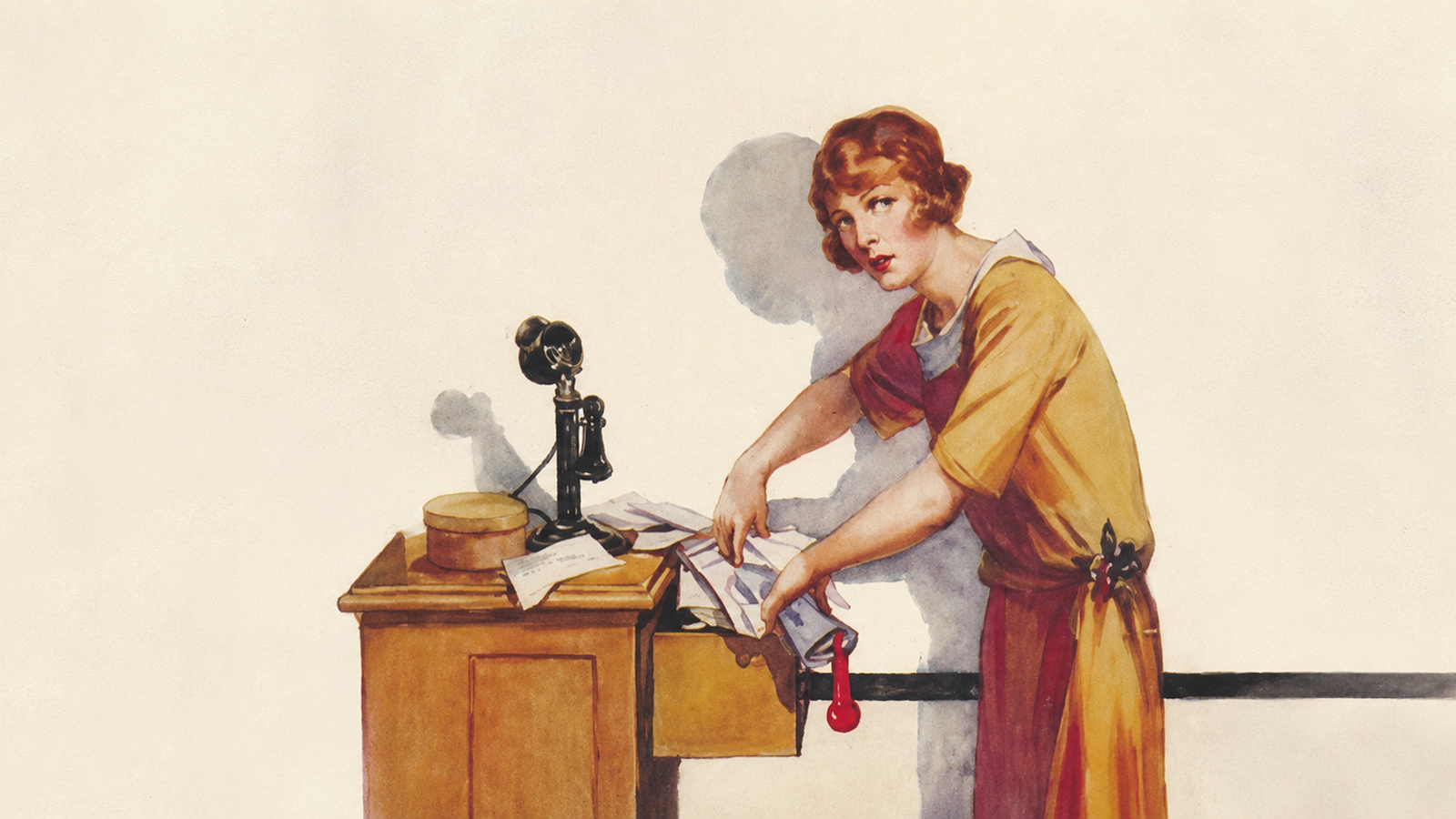
Image via Ellen Edwards/William Collins, Sons Published Sep 18, 2026, 12:07 AM EDT Anja Djuricic was born in Belgrade, Serbia, in 1992. Her first interest in film started very early, as she learned to speak English by watching Disney animated movies (and many, many reruns). Anja soon became inspired to learn more foreign languages to understand more movies, so she entered the Japanese language and literature Bachelor Studies at the University of Belgrade. Anja is also one of the founders of the DJ duo Vazda Garant, specializing in underground electronic music influenced by various electronic genres. Anja loves to do puzzles in her spare time, pet cats wherever she meets them, and play The Sims. Anja's Letterboxd four includes Memories of Murder, Parasite, Nope, and The Road to El Dorado. Sign in to your Collider account Mystery novels are among the most popular today, but a good mystery isn't all that easy to write. The earliest noted example of the modern, typical detective novel is The Moonstone by Wilkie Collins, which established many of the modern tropes of crime and mystery storytelling, but that boundary is constantly pushed by new writers who understand the genre's conventions and add their own twist to it. Many classic and modern mystery novels deserve to be adapted for the screen, but the question is, how well can that truly be done? Some novels are best experienced on paper, where we're submerged into the psyche of the protagonist, effectively becoming him. No other medium (except perhaps video games) can make the viewer/reader feel as if they're in the story themselves. The following mystery novels would be amazing adaptations if done correctly; their television versions could easily make us feel as if we're the main character and yet present the protagonist with a certain objectivity, adding a spice to the main twist and building worlds that may have been hard to imagine while reading. Here are mystery books that deserve a TV adaptation. 'Time Out of Joint' (1959) Image via Gollancz Fans of classic science fiction and its literary godfather, Philip K. Dick, know about Time Out of Joint all too well. This is one of the maybe lesser-known books by Dick, whose works have had numerous film and TV adaptations thus far (the most notable being the Blade Runner franchise). Time Out of Joint is a classic sci-fi story, so it may not classify as a mystery to some, but its plot and atmosphere around the first half of the novel are built on a tightly wound unknown that drives the protagonist crazy and makes him question his own sanity. If there was a proper comparison, this novel would be the grandfather of The Truman Show and Severance, though there are other shows that match the plot well. Time Out of Joint follows Ragle Gumm, who lives in an idyllic and typical American small town in 1959. Ragle has a unique talent, where he plays the local newspaper's game called "Where Will The Little Green Man Be Next?" guessing the answer correctly every single time and getting a cash prize for it. This makes Ragle somewhat of a local celebrity, and he lives happily until one day, things in his world begin to disappear and appear without a good explanation. Ragle dives deeper into his investigation, and his world suddenly flips upside down. Time Out of Joint is an incredible novel, full of intense moments, surprising twists, and a satisfying ending. Adapting it to modern times wouldn't be difficult, but getting the atmosphere right might take some trial and error. Either way, this Philip K. Dick novel only needs a dedicated showrunner—the story itself is already perfect. 'The Murder of Roger Ackroyd' (1926) Image via William Collins, Sons OK, so yes, The Murder of Roger Ackroyd does have its place on TV already: the Poirot series starring David Suchet adapted the book into a feature-length episode, and there's even a Japanese feature film based on it, but there's not an actual series. Anyone who reads Agatha Christie often knows exactly why The Murder of Roger Ackroyd is a gem among her other works; the unusual twist really delivers a stunner and shifts the entire novel on its side. The precision of the storytelling that Agatha Christie delivers in this novel is pretty much her magnum opus; a typical murder mystery on the surface, Roger Ackroyd is a methodically written slow-burn that hides its central mystery brilliantly. Hercule Poirot is summoned to solve the death of the wealthy widower Roger Ackroyd, and he is aided by Dr. James Sheppard, who was called to the scene by Ackroyd's assistant. Poirot and Sheppard work on consolidating their clues and motives of various people who attended a dinner at Ackroyd's home on the night of his death. The narrator of the novel, though, is not a third party or Poirot, but Sheppard himself, who observes clues and Poirot at work with attention to detail and great dedication. Sheppard and Poirot are a formidable team, and a methodical and clever showrunner could really make this duo stand out. With so many Poirot adaptations, though, Roger Ackroyd may not be a priority to many writers. However, that's not even the biggest problem, but the fact that serving justice to the best crime novel of all time might be a big bite to take after all. 'The Silver Road' (2018) Image via Corvus Nordic noir is definitely worthy of adapting for TV screens, and though there are many examples of good novels in the genre, The Silver Road by Stina Jackson is unique and carries special weight. Unlike most Nordic noirs, it doesn't follow a detective solving a murder mystery but a grieving father who refuses to let go of his missing daughter. The novel depicts the backwoods of Sweden, way up in the north where it's colder, houses are far away from each other, and boredom often prevails without much to be done about it. Jackson writes with incredible empathy and precision, driving the wedge of grief further into her protagonist. But the book doesn't stop at being a process of sadness; rather, it turns very quickly into a mystery that grows sinister with each page. It's a brilliant debut novel, awarded with the Best Swedish Novel award in 2018. Lelle, a high school teacher in a remote town in Sweden, searches for his missing 17-year-old daughter Lina every single day. She disappeared on the road known as the Silver Road three years before, where Lelle dropped her off at the bus station when she was headed to school. He drives past, investigates decrepit houses, and asks about Lina wherever he can. At the same time, now 17-year-old Meija arrives in town and becomes Lelle's new student; Meija comes from a dysfunctional home and doesn't have the parental support any child should expect, and after another girl who looks like Lina disappears, Lelle and Meija become integral parts of the search for the culprits. This could be a very well-made slow-burn mystery series with the right showrunners, but the focus would have to be on Lelle's intensifying guilt and self-isolation in parallel with the increasing looming dread of Meija's loneliness. It wouldn't be an easy show, but it would be brilliant if it were made anything like the novel. Collider Exclusive · Villain Personality Quiz Which Criminal Mastermind Would Be Your Nemesis? Lecter · Joker · Moriarty · Chigurh Four of the finest criminal minds ever put on screen. One of them would look at you and see something worth their time. Eight questions decide which one comes for you, why they picked you, and what they would want when they arrived. 🍷Lecter 🃏Joker ♟️Moriarty 🪙Chigurh MEET YOUR NEMESIS → 01 What would a criminal mastermind notice about you first? Great villains choose their opponents carefully. Something about you got their attention. AMy manners, and everything I am careful not to say. BThat I still believe people are basically decent. CThat I am clever, and quietly enjoy proving it. DThat I handle things myself, and always have. NEXT QUESTION → 02 How do they make first contact? The introduction tells you everything about what is coming next. AA polite letter. Beautiful handwriting. Quietly wrong. BSomething on fire, with a message left beside it. CA puzzle, left where only I would look. DNo contact. Just the aftermath, and a coin. NEXT QUESTION → 03 What do you actually believe about right and wrong? Every nemesis is really an argument about the thing you believe most. AThere are lines. Mine are private and absolute. BRules are the only thing keeping us from being animals. CMorality is a system, and systems can be solved. DThings happen. Most of it was never up to me. NEXT QUESTION → 04 What finally gets under your skin? Everybody has a pressure point. Finding yours is the whole plan. ABeing seen clearly by somebody I cannot read. BWatching good people do something ugly. CLosing to someone who was simply better prepared. DHaving no move left that changes anything. NEXT QUESTION → 05 They have made their move. How do you fight back? This is the part of the film where the audience finds out who you are. ACarefully, and never where they expect to be touched. BLoudly. I would rather lose than play their game. CWith a better plan. I can out-think this. DDirectly, once, with whatever is closest to hand. NEXT QUESTION → 06 What would they use against you? A good villain never brings a weapon you have not already handed them. AMy privacy. I have kept far too much to myself. BMy conscience. I will not cross the line they want. CMy ego. I cannot resist a worthy opponent. DMy certainty that I can handle it alone. NEXT QUESTION → 07 What do they actually want from you? The money is never the point. Something else always is. ATo understand me better than anyone ever has. BTo prove I am no better than they are. CTo finally be beaten by someone worth the trouble. DNothing at all. I stepped into the wrong path. NEXT QUESTION → 08 How does it end between the two of you? Eight questions in, this is the one that decides who comes for you. AA conversation I will be replaying for years. BA choice forced on me that has no clean answer. COne final move, and the better mind wins. DA coin in the air, and nothing I can say. REVEAL MY NEMESIS → The Case File Is Complete Your Nemesis Is…Four criminal masterminds. One of them was always going to be yours. Here is who comes for you, why they picked you out of everyone available, and what they want from the encounter. Hannibal LecterYour nemesis does not want to beat you. He wants to know you completely, and he is patient enough to wait for it. The frightening part is how good the conversation is. Lecter is the most dangerous kind of opponent: the one who finds you interesting. He never raises his voice, because he has never needed to. You keep a great deal to yourself and you are careful about what you show. That reserve is exactly the door he would knock on. The films understood something other thrillers missed. The horror is not the violence. It is being perfectly understood by the wrong person. He would be unfailingly polite about all of it. That is the worst part. The JokerYour nemesis is not after money, territory or revenge. He is after a demonstration, and you are the person he has chosen to prove his point on. The Joker only picks opponents who believe in something. Your decency is not a defence against him. It is the entire reason he showed up. He has no plan you can predict and nothing you can take away, which removes every tool you would normally reach for. His whole argument is that you are one bad day away from being him, and you would spend the rest of your life proving him wrong. He would call it a magic trick. You would call it the worst night of your life. MoriartyYour nemesis respects you, which sounds flattering until you work out what it means. He chose you because nobody else was worth his time. Moriarty is the original criminal mastermind, the template every later one borrows from: a mind the equal of the hero's, pointed the wrong way. You enjoy being the cleverest person in the room. He is counting on exactly that, and he has already built the room. This is the rare nemesis who would be genuinely disappointed if you lost badly. He needs the game to be worth playing. It ends the way these things always end. Two people, one problem, and only one way down. Anton ChigurhYour nemesis has no personal interest in you whatsoever, and that is precisely what makes him unsurvivable. You are not a rival. You are a stop on the way. Chigurh does not negotiate, gloat or explain. He arrives, he asks one question, and the answer was decided long before you opened your mouth. You trust yourself to handle things. He is the one problem in the world that has no interest in how capable you are. No Country for Old Men rewrote the screen villain by removing the thing audiences quietly rely on: the sense that talking might work. Call it. He will wait. ↻ RETAKE THE QUIZ 'Strange Houses' (2021) Image via Pushkin Vertigo Strange Houses was a social media phenomenon when it came out because it's not like other mystery novels. Strange Houses literally features house plans spread out across its pages, where the readers aren't meant to just parse through lines of text and inhale the mystery but take a long, hard look at the houses featured in the novel and make their own conclusions. Strange Houses is a bona fide mystery that combines modern journalism with Japanese tradition and folklore, and its author is just as mysterious as the book itself. Known only as Uketsu, this creator is best known for his YouTube career and hiding behind a white, faceless papier-mâché mask. Uketsu creates videos about unsolved mysteries across Japan, and though his content is only in Japanese, his published novels have been translated into numerous languages across the globe. Strange Houses is the first in the Strange series of novels (followed by Strange Pictures, Strange Buildings, and Strange Maps), and it follows an unnamed journalist in the first person as he is contacted to analyze a baffling house plan. We're immediately confronted with it, and things seem off from the start; the child's room is in a weird place, and why is there a triangle-shaped room no one can see? The journalist enlists the help of architect Kurihara, and together, they come to conclusions that become more and more shocking with each discovery. Strange Houses is an extremely fast read, but it's such a fun novel that imagining it as a TV series is pretty much a given. There is already a feature film of the same name from 2024, but the adaptation was so bad compared to the book that the only way this brilliant, fast-paced, and super tense mystery novel could be given justice is by a TV series. 'Drood' (2009) Image via Quercus The task of adapting the colossal and magnificent Drood for TV screens remains one of the hardest things to do, according to Guillermo del Toro, at least. When Dan Simmons wrote it, he made sure to combine fact with fiction in such an immersive and intricate way that a lot of the things featured in the two-novel story feel like they've actually happened. Simmons is known for writing stories like that, and his audacious approach to these things has often been a hit-or-miss with audiences, from the gargantuan Abominable to the more TV-friendly The Terror. Still, many readers love Simmons and his weird proclivity for taking real-life mysteries and giving them his own, fictional, and often supernatural explanations—I am one of them. And to go back to del Toro, so is he. Del Toro tweeted out once that his script for Drood was completed and that it was one of the stories that took months of his life to finish; a lot of us, fans of the book and Simmons and del Toro, hope to still see this come to fruition in some way. Drood is a two-part novel about the final five years of Charles Dickens' life, told from the perspective of writer Wilkie Collins (a full circle moment here, since Collins is mentioned as the creator of the first detective novel). Collins is friends with Dickens and often describes his daily routine and the process of writing his final novel, The Mystery of Edwin Drood. But Dickens leaves all of his writing aside to try and track down information about the man who calls himself Drood, one who saved him from certain death during a train accident in 1865. As Dickens searches obsessively, Collins helps him but descends further into opium usage due to his gout, becoming an unreliable narrator along the way. The mysterious circumstances of Dickens' well-known unfinished novel are intertwined with a fictional, terrifying, and mysterious encounter with Drood, which Simmons turned into a stellar piece of reading. With each new page, you're either getting frustrated with the dynamics of 19th-century England or absolutely stunned by the Count Orloff-esque appearances of Drood. It's safe to say that Drood would need a clever adaptation that doesn't take any of its parts for granted; it might even work better as a TV series.
5 Mystery Books That Deserve a TV Adaptation
Full Article
Original Source
Read the full article at Collider →KhanList aggregates and links to publicly available news content. We do not host full articles from third-party sources. Always verify important information with original sources.