
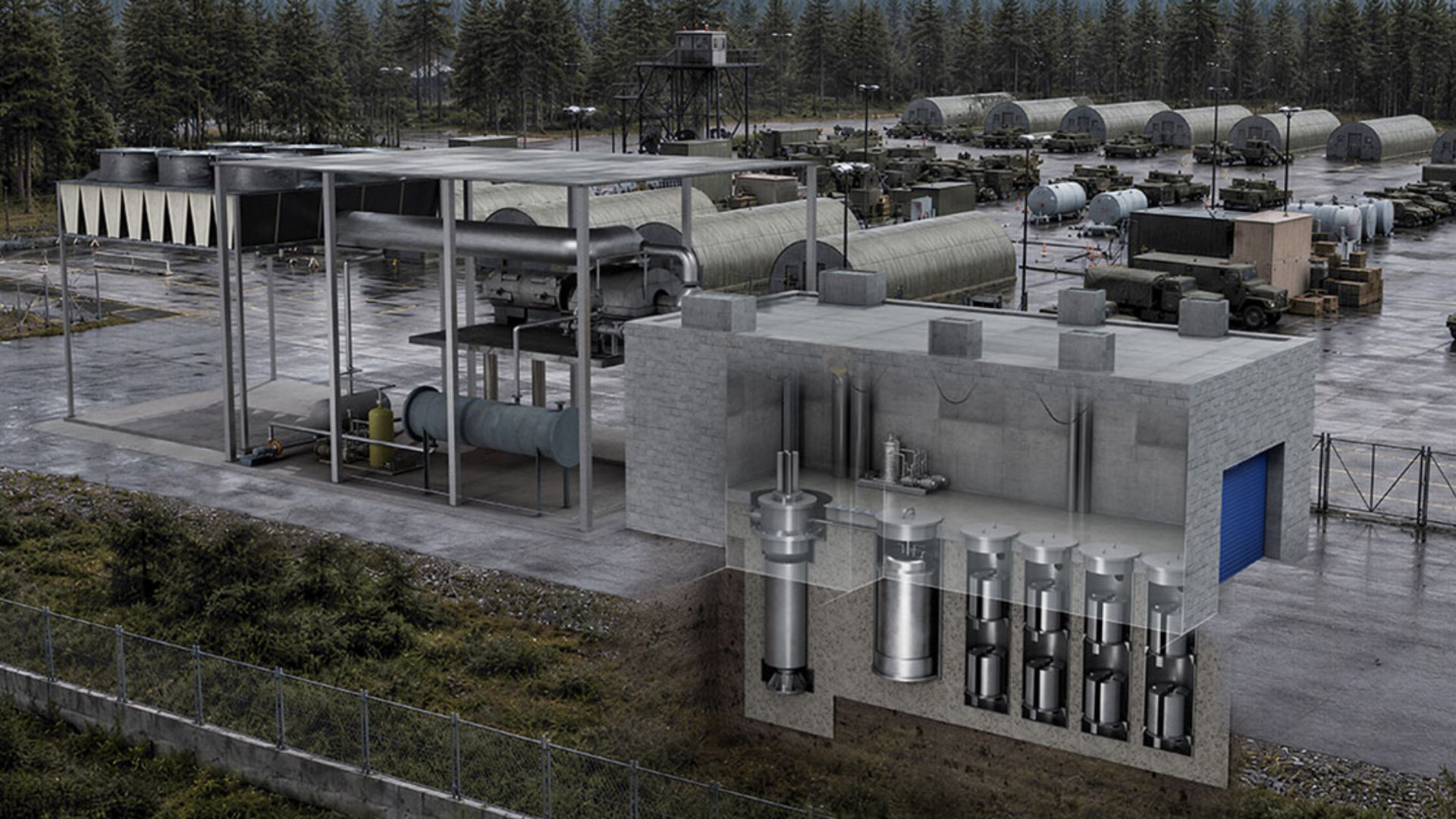
An artistic rendering depicts GA-TES at a notional military installation.General AtomicsA San Diego-based company’s tactical energy system (microreactor) is set to support one of the U.S. Army’s key programs. General Atomics’ Tactical Energy System (GA‑TES) has ben selected by the U.S. Army to support the Janus Program, which is accelerating commercially developed nuclear technologies into operational use. The company revealed that GA‑TES is a liquid-metal-cooled microreactor with a baseline net output of approximately 5 megawatts electric (MWe) and an architecture scalable to approximately 20 MWe. Designed for remote, off-grid and extreme environments, the plant has a design life of 40 years. Its modular architecture supports transport and deployment by truck or rail, while natural-circulation primary coolant flow eliminates pumps and associated mechanical complexity. Microreactor technologies provide safe, dependable and independent power “General Atomics draws on more than 70 years of nuclear innovation and reactor expertise to deliver microreactor technologies that provide safe, dependable and independent power for military installations,” said Scott Forney, president of GA-EMS.“Our experience designing and deploying 68 reactors worldwide and supporting reactor technologies throughout their lifecycles positions us to deliver assured energy solutions that enhance operational resilience and strengthen mission readiness.”General Atomics Electromagnetic Systems (GA-EMS) revealed that it will execute its effort through an Other Transaction Authority-based agreement and milestone-based funding tied to specific technical goals.It was also revealed that under the Janus Program, Fort Hood, Texas, will serve as the installation to advance GA-TES through development, testing and site-planning milestones toward potential deployment. This work supports the Army’s broader nuclear objectives. Reliable commercial hardware that secures energy independence “The Janus Program is about transitioning from designs and experiments to reliable commercial hardware which secures our energy independence,” said Jeff Waksman, PhD., principal deputy assistant secretary of the Army for Installations, Energy and Environment. “The Janus Program vendors were selected through a deeply rigorous evaluation on technical, financial and organizational capabilities conducted by an all-star panel of dozens of experts from across the nation. We look forward to working alongside each team as they proceed toward successfully completing the rigorous technical milestones we’ve agreed upon.” General Atomics’ longstanding nuclear heritage GA‑TES builds on General Atomics’ longstanding nuclear heritage, including its pioneering work in uranium-zirconium hydride (UZrH) fuel technology and the proven safety and operating record of TRIGA reactors deployed globally. GA-EMS carries that legacy forward by integrating nuclear technologies and materials with power and energy systems expertise to develop practical solutions for demanding national security missions, according to a press release. GA-TES combines the self-regulating characteristics of UZrH fuel with pump-free natural-circulation cooling to enhance passive safety and simplify operations while providing secure and reliable power for critical defense infrastructure without dependence on large cooling‑water infrastructure, as per the release.Get the latest in engineering, tech, space & science - delivered daily to your inbox.Prabhat, an alumnus of the Indian Institute of Mass Communication, is a tech and defense journalist. While he enjoys writing on modern weapons and emerging tech, he has also reported on global politics and business. He has been previously associated with well-known media houses, including the International Business Times (Singapore Edition) and ANI.
5 MWe liquid-metal-cooled microreactor that works in extreme environments to support US Army
Full Article
Original Source
Read the full article at Interestingengineering →KhanList aggregates and links to publicly available news content. We do not host full articles from third-party sources. Always verify important information with original sources.