
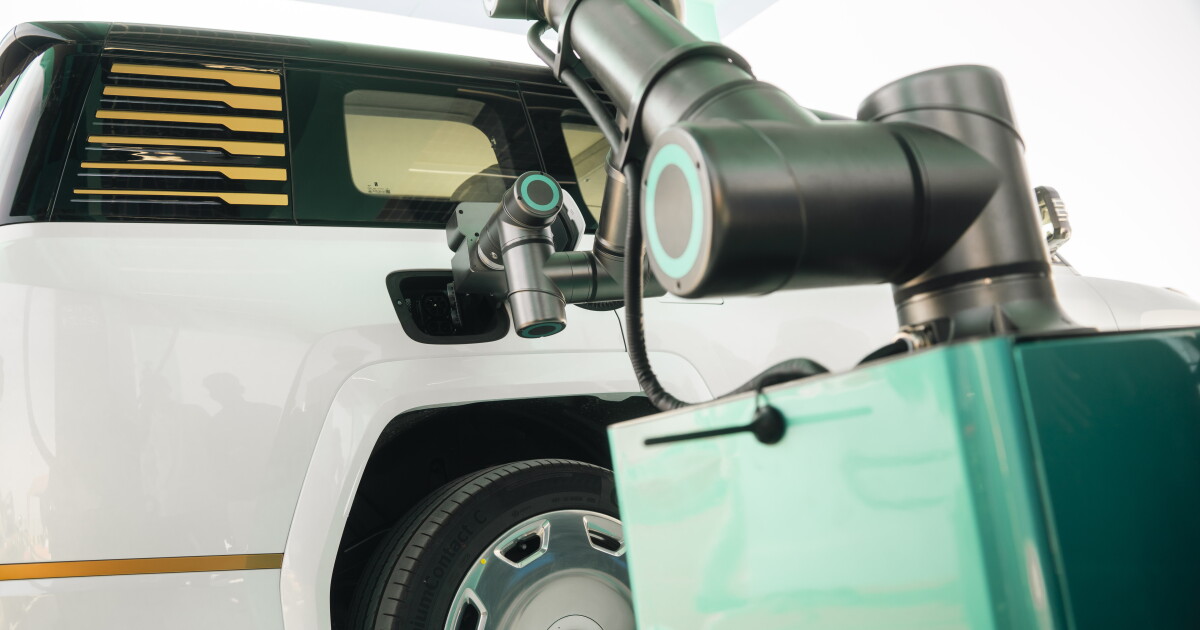
Is this the 'gas station' of the future? Chinese battery tech and electric vehicle (EV) giant BYD has unveiled an extraordinary new charging point that combines massive battery storage, ultra-fast megawatt flash charging and a robotic automatic plug-in arm.And, best of all, the whole thing can "support operation independent of the electricity grid" courtesy of solar panels on the canopy roof. "For the first time, BYD is bringing its integrated Solar-Storage-FLASH Charging technology to the global stage," said BYD Exec VP Stella Li. "We are providing clean energy generation, energy storage and ultra-fast charging together, and we are making the charging experience smarter, simpler and more seamless for drivers around the world."The global unveiling reads like a greatest-hits compilation of everything the Shenzhen-based automaker has been building behind closed doors over the last two decades. It’s a unique triumph of photovoltaic roofing, stationary lithium-iron-phosphate battery banks, blistering liquid-cooled chargers and vision-guided automation into a single pit stop.Alongside the headline-grabbing stunt of a 312.66-mph production speed record from its Yangwang U9 Xtreme hypercar, it completes a staggering week for the company. BYD Executive VP Stella Li introducing the world's first integrated solar, energy storage, Flash charging and robotic charging system in Abu DhabiBYD The charging installation is billed by BYD as the world's first integrated solar-storage-charging and robotic refueling hub. Behind the PR hype, we’ve decoded how it all works.A driver pulls up to the BYD station, steps out, locks the doors and walks to an air-conditioned lounge. BYD's Automated Valet Parking software steers the car into an open bay.A multi-axis robotic arm uses optical cameras and feedback sensors to locate the charging flap, pop it open and seat a hefty liquid-cooled connector into the port.When the electrons finish flowing, the arm disconnects, stows the cable and leaves the car ready to roll – saving the driver from the sweaty chore of wrestling thick, high-amperage hoses in triple-digit heat.The real engineering trick happens, however, before a single watt reaches the car. Megawatt-scale fast charging normally terrifies local utility operators because drawing 1,000 to 1,500 kilowatts at once can humiliate a weak neighborhood transformer.BYD potentially sidesteps that bottleneck with its Solar-Storage-Charging architecture. Overhead solar arrays harvest sunlight all day and trickle-charge on-site stationary battery packs. This is sited in the United Arab Emirates remember, so there’s a lot of sun to harvest. When an EV pulls in, those batteries discharge at ferocious rates, allowing the station to operate completely off-grid. However, BYD has left a key detail out of the press materials for the Abu Dhabi installation – whether this world's first setup is actually totally off-grid or gets some of its juice from a grid connection. We've reached out to the company for confirmation.During the recent press demonstration, reporters watched the system push a megawatt into a test vehicle, taking its pack from 10% to 70% in five minutes and 17 seconds, and hitting 97% in eight minutes and 57 seconds. Those numbers mirror the five-minute fast-charging system BYD teased on its 1,000-volt Super e-Platform last year. It claims to add roughly 249 miles (400 km) of range in the time it takes to buy a cup of coffee.Paired with the company's second-generation Blade Battery – hardware I recently saw debut in Europe inside the BYD Atto 8 flagship SUV and even trickle down into the sub-$10,000 BYD Seagull – BYD's production Flash Dispensers can now theoretically peak at 1,500 kilowatts through a single charge point. That new BYD megawatt superfast charger is undeniably hefty, letting a robot do that job seems like a good callBYD For BYD, the Abu Dhabi desert outpost is a victory 20 years in the making.Long before it overtook Tesla to become the world's largest seller of plug-in vehicles, BYD started life simply making rechargeable batteries. In 2006, Chairman Wang Chuanfu laid out his "Three Green Dreams" roadmap: pairing solar generation, stationary energy storage and electric transport into one closed-loop business.Today, BYD Solar operates in more than 100 countries, while its energy storage division supplies grid-scale megabatteries across the Middle East. Few automakers on Earth can compete with an operation that owns every single link in the supply chain from raw solar cell to silicon-carbide inverter.Okay, US EV drivers shouldn't expect a robot-staffed BYD oasis off Interstate 10 anytime soon. Steep tariffs are keeping BYD passenger cars out of American showrooms. US drivers are reliant on Tesla's 500-kilowatt Superchargers or 350-kilowatt CCS stalls from Electrify America and Ionna.BYD admitted in Abu Dhabi that the robotic arm remains a prototype with no commercial launch date. Complex outdoor robotics exposed to blowing desert sand, or Midwestern sleet and road salt, would face heavy maintenance issues. Note how existing charging networks already struggle to keep basic card readers online.Finally, those amazing five-minute megawatt fills only work on vehicles engineered with 1,000-volt architectures and second-generation Blade packs; plugging an older EV into a Flash Charger won't magically turn it into a pit-stop racer.Even so, BYD’s message to Western automakers and oil companies is unmistakable. It isn't waiting for national power grids to catch up. BYD aims to roll out 6,000 Flash Charging stations globally by the end of next year, including 3,000 across Europe.By treating the charging station as a self-contained solar microgrid rather than a dumb extension cord plugged into the utility, BYD has now sketched out a compelling blueprint for how highway refueling could work from the Mojave Desert to the Australian Outback.Source: BYD
5-minute solar charging station auto refills EVs using robots
Full Article
Original Source
Read the full article at Newatlas →KhanList aggregates and links to publicly available news content. We do not host full articles from third-party sources. Always verify important information with original sources.