
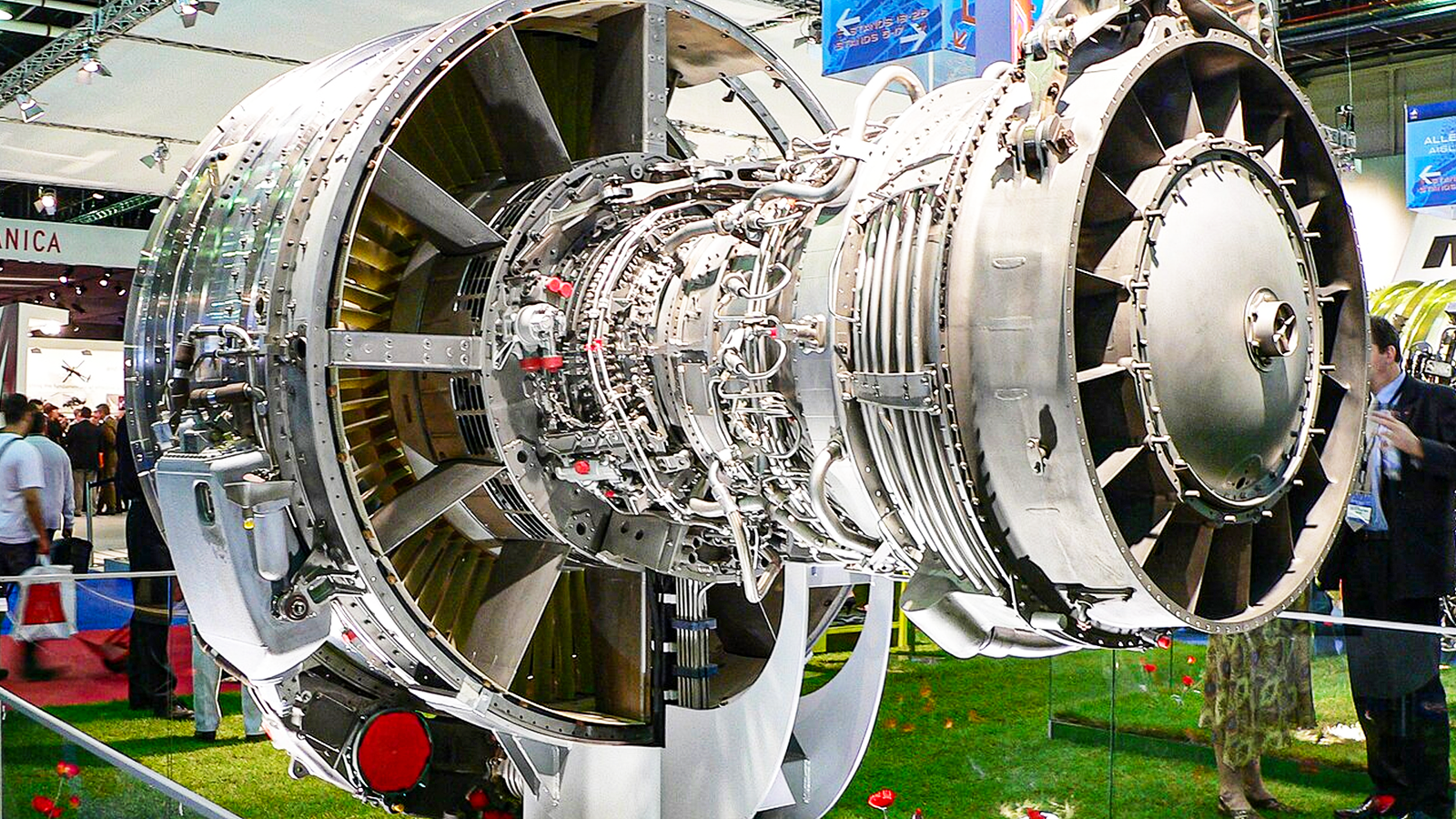
Published Nov 14, 2026, 4:00 PM EST Louis is a military historian and the staff writer for History of War magazine, a leading military history monthly. He also has an interest in private and commercial aviation. Many military aircraft use commercially derived powerplants. This is especially true for transports, tankers, and maritime patrol aircraft. These uses share many engine characteristics that are also useful in commercial aviation. Examples include reliability, low maintenance costs, and fuel efficiency. It also avoids manufacturers having to spend a vast amount on engine development. A Boeing spokesperson explained the benefits to Simple Flying. “Using commercial-derived engines lets manufacturers and operators leverage existing design maturity, production capacity and global maintenance infrastructure. That translates into lower development risk and cost, faster fielding, more abundant spare parts and established MRO networks—while still allowing mission-specific adaptations to meet durability, fleet performance and mission capability.” Boeing C-17 Globemaster III And The Pratt & Whitney F117 F117 is the military designation for the Pratt & Whitney PW2000. The engine is used exclusively by the C-17 Globemaster III. The transport aircraft uses four of these engines, each rated at 40,400 lbf (180 kN). This power is enough for the aircraft to carry a payload of up to 160,600 lb (72,800 kg) with a range of 2,400 nautical miles (4,400 km). Perhaps the most impressive attribute the engine gives the Globemaster is its ability to take off fully loaded from a runway 7,600 feet (2,300 meters) long. Likewise, the aircraft can land at airfields under 3,000 feet (900 meters) long. The aircraft achieved 22 world records during its testing. Another unique feature of the engine is its thrust reversers, which can be deployed in flight, allowing it to reverse up a two-degree slope. The F117 has gradually been improved during the Globemaster's operation and has reached a reduced-temperature configuration (RTC). This configuration uses single-crystal turbine materials that improve reliability and have lowered operating temperatures. Pratt & Whitney claims that these improvements have resulted in increased time on-wing. The F117 is closely tied to the PW2000. In commercial operations, the engine is used for the Boeing 757 and the Ilyushin Il-96M, which first flew in 1993. The PW2000 produces 38,400 to 43,734 lbf (170.81 to 194.54 kN) of thrust with a thrust-to-weight ratio of 5.41 to 6.16. Boeing P-8 Poseidon And The CFM International CFM56-7BE The P-8 Poseidon is a maritime patrol and reconnaissance aircraft that was developed for the United States Navy as a derivative of the Boeing 737 Next Generation airliner. As a result, it uses the CFM56-7 series of engines, which also power the Boeing 737-600, -700, and -800. The same engine powers the other 737 NG-derived military aircraft in the US Air Force, including the Boeing E-7 Wedgetail and C-40 Clipper. Other Boeing aircraft using different variants are the E-3D Sentry, E-6 Mercury, and KC-135R Stratotanker. The table below shows the specifications for the P-8 Poseidon, making use of data published by Boeing: Wingspan 123.6 feet (37.6 meters) Thrust 27,300 lbf (121.4 kN) per engine Ceiling 41,000 feet (12,496 meters) Range 1,200 nautical miles (2,225 km), or around four hours on station Max speed 490 knots Maximum takeoff weight 189,200 lb (85,820 kg) The CFM56-7 series first ran on April 21, 1985. It offered reduced fuel burn and maintenance costs compared with older engines in the series. It also allowed the 737 NG to achieve 180 minutes of extended-range twin-engine operations (ETOPS) certification from the US Federal Aviation Administration. This attribute is essential for maritime patrol aircraft like the P-8 Poseidon, which often fly in remote areas. The CFM56 has helped the P-8 achieve an impressive level of commercial success, with almost 200 jets built. Operators outside the US include the Royal Australian Air Force, the German Navy, the Indian Navy, the Royal New Zealand Air Force, and the Royal Air Force. Canada also has 14 P-8s currently on order, and options for two more. Lockheed Martin C-5M Super Galaxy And The General Electric CF6-80C2 The C-5 Super Galaxy is the largest strategic airlifter currently used by the United States Air Force. The 52 in-service aircraft have all been upgraded to the C-5M variant, which uses updated engines and modernized avionics. The Air Force hopes to keep this aircraft in service until at least 2040. The C-5M Super Galaxy uses CF6-80C2 engines. These jets are used on 15 widebody aircraft types, many of which are commercial. Examples include the Boeing 747-400 and McDonnell Douglas MD-11. The engine has ETOPS-180 certification for the Airbus A300, Airbus A310, Boeing 767, KC-767A/J, E-767J, and Kawasaki C-2. The table below shows the specifications for the C-5M Super Galaxy. It uses data collected by Air Mobility Command: Length 247 feet, 10 inches (75.3 meters) Wingspan 222 feet, 9 inches (67.89 meters) Maximum payload 281,001 lb (127,460 kg) Maximum takeoff weight 840,000 lb (381,024 kg) Range (no cargo) 7,000 nautical miles (13,000 km) Range (maximum payload) 5,500 nautical miles (10,190 km) The older C-5 Super Galaxy variants (C-5A, C-5B, and C-5C) were powered by four older General Electric TF39-GE-1 or TF39-GE-1C. Enthusiasts loved this engine because of its distinctive scream, which is no longer present in the newer C-5M engine. Unlike the CF6-80C2, this engine was developed specifically for the Super Galaxy. However, it was later modified into the General Electric CF6. The civilian engine entered service in 1971 with the McDonnell Douglas DC-10. The new engine brings a host of improvements over the TF39. It delivers higher power, allowing for shorter takeoffs and faster climb rates. It is also more reliable and fuel-efficient, and produces less noise. This gives Super Galaxy operators more flexibility in using civilian airfields. Finally, wider use of the engine in commercial markets leads to an abundance of relatively affordable spare parts. Boeing KC-46 Pegasus & The Pratt & Whitney PW4062 The KC-46 Pegasus is an aerial refueling and strategic transport aircraft developed and produced by Boeing. The manufacturer claims it is the world's most advanced aircraft in this role. It is capable of refueling friendly aircraft at a rate of 400 gallons per minute (1,500 liters per minute). The aircraft can also be configured for 58 passengers in normal operations or 114 as a maximum limit. In an aeromedical configuration, the aircraft can hold 54 patients, although 30 must be ambulatory. It also seats 15 crew members. In the transport configuration, the plane can hold 18 463L pallets. The plane has been developed from the Boeing 767. As a result, it uses the PW4062, a variant of the Pratt & Whitney PW-4000-94. Other examples of civilian usage of this engine family include the MD-11, 747-400, A330, and the A300-600. The PW4000 has been in service since 1987, amassing 140 million flight hours. The table below shows the specifications for the -94 variant of the engine, as is used by the KC-46 Pegasus. The data is from the FAA: Maximum continuous thrust 50,250 lbf (223.5 kN) Length 153.6 inches (390 cm) Weight 9,420 lb (4,273 kg) Fan 94 inches (239 cm) Overall pressure ratio 27.5 to 32.3 Compressor 1 fan, four low-pass, and 11 high-pass Bypass ratio 4.8 to 5:1 The primary benefit that the PW4062 brings to the KC-46 Pegasus is reliability. Pratt & Whitney claims that the engine averages 16,000 hours on-wing before requiring a shop visit. It says that this attribute greatly reduces the maintenance costs that the US Air Force has to pay to keep Pegasus in the skies. Boeing E-4B Nightwatch And The General Electric CF6-50 The US military calls the E-4 "Nightwatch," but it is popularly known as the "Doomsday Plane." It is a strategic command and control military aircraft used by the National Emergency Airborne Command Post (NEACP) program. A key purpose of this aircraft is to keep the US government operational in the event of nuclear warfare. In such a crisis, it would become a mobile command post for the President of the United States and the Secretary of Defense. Four E-4s have been built. The E-4 is modified from the Boeing 747-200B. It is powered by four General Electric F103 turbofan engines. Each of them produces 52,500 lbf (234 kN) of thrust. This engine is derived from the General Electric CF6-50E2. The engine was launched in 1969, used to power the DC-10. It also powered the A300 from late 1969 and the 747 from 1975. The CF6-45 variant of the engine was developed with 10% less thrust, used for a short-range variant of the 747. In military aviation, the engine is also used by the McDonnell Douglas KC-10 Extender. When the aircraft first emerged, named the E-4A, four Pratt & Whitney JT9D powered it. The first two Nightwatch planes built used this engine. The third E-4 built used the F103 engine. This engine use was instituted for future E-4s built and standardized across the fleet. The advantage of this engine was that it was modified to run two constant speed drives (CSDs) and two generators per engine. These components produced enough electrical power to run a more advanced command-and-control suite.
5 Military Aircraft Powered By Engines Found On Commercial Airliners
Full Article
Original Source
Read the full article at Simpleflying →KhanList aggregates and links to publicly available news content. We do not host full articles from third-party sources. Always verify important information with original sources.