
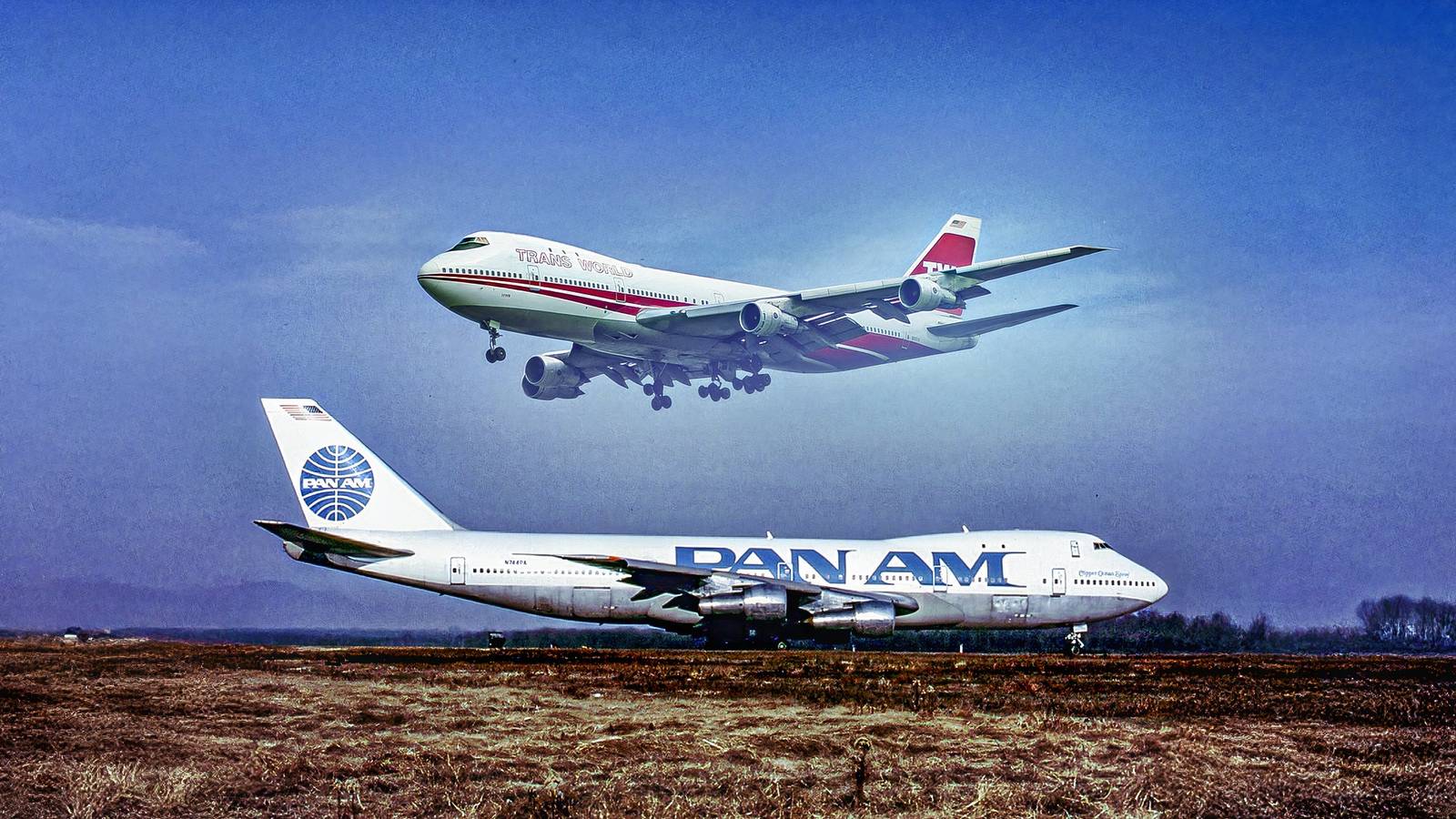
Published Oct 12, 2026, 11:00 AM EDT Passionate about promoting aviation, the beauty of flight and the science behind it, Antonio is an avid reader of aviation magazines and books, and he loves visiting airshows all over the world, taking photos and writing about airplanes and helicopters as well. He is currently based in Palermo, Sicily. Sign in to your Simple Flying account One of the saddest things in aviation is a famous airline name on a plane that will never fly again. For generations of Americans, the globe of Pan American World Airways, the red stripe of TWAand the loud colors of Braniff were as familiar as the airports they served. Together with Eastern Air Linesand Continental Airlines, these brands shaped how the country traveled, and then, one by one, they disappeared. Many of these names still turn up in museums, collectibles and movies, and their stories explain a great deal about how the modern US airline industry took shape after deregulation in 1978. Our list looks at five legendary US carriers that no longer exist, from the one that was simply absorbed by a rival to the one that defined an era. Each entry explains how the airline ended, what made it special, and how people remember it. The ranking weighs historical weight and cultural reach, and it builds toward the most iconic name of all at #1. 5 Continental Airlines 1934-2012 Unlike the others on this list, Continental did not fail. The carrier traces its roots to Varney Speed Lines, took the Continental name in 1937, and grew into a major airline with hubs in New York, Cleveland, Houston, and Guam, according to Britannica. By the time it ended, it was a healthy, respected operator, which makes its disappearance unusual among the airlines remembered here. Both lines trace back to Varney Air Lines, the mail carrier Walter Varney launched in 1926. In May 2010, Continental announced a merger with United Airlines, and over the next two years its brand was folded into United's. The merger of equals was valued at $8.5 billion, and the United name and Continental's globe livery were retained. By the end, Continental flew 348 Boeing aircraft to 140 destinations, as The Points Guy has covered in its merger history. Shortly before the deal, Continental had left SkyTeam to join Star Alliance, the world's largest global airline partnership. Continental lands fifth because its ending was a business decision rather than a collapse. Passengers lost a name, not a network, and its globe livery still flies on United jets today. The last Continental-branded flight took place in March 2012, after the FAA granted a single operating certificate in late 2011, so travelers saw the change gradually rather than overnight. For travelers, the change was mostly cosmetic: the same planes, crews, and routes under a new owner. 4 Braniff International Airways 1928-1982 Braniff began on June 20, 1928, when a single-engine Stinson Detroiter flew from Oklahoma City to Tulsa, a hop of about 116 miles (187 km), according to Airport Spotting. From that modest start, the Oklahoma-born carrier grew through mergers and buyouts into a Texas-based network reaching the Midwest, the Southwest, Mexico, and South America. Along the way, it bought Mid-Continent Airlines in 1952, which added a network of 35 airports across 12 states. Braniff became famous for style. Its jets wore bold single colors, while its advertising encouraged travelers to embrace the airline's distinctive look, as Flight Path LAX recalls. In January 1979, it also began the unusual BA Concorde interchange operation linking Paris and London with Dallas/Fort Worth International Airport (DFW) via Washington Dulles International Airport(IAD). FAA documentation explains that Braniff crews flew the Dulles–Dallas segment at subsonic speed, while Air France or British Airways crews operated the transatlantic legs. Braniff's collapse had multiple causes, and deregulation alone does not explain it. After the Airline Deregulation Act of 1978, chairman Harding Lawrence pursued a huge expansion, adding 31 destinations in two years and increasing long-term debt by more than $305 million by the end of 1979, according to the Texas State Historical Association. At the same time, fuel prices surged, interest rates rose, and a recession weakened demand. Braniff lost $131 million in 1980, while its net worth fell sharply. The airline then faced increasingly intense competition from both larger carriers such as American Airlines and Delta Air Lines and lower-fare airlines such as Southwest Airlines. By 1981, fare cuts were squeezing revenue while debts and interest obligations continued to weigh on the balance sheet. Contemporary reporting noted that Braniff had accumulated a net loss of $377 million since 1979 and had run out of cash. The Christian Science Monitor reported that fuel suppliers demanded cash, and Braniff could not meet its $15 million payroll. That combination explains the abrupt ending. Braniff stopped flying on May 12, 1982, and filed for Chapter 11 the following day. More than the Concorde operation, the decisive case was an aggressive expansion undertaken at a moment in which fuel, borrowing, and competitive pressures turned against the airline. 3 Eastern Air Lines 1926-1991 Eastern grew from a patchwork of 1920s air travel companies and was bought by World War I flying ace Eddie Rickenbacker's group in 1938. According to the National Air and Space Museum, it introduced jet service with Douglas DC-8s in January 1960 and launched its Air Shuttle in April 1961, linking Boston, New York, and Washington, DC. The New York–Boston leg alone is roughly 185 miles (300 km). It was a household name from Miami to Montreal. Its biggest rival at Hartsfield-Jackson Atlanta International Airport (ATL) was Delta, which later absorbed part of its fleet, a reminder of how quickly an airline's assets scatter once it stops flying. By 1975, Eastern served 100 cities in 30 states, plus destinations in Mexico, Canada, and the Caribbean. In 1986, Eastern was acquired by Texas Air Corp., making Texas Air the largest airline in the United States at the time. The acquisition was followed by severe labor unrest, including a machinists' strike supported by Eastern's pilots and flight attendants. Eastern ultimately filed for bankruptcy in March 1989. These events are documented in the Smithsonian National Air and Space Museum's Eastern Air Lines Collection and the Wayne State University Walter P. Reuther Library's Eastern Air Lines Strike Center Records. Eastern and Pan Am were both flagship US carriers that collapsed within a few years. Eastern tried to reorganize, but it shut down for good on January 18, 1991. Delta picked up many of its Lockheed L-1011 TriStars, and a Simple Flying piece on the Douglas DC-7 shows that a former Eastern DC-7B was restored to flying condition before an engine failure grounded it in 2013. The name has since been revived by charter operators, though under a different airline from the original. 2 Trans World Airlines (TWA) 1930-2001 TWA's corporate history dates from July 16, 1930, when Western Air Express and Transcontinental Air Transport were combined. It became Trans World Airlines in 1950 and, on October 19, 1953, inaugurated regularly scheduled nonstop service between Los Angeles and New York, about 2,470 miles (3,975 km), as Simple Flying's history of TWA recounts. TWA moved its headquarters from New York to Kansas City in the summer of 1931. TWA was also known for innovation. In 1961, it became the first airline to show in-flight movies, according to the University of Alabama in Huntsville Archives. By July 1969, it had even beaten Pan Am as the number-one transatlantic airline, and in its final year it served 132 destinations with 248 aircraft, per Airport Spotting. The airline also ordered six Concordes, but let that order lapse in 1973 as the oil crisis hit, according to Simple Flying. Over the years, TWA operated 35 Boeing 747s, and in 2001 it flew Boeing 717, 757 and 767 jets plus McDonnell Douglas MD-80 variants. It even had 70 Airbus aircraft on order when it was sold. AMR, American Airlines' parent company, bought TWA's assets in April 2001, and TWA filed for its third bankruptcy as the sale took shape in January. Its last flight, Flight 220 into St. Louis, landed on December 1, 2001, ending 71 years of operations, as AeroCorner recounts. American kept the TWA brand running for months afterward, until the aftermath of September 2001 forced job cuts. 1 Pan American World Airways 1927-1991 Pan Am began in 1927 with a route from Key West to Havana, roughly 110 miles (175 km), and grew into the dominant international airline of the 20th century. It kick-started the jet age in 1958, and its blue globe became a symbol of global travel. Few brands, in or out of aviation, have stayed in popular culture as long. By the mid-20th century, it enjoyed a near monopoly on international routes. The airline also pioneered extensive use of jets and computerized reservation systems, according to Transportation History. Pan Am filed for Chapter 11 bankruptcy in January 1991 and tried to survive as a smaller airline built around Miami. To do it, it sold many of its most valuable assets to Delta, including much of its transatlantic network and the Northeast Shuttle. Earlier sales had already sent its Pacific division, London routes, and Latin American operations to United. Simple Flying reports it was losing up to $3 million a day. A disastrous 1980 merger with National Airlinesand the Lockerbie bombing also weakened it, according to pilot Patrick Smith's retrospective. It briefly relaunched service on November 1, 1991, but kept losing money, and it shut down on December 4, 1991, when the financing behind its reorganization fell apart. Its final flight, Pan Am Flight 436, was from Barbados to Miami, about 1,610 miles (2,590 km). Airways describes airport fire trucks greeting the jet with a water salute, and by the time it landed, the airline no longer existed. Captain Mark Pyle commanded the jet, a Boeing 727-221ADV named Clipper Goodwill, on a route that echoed the airline's own Caribbean beginnings. Pan Am may have disappeared from the skies, but the blue globe never really went away. The question is whether it might rise again one day.
5 Legendary US Airlines That No Longer Exist: Pan Am, TWA, Eastern & More
Full Article
Original Source
Read the full article at Simpleflying →KhanList aggregates and links to publicly available news content. We do not host full articles from third-party sources. Always verify important information with original sources.