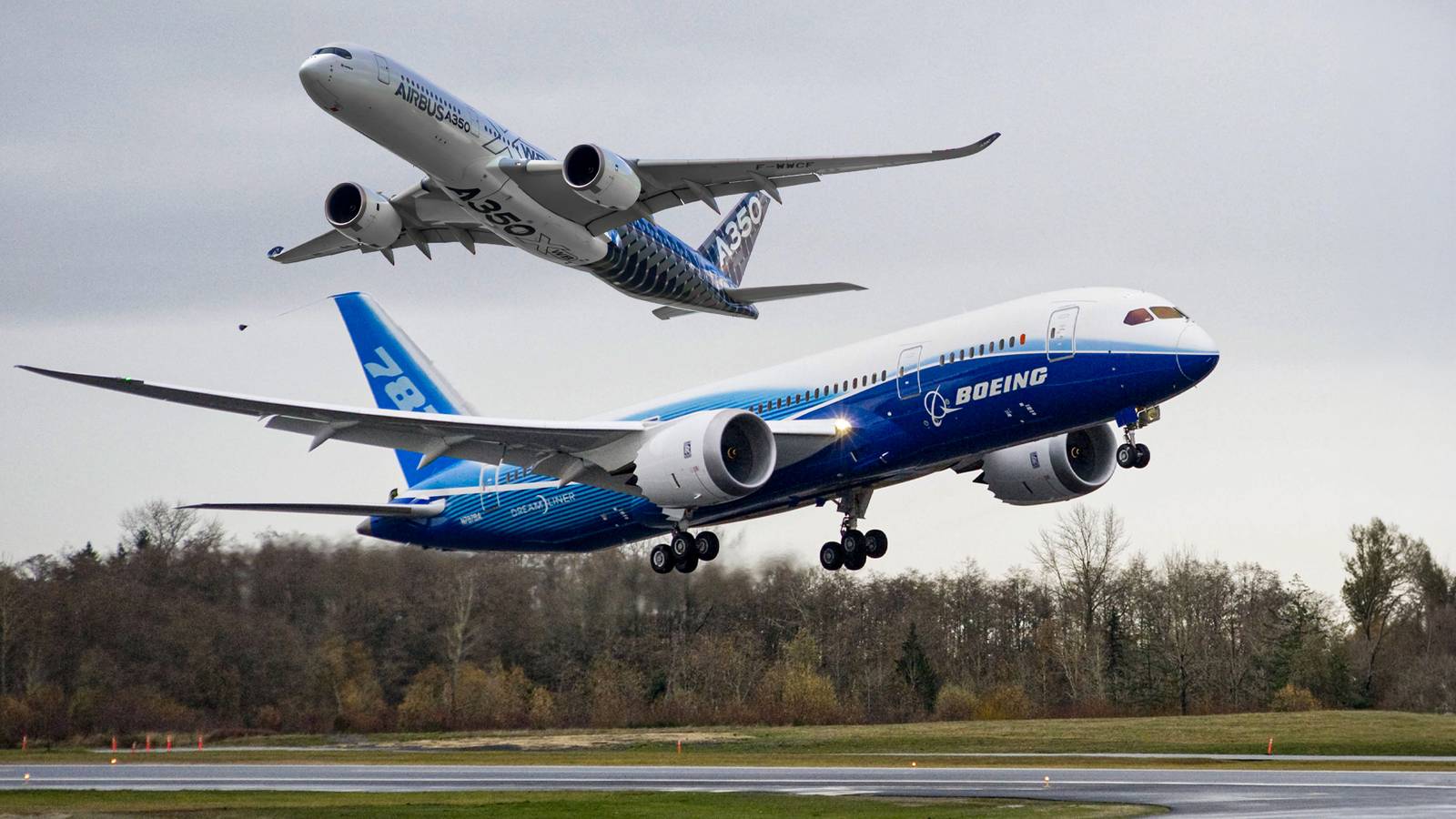
Published Jul 26, 2026, 2:00 PM EDT Brandon's passion for aviation started at a young age. Growing up, he was involved in the flight simulator and VATSIM communities, and he went on to earn his private pilot license while in college. Brandon holds a BSE in computer science and currently works as a software engineer. Outside of work, he continues to build flight hours and explore new airports around the country. The Boeing 787 and Airbus A350 are both composite widebodies that entered service within four years of each other, both pressurized to a cabin altitude of approximately 6,000 feet (1,829 meters), and both designed to replace the same generation of aluminum aircraft on long-haul routes. From the outside, they solve the same problem in similar ways. From a passenger seat, they feel different, and the reasons trace back to five specific engineering decisions where Boeing and Airbus went in different directions. The differences range from how the windows dim to where the cabin air comes from to how wide the fuselage is at floor level. None of them are accidents. Each one reflects a deliberate choice by the manufacturer about how to balance passenger comfort, operational efficiency, and manufacturing complexity. Electrochromic Windows vs Pull-Down Shades Electrochromic glass (787) vs Manual shades (A350) Credit: Shutterstock The most immediately noticeable difference between the 787 and A350 is how the windows work. The 787 has no physical window shades. Boeing replaced the conventional pull-down shade with electrochromic glass that dims electronically through five settings, from fully clear to nearly opaque. Passengers control the dimming through a button on the window sill. The system uses a gel layer between two panes of glass that changes opacity when an electrical current is applied. The windows are also approximately 30% larger than those on previous-generation widebodies like the 767, which gives the 787 cabin a more open feel when the glass is set to clear. The A350 uses conventional pull-down shades on windows that are similarly large. Passengers pull them down manually when they want to block light and push them up when they do not. There is no electronic system involved. The window operation is identical to what passengers have used on every commercial aircraft for decades. The 787's electrochromic system has divided passengers since the aircraft entered service. The tinting creates a permanent bluish cast even at its clearest setting, which means the view through a 787 window is never as neutral in color as a clear A350 window with the shade raised. In the darkest setting, the glass blocks most light but not all of it, allowing a glow that a physical shade would eliminate entirely. Cabin crew can also override individual passenger settings and dim all windows simultaneously, which means a passenger who wants to look out during a daytime flight may find their window darkened remotely. More Cabin Width On The Airbus And What Airlines Do With It Credit: Shutterstock The A350's fuselage produces a cabin that is approximately 5 inches (13 cm) wider than the 787's at floor level, measuring roughly 220 inches (559 cm) compared to the 787's 215 inches (546 cm). Both aircraft seat nine passengers per row in a 3-3-3 economy configuration as standard. The difference is that the A350 fits those nine seats at approximately 18 inches (46 cm) each, while the 787 fits them at approximately 17-17.5 inches (43-44 cm) each. The half-inch to full-inch difference per seat does not sound significant in isolation. Over a 10 or 12-hour flight, it becomes noticeable, particularly for larger passengers or anyone seated in a middle position. Both aircraft have the same seat layout and the same number of middle seats per row, but the A350's wider seats provide slightly more shoulder room and personal space in each position. The width difference is a fixed property of the fuselage cross-section that the airline cannot change. An airline can choose seat cushion width, armrest design, and padding, but it cannot make the fuselage wider. Some airlines have configured the A350 at 10 abreast in a 3-4-3 layout to maximize seat count, which compresses seat width below what the 787 offers at 9 abreast and eliminates the comfort advantage entirely. No-Bleed Air vs Conventional Bleed Air How each aircraft gets its cabin air Credit: Shutterstock The 787 draws its cabin air from dedicated electric compressors mounted on the aircraft rather than from the engines. On a conventional commercial aircraft, including the A350, cabin air is extracted by tapping high-pressure air from the engine compressor stages, a process called engine bleed. That air is cooled, filtered, and distributed through the cabin environmental control system. The 787 eliminated engine bleed entirely and replaced it with electrically driven compressors that draw outside air directly, compress it, and deliver it to the cabin without routing it through the engine core first. The practical difference for passengers is subtle but has been consistently noted by frequent flyers who travel on both types. The 787's cabin air is widely described as smelling fresher and feeling less dry than the A350's, particularly in the first few hours of a long-haul flight. The no-bleed system avoids the possibility of engine oil or hydraulic fluid contamination entering the cabin air supply, an issue that occurs rarely but is not unknown on bleed-air aircraft. The 787's system also allows more precise control over temperature and humidity zones within the cabin, because the electric compressors can be adjusted independently of engine power settings. Both aircraft maintain cabin humidity levels well above what older aluminum widebodies like the 767 or A330ceo provided. Composite fuselages do not corrode, which allows both manufacturers to run higher humidity without degrading the airframe over time. The 787 typically maintains cabin humidity at approximately 15-16%, and the A350 operates at a comparable level. Which Aircraft Is Quieter And Why Cabin noise and engine placement Credit: Shutterstock The A350 is generally reported as the quieter aircraft of the two, particularly in economy class seats between the wing root and the rear of the cabin. Independent measurements and passenger surveys have consistently placed the A350 ahead of the 787 on interior noise levels, though the margin varies depending on where in the cabin the measurement is taken and which engine option the 787 is equipped with. Both aircraft are substantially quieter than the aluminum widebodies they replace, but they achieve their noise reduction through different approaches. The A350 benefits from its Rolls-Royce Trent XWB engines, which are the sole engine option on the type. The nacelle design incorporates extensive acoustic lining, and the engine's bypass ratio and fan diameter were optimized as a matched pair with the airframe from the start of the program. Because Airbus and Rolls-Royce developed the engine and airframe together with no alternative engine option, the acoustic integration between the nacelle, the wing, and the fuselage was designed as a single system. The 787 offers two engine choices, the GE GEnx-1B and the Rolls-Royce Trent 1000, each with its own acoustic signature and nacelle design. The need to accommodate two different engines limited how tightly Boeing could optimize the noise characteristics of the engine-airframe combination. The fuselage construction also plays a role. Both aircraft use composite fuselage barrels, but composite material transmits sound differently than aluminum. The specific layup schedules, insulation materials, and panel damping approaches used by each manufacturer affect how much engine, aerodynamic, and environmental noise reaches the cabin interior. Airbus has been more aggressive in marketing the A350's cabin noise levels as a competitive advantage, and the available data supports the claim. Boeing Sky Interior vs Airbus Airspace Cabin Design Boeing Sky Interior vs Airbus Airspace Credit: Airbus Boeing and Airbus each designed a proprietary cabin architecture for their composite widebodies, and the two produce noticeably different environments even when the seats, carpeting, and service are identical. Boeing's Sky Interior, introduced on the 787, uses a sculpted ceiling with a raised arch that runs the length of the cabin, creating a sense of height that is enhanced by LED lighting recessed into the ceiling panels. The overhead bins are pivot-style units that swing upward on a hinge, and the ceiling arch rises above them to produce an open feel overhead. The overall impression is a cabin that appears taller than it is. The A350's Airspace cabin takes a different approach. The ceiling profile is wider and flatter than the 787's, with a more gradual curve from the sidewall to the center. The overhead bins are larger than the 787's and sit slightly lower, trading some of the vertical openness for additional storage volume. The LED lighting system runs along the edges of the ceiling where it meets the sidewall panels, producing a softer wash of color across a wider surface area than the 787's more concentrated ceiling strip. The result is a cabin that feels wider and more evenly lit rather than taller and more focused. The bin design is one of the more practical differences between the two. The A350's overhead bins accommodate more carry-on bags per bin and are easier to load because the opening faces the passenger more directly. The 787's pivot bins require passengers to lift bags higher to clear the hinge point before swinging the bin closed. Both systems work, but the A350's bins are more frequently cited by cabin crew as easier to manage during boarding, which affects turnaround times on high-density flights. For passengers, the cumulative effect of the ceiling shape, lighting placement, and bin design is that the two cabins feel different in ways that are perceptible but difficult to articulate without comparing them directly.
5 Engineering Decisions That Explain Why The Boeing 787 & Airbus A350 Feel Nothing Alike Inflight
Full Article
Original Source
Read the full article at Simpleflying →KhanList aggregates and links to publicly available news content. We do not host full articles from third-party sources. Always verify important information with original sources.