
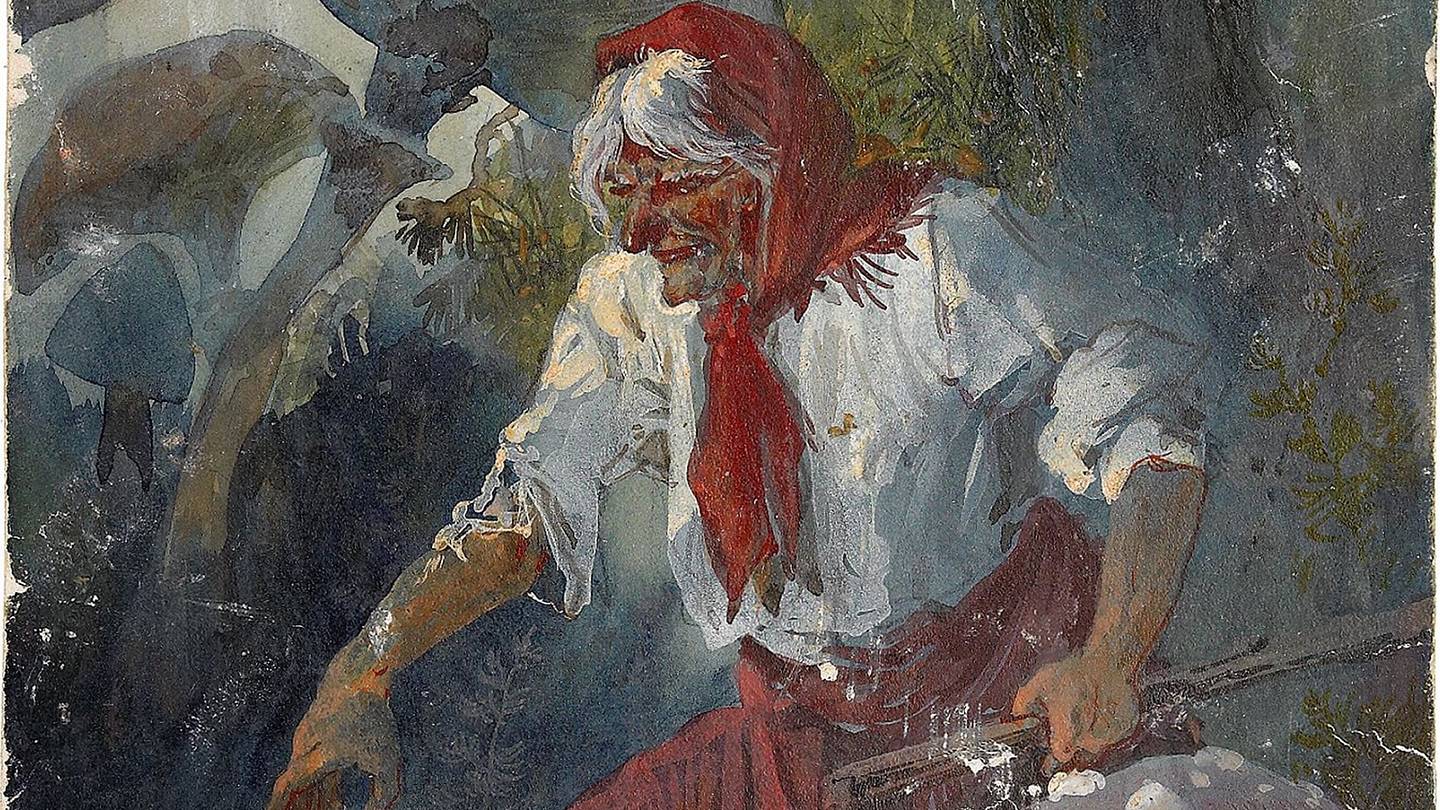
A major figure in Slavic folklore, Baba Yaga is typically portrayed as an old ogress or witch who hunts and eats children, lives in a house made of bones and burning skulls that stands upon chicken legs, and who flies around the forests in which she dwells in a giant pestle and mortar (or, in alternative versions, an iron kettle or cauldron). The origins of the character are unclear, but she has been portrayed in Russian and Eastern European art since the 1600s, with tales featuring Baba Yaga first emerging in Slavic literature in the 18th century. Some of her stories show her as more of a humanlike figure than a monster, or else as more of a cunning or malevolent trickster than a cannibalistic enchantress, with different countries favoring their own Baba Yaga fairy stories and folktales—five of which are explored here. The Daughter-In-LawViktor Vasnetsov's 'The Hut on Chicken Legs' depicts Baba Yaga's infamous forest dwelling. | Heritage Images/GettyImagesIn a handful of different versions of her stories, Baba Yaga is portrayed as an old, bitter, crone-like mother-in-law, who is intensely jealous of her only son's beautiful new young wife. In at least one version of this daughter-in-law story, Baba Yaga plots to do away with his new wife by setting her increasingly dangerous errands around their home while her son's away. First, she asks her daughter-in-law to go and milk her cows that live in the woods nearby; luckily, the daughter-in-law's husband arrives on the scene just in time to reveal that the cows are in fact bears in disguise. The next day, Baba Yaga asks her daughter-in-law to shear some of her sheep who likewise live in the woods; again, her husband arrives just in time to reveal that the sheep are wolves. Finally, on the third day, Baba Yaga requests that her daughter-in-law go visit her sister to retrieve a reed for weaving; Baba Yaga’s sister is also a monstrous and murderous witch, who begins setting a fire to cook her when she arrives. Luckily, her husband had again prepared her for the dangers of her journey, and gave her a random assortment of items—including ham, lard, a comb, and sewing needles—to keep her safe on her errand. The daughter-in-law gives the ham and the lard to Baba Yaga's sister's dog and cat, and gives the needles to some girls she finds in her home. Because of her kindnesses, the girls warn the daughter-in-law that the witch is planning to eat her, and tell her to take the reed and flee (while the dog and cat, having been well fed, do not chase her or raise the alarm). The daughter-in-law ultimately escapes, flinging the comb down behind her as she runs, which magically grows into a dense forest that Baba Yaga's sister cannot get through to pursue her. On returning home, she hands the reed to Baba Yaga, who at long last—and with all her trials successfully survived—begins to warm to her new daughter-in-law.Baba Yaga and Her DaughtersIn a particularly gruesome and somewhat tragic Russian version of Baba Yaga's story, a local couple who are unable to have children are advised to collect a single egg from every house in their village, and place all 41 eggs in their own hens' coop. From each of the eggs hatches a son, all but one of whom are strapping and heroic young men. The 41st son is weaker than his brothers, but soon proves his worth when it's arranged that all the sons are each to marry one of Baba Yaga's 41 daughters. On the night of the wedding, it's revealed that Baba Yaga intends to murder all her daughters' new husbands, and when word of their mother-in-law's plot reaches the 41st son, he warns his brothers and hatches a plan of his own to thwart her murderous scheme. The brothers all swap nightclothes with their brides, so when Baba Yaga's servants sneak into their rooms that night, they each kill the bride rather than the groom. The following morning, Baba Yaga awakes to find the heads of her 41 daughters impaled on spikes outside her home, and begins burning down the village in anger at being deceived. The sons are able to escape via a magic bridge, leaving Baba Yaga to burn up in the town behind them. Vasilisa the Beautiful'Vasilisa the Beautiful,' 1900. | Heritage Images/GettyImagesOne of the best-known of Baba Yaga's stories is a spin on the Cinderella fairy tale, known as "Vasilisa the Beautiful." Vasilisa is the young daughter of a merchant, whose wife, Vasilisa's mother, dies when she is still just a child. On her deathbed, her mother gives Vasilisa a magic doll that can come alive and help her whenever she gives it something to eat. Vasilisa's father remarries, and his new wife has two wicked daughters. Her stepfamily treats Vasilisa terribly while her father is away, but she uses her magic doll to help her with the extra chores and household jobs she is ordered to do. Eventually, Vasilisa's stepmother has had enough of her unwanted stepdaughter and sets her the task of going to Baba Yaga's house in the woods to fetch a fire as the household candles have been extinguished. Vasilisa sets off with her doll, but when she arrives at Baba Yaga's house, Baba Yaga traps her inside and keeps her as her own personal servant. Just as before, however, Vasilisa manages to do every task she's given with the help of her magical doll. When Baba Yaga asks her how she's able to do so much work on her own, Vasilisa replies that it is with her late mother's blessing, and nothing else. On this, Baba Yaga flies into a rage, stating that she cannot keep a virtuous person in her home, and ejects Vasilisa from her house. Remembering her stepmother's errand, Vasilisa takes a burning skull from Baba Yaga's garden on her way out, and uses it as a lantern to light her way back to her home. When she arrives, Vasilisa's stepmother is horrified to find that she's still alive and survived her run-in with Baba Yaga—but the fire in the skull suddenly burns out of control, and the flames spewing from its eye sockets burn Vasilisa's stepmother and stepsisters to ashes. Prince IvanIn some versions of the Baba Yaga story, she’s shown as having essentially the same petrifying qualities as the Gorgons of Greek mythology, and as such is able to turn people to stone. In at least one of these tales, a young servant-maid’s son named Ivan Dévich, a friend of the handsome Prince Ivan, happens to encounter Baba Yaga while riding through the forest. Baba Yaga approaches Ivan and plucks a hair from her head, challenging him to tie three knots in it. This he does, but when Baba Yaga then tells him to blow on the hair, he and his horse are immediately transformed into stone, which she then grinds up in her pestle and mortar and scatters in her garden. Sometime later, Prince Ivan himself is riding through the forest, looking for any trace of his missing friend. He too encounters Baba Yaga, who again plucks a hair from her head and challenges him to tie three knots in it. Suspicious of the old witch’s tricks, Ivan cleverly feigns ignorance and asks Baba Yaga to show him how to tie the knots. Ultimately, she falls victim to her own trick and turns herself to stone—at which point the prince places her in her own pestle and mortar, and threatens to grind her up unless she reveals what she did to Ivan Dévich and brings him and his horse back to life. The Tale of the Four HuntersIvan Shishkin's 'The Forest.' | DEA / N. CIRANI/GettyImagesFour friends are riding through Baba Yaga's forest one day when they stumble across her hut, propped up on top of two enormous chicken legs. Upon entering, they find the hut empty, but the cupboards well-stocked with plenty of food and crockery. The friends decide that one will stay behind and prepare a meal for the others, who leave to go off hunting. With his three friends gone, however, the first hunter is attacked at the hut by Baba Yaga, who creeps out from beneath a stone in the wall and strikes him with her giant pestle. As he is knocked unconscious, Baba Yaga tears a strip of skin from his back, and devours the meal he has prepared for his friends before returning to her hiding place in the wall. The hunter regains consciousness and tends to his wounds, but when his friends return and find no food ready for them, he's too embarrassed to tell them what happened and so does not warn them of Baba Yaga. The next day, the friends return to the hut and the second hunter stays behind to prepare food. He, too, is attacked, yet too embarrassed to admit it. On the third day, the third friend is attacked and likewise does not tell his companions. On the fourth day, however, it's the turn of the handsome hunter Ivan to stay behind at the hut—and when Baba Yaga tries to attack him, he quickly snatches the pestle from her hands, clubs her with it instead, and tears three strips of skin from her back before tying her up and locking her in a closet. When his friends get back from their hunt, they find that Ivan's meal is prepared and ready to eat, and head to the bathroom to wash up before dinner. As they do so, Ivan notices that each of his friends has a strip of skin torn from their backs, which leads to his friends confessing their embarrassing run-ins with Baba Yaga. Ivan runs to the closet and fetches the witch, and together the men hang her from the rafters of the hut by her ankle. Ivan then uses the strips of skin he took from her back to magically repair the skin of his friends' backs, before they sit down to enjoy the meal he has prepared for them. Read More:
5 Creepiest Baba Yaga Stories From Slavic Folklore
Full Article
Original Source
Read the full article at Mentalfloss →KhanList aggregates and links to publicly available news content. We do not host full articles from third-party sources. Always verify important information with original sources.