
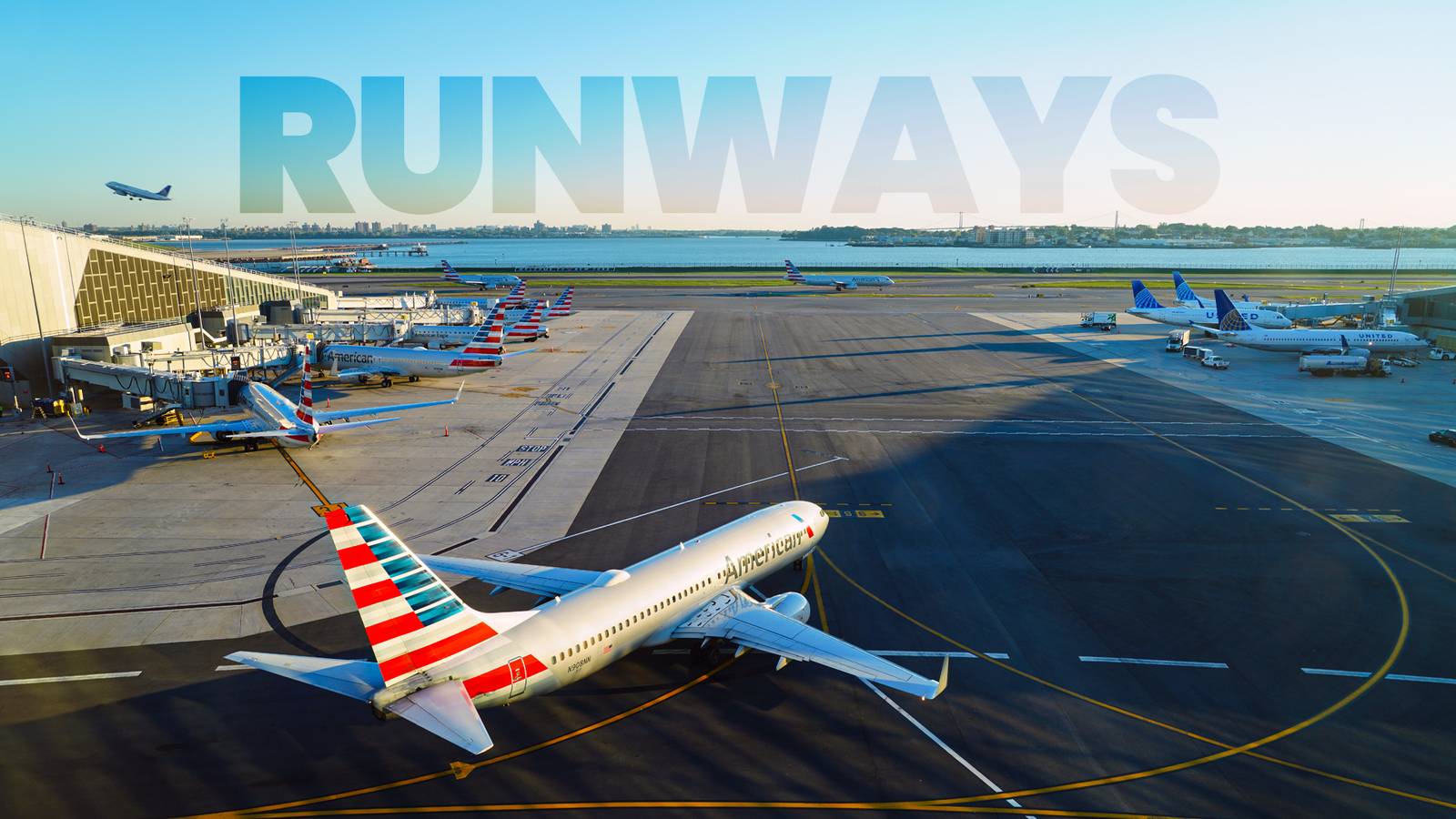
Credit: EQRoy | Shutterstock, Simple Flying Published Nov 13, 2026, 1:00 AM EST Daniel comes to Simple Flying with a business focused approach to the aviation world. Daniel enjoys analyzing strategy and how companies move against each other to gain a step ahead in the skies. Besides strategy, Daniel also has a passion for aircraft design and the history of aviation. Based in New York Sign in to your Simple Flying account Perhaps the most ideal layout for an airport is the 'pinwheel' arrangement at Denver International Airport (DEN). This allows multiple sets of parallel runways in different directions to operate largely independently. This increases capacity, reduces taxi times, and there are no intersections. However, the problem is that the pinwheel arrangement takes up a significant amount of space, and many airfields simply lack the land to design such a layout. Still, adding runways is primarily how airfields boost capacity. Many older airports operate with intersecting runways, which represent a compromise for airports that need to add capacity but are limited on space. These arrangements can have lower capacity because intersections require more spacing to accommodate arrivals and departures in certain cases. Using intersecting runways simultaneously also requires added coordination to ensure safety. Still, several major hubs use intersecting runways, including some of the busiest airports in the United States. 5 LaGuardia Airport One point of intersection Credit: Ron Adar I Shutterstock LaGuardia Airport (LGA) is the smallest of the three primary airports serving the New York metropolitan region, alongside JFK and Newark. However, it is also the one located closest to Manhattan, making it the most desirable airport for business travelers, as it takes less time to travel from LGA to the city. As such, there's heavy demand for flights to destinations within the 1,500-mile (2,414 km) perimeter limit. Demand to LGA is high, but the airport lacks the capacity to truly accommodate the demand. LaGuardia originally opened with four runways, two of which have since closed. The remaining runways, which have been extended since the airport's opening, are numbered 4/22 and 13/31, and each is 7,002 feet (2,134 meters). They intersect at the northwestern part of the airfield, which can complicate daily operations. Controllers typically use one runway for departures and one for arrivals, so planes must be sequenced carefully to prevent conflicts. New York Metropolitan Airports Runways Length (feet) Length (meters) LaGuardia Airport (LGA) Runway 4/22 7,002 feet 2,134 meters Runway 13/31 7,002 feet 2,134 meters John F. Kennedy International Airport (JFK) Runway 4L/22R 12,079 feet 3,682 meters Runway 4R/22L 8,400 feet 2,560 meters Runway 13L/31R 10,000 feet 3,048 meters Runway 13R/31L 14,511 feet 4,423 meters Newark Liberty International Airport (EWR) Runway 4L/22R 11,000 feet 3,353 meters Runway 4R/22L 9,999 feet 3,048 meters Runway 11/29 6,725 feet 2,050 meters Demand for LaGuardia far outstrips the airport's flight capacity, making it one of only three slot-restricted airports in the US (alongside JFK and Washington National). The intersecting runways mean its practical flight capacity is lower than if the airport had two parallel runways. However, LaGuardia has been around for nearly 80 years, and it's severely restricted on space as it's surrounded by either residential neighborhoods or water. As such, it will remain a constrained airfield. 4 Chicago Midway International Airport Four points of intersection Credit: Markus Mainka I Shutterstock Chicago Midway International Airport (MDW) served as the primary airport for Chicago until O'Hare Airport opened in the 1950s. Since then, airlines have generally preferred O'Hare, although Midway remains active. Today, over 90% of the airport's commercial operations come from Southwest Airlines, which has established MDW as a major operating base. In addition, Midway also receives regular flights from Allegiant Air, Delta Air Lines, Frontier, and Volaris, although these operations are comparatively tiny. The airport has four runways, numbered 4L/22R, 4R/22L, 13L/31R, and 13R/31L. The last one, 13R/31L, is significantly shorter than the rest and is primarily used for light aircraft, while the airliners use the other three runways. Runways 13R and 31L intersect both 4L/22R and 4R/22L, while the parallel 13L/31R also intersects both runways. This creates four runway intersections, requiring careful coordination by air traffic control and vigilance from pilots on the ground to maintain safety. MDW is landlocked on all sides, which means that it has practically no room to expand or revise the runway layout. The airport is not at capacity, so the runway layout is not a major commercial issue. However, it does require extra caution due to the added risk of having four runways that intersect at four different points. In addition, there are difficulties with the airport's general layout, including the much shorter and narrower Runway 13R/31L, which can be confused for a taxiway. 3 Detroit Metropolitan Wayne County Airport Four points of intersection Credit: Wangkun Jia I Shutterstock Detroit Metropolitan Wayne County Airport (DTW) is a major hub for Delta Air Lines, which operates it as a midcontinent connecting hub with significant service to Europe and Asia. It is a fortress hub for Delta, which holds over 70% market share at the airport and connects Detroit to over 100 destinations around the US and the world. It's a busy hub with well over 300,000 aircraft movements annually, 147 gates, two main terminals, as well as six runways in total. Two of them run east-west, while the remaining four run north-south. The two east-west runways are numbered 9L/27R and 9R/27L, while the four parallel north-south runways are numbered 3L/21R, 3R/21L, 4L/22R, and 4R/22L. Runway 9R/27L crosses Runway 3R/21L, while Runway 9L/27R crosses Runway 3R/21L, 3L/21R, and 4R/22L. The only runway at DTW that does not intersect with another is Runway 4L/22R, located at the westernmost part of the airfield and running parallel to the other north-south runways. Runway Length (feet) Length (meters) Runway 3L/21R 8,500 feet 2,591 meters Runway 3R/21L 10,001 feet 3,048 meters Runway 4L/22R 10,001 feet 3,048 meters Runway 4R/22L 12,003 feet 3,659 meters Runway 9L/27R 8,708 feet 2,654 meters Runway 9R/27L 8,500 feet 2,591 meters Although there are four intersection points, DTW rarely actually uses Runways 9L/27R and 9R/27L. Instead, it mainly operates using the four north-south parallel runways, which intersect the east-west runways but not each other. As such, the intersection points rarely play a significant role in everyday operations. Instead, Runways 9L/27R and 9R/27L are used when winds would produce an unusually strong crosswind on the north-south parallel runways. 2 San Francisco International Airport Four points of intersection Credit: Bradley Caslin I Shutterstock San Francisco International Airport (SFO) is one of the most unique airports in the US. Bounded on three sides by water and on the fourth by residential developments, the airport is quite space-constrained. It operates four runways, with two sets of parallel runways set perpendicular to one another. The two pairs of runways intersect each other, creating four intersection points. The airport is famous for its simultaneous approaches, but it also often runs simultaneous departures, particularly with narrowbody aircraft. The operations of SFO require intense coordination, with departures and arrivals having to be staggered to prevent conflicts as SFO often uses both runway pairs. Recently, however, the FAA prohibited SFO from continuing its longstanding practice of operating side-by-side landings, instead requiring planes to be offset from one another. This significantly reduced the airport's arrival capacity, leading to additional delays due to weather or congestion as the airport becomes increasingly constrained. SFO serves as the primary hub for United Airlines, which uses it as its primary gateway to Asia and Oceania. The airline has over 50% market share, and United connects San Francisco to over 120 destinations worldwide. The airport serves one of the biggest business markets in the country, and international traffic is surging. However, it's also becoming increasingly constrained by its runway layout, while frequent fog results in weather delays far more often than airlines, passengers, and the airport would like. 1 Boston Logan International Airport Six points of intersection Credit: Wirestock Creators I Shutterstock Boston Logan International Airport (BOS) has one of the most unusual runway layouts of any airport in the US. It has six runways, including what are technically two sets of parallel runways. The runways are numbered 4L/22R, 4R/22L, 9/27, 14/32, 15L/33R, and 15R/33L. There are six intersections in total, although the runways are not used equally. Runway 15L/33R, at only 2,557 feet (779 meters) long, is used solely by light aircraft, while the runways that are used by airliners are assigned depending on the winds. BOS is locked on all sides, with limited land available and no room for expansion. The arrangement of the different runways allows the airport to more easily accommodate flights during shifting winds, which can change very often in a given day, without compromising on arrival capacity. Runways 4L/22R and 4R/22L are often the runways most commonly used by air traffic controllers at BOS, but the airport can easily switch directions if weather conditions necessitate it, while the arrangement provides more flexibility. Boston Logan International Airport Runways Length (feet) Length (meters) Runway 4L/22R 7,864 feet 2,397 meters Runway 4R/22L 10,006 feet 3,050 meters Runway 9/27 7,001 feet 2,134 meters Runway 14/32 5,000 feet 1,524 meters Runway 15L/33R 2,557 feet 779 meters Runway 15R/33L 10,083 feet 3,073 meters Although there are several intersection points at BOS, this doesn't complicate operations significantly. Unlike an airport such as LaGuardia or San Francisco, only a few runways are used at a time at BOS, and they usually follow the same direction. At LGA or SFO, controllers have to manage aircraft operating in multiple directions routinely, but this isn't the case at BOS or DTW. While the intersections reflect compromises due to a lack of space, they're not a major issue for BOS's operations specifically.
5 Busy Airports Where Intersecting Runways Complicate Takeoffs & Landings
Full Article
Original Source
Read the full article at Simpleflying →KhanList aggregates and links to publicly available news content. We do not host full articles from third-party sources. Always verify important information with original sources.