
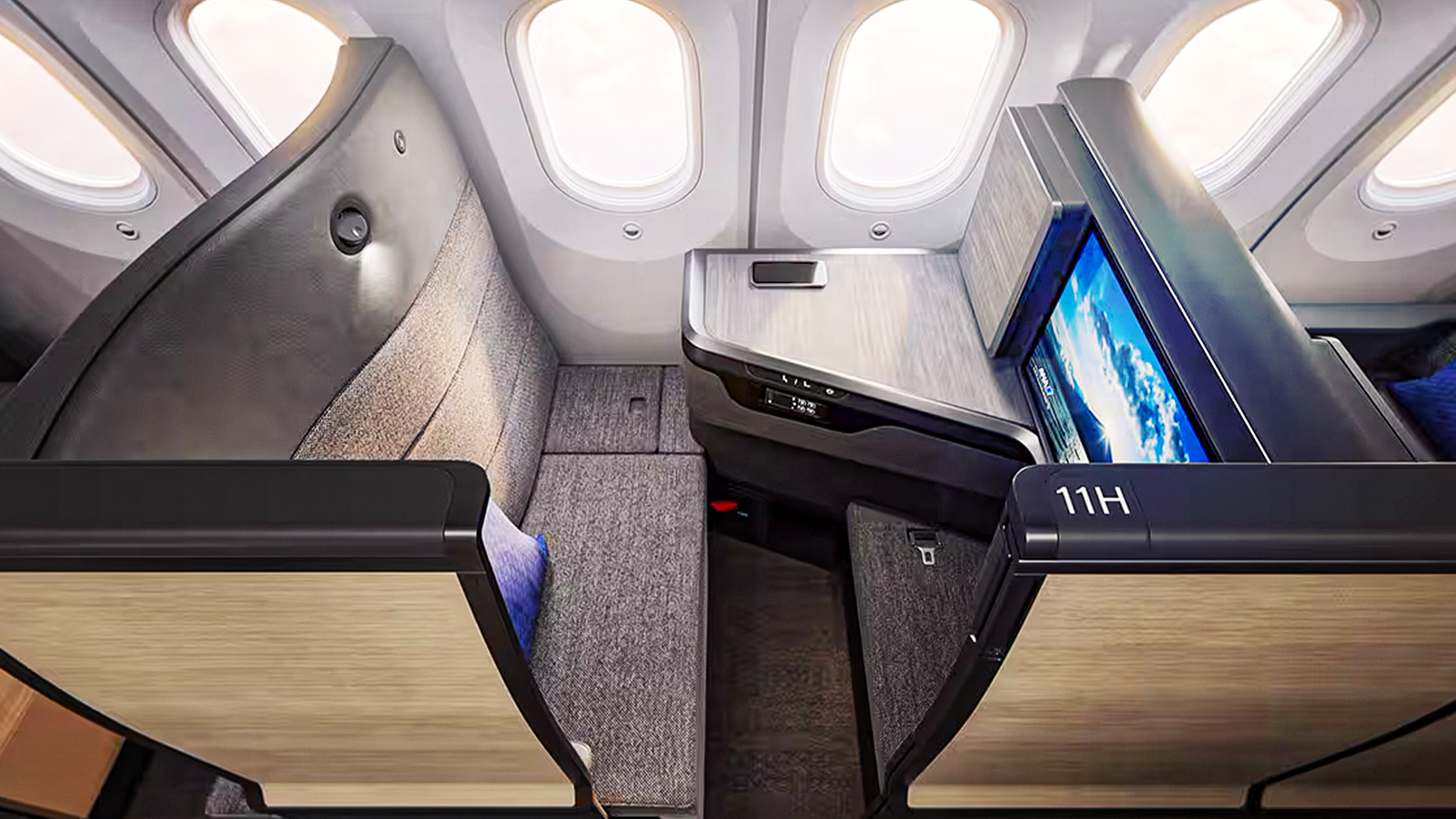
Published Nov 4, 2026, 1:00 PM EST Passionate about promoting aviation, the beauty of flight and the science behind it, Antonio is an avid reader of aviation magazines and books, and he loves visiting airshows all over the world, taking photos and writing about airplanes and helicopters as well. He is currently based in Palermo, Sicily. The Boeing 787-9 is often associated with long-haul efficiency, but its business-class cabins can offer remarkably different experiences. Depending on the airline, passengers may find themselves in a relatively conventional layout or a spacious suite with a sliding privacy door. As AwardLocker’s comparison of business-class cabins highlights, the aircraft model alone reveals very little about what awaits behind the boarding door. For travelers choosing a long-haul flight, those differences can make one 787-9 considerably more appealing than another. Some airlines have gone particularly far in dedicating cabin space to business class, with configurations that stand out even among widebody aircraft. This list examines five carriers operating Boeing 787-9s with at least 40 business class seats, comparing their layouts, seating products, and approach to premium travel. The order follows the number of business class seats, but the figures alone do not tell the whole story. And one configuration in particular raises an interesting question about just how much of a Dreamliner's cabin an airline is willing to reserve for its most valuable passengers. 5 Qantas’ 787-9: 42 Business Seats The smallest business cabin on the list, built for the longest flights Credit: Qantas News Room Qantas’ 236-seat 787-9 has 42 business seats in a 1-2-1 layout, each with direct aisle access. Australian Aviation reported that the cabin also includes 28 premium economy seats and 166 economy seats. The first of Qantas’ 787-9s arrived in October 2017, and the business seat is the Thompson Aero Vantage XL, an evolution of the suite Qantas already flew on its Airbus A330s. Business Traveller’s review adds that the 42 seats are split between a 30-seat forward cabin and a 12-seat secondary cabin, with a galley and lavatories in between. Business class accounts for about 18% of the aircraft's total capacity, a relatively modest share compared with the other configurations in this countdown. Simple Flying examined how the 787-9's range lets Qantas operate long-haul routes directly from Australia instead of relying as heavily on hubs such as Singapore and Hong Kong. The aircraft also allows the airline to match capacity to demand without needing to fill an Airbus A380, which matters when a jet has so few seats to sell. It is a small business cabin with big ambitions, designed for passengers who can spend most of a day in the air. Qantas is not standing still. AwardLocker notes that the airline advertises an evolved suite with a sliding door for new 787-9 deliveries from fiscal year 2028. Simple Flying examined how the carrier is reshaping its fleet without grounding. Today's Qantas suites have no doors, so the upgrade represents a significant change to the passenger experience. Still, 42 seats are enough to make the aircraft a serious long-haul proposition. The next airline takes that premium investment further, with a cabin that offers considerably more personal space. 4 ANA’s 787-9 With The Room FX: 48 Business Seats A sofa by day, a bed by night Credit: All Nippon Airways All Nippon Airways' 206-seat 787-9 layout has 48 business seats in The Room FX. According to ANA, the seats alternate between forward- and rear-facing positions, and each is self-contained, with a door and a large 24-inch (61 cm) 4K monitor. ANA says it is the largest business class seat for a mid-sized aircraft, KarryOn reported, and the seat was developed with Safran Seats and Acumen. Pre-reclining the seat creates a sofa-like position, while adjustable leg rests turn it into a bed. The Points Guy adds that the 48 pods are split between the forward and rear cabins, with six rows each. The dimensions help explain the attention surrounding the product. AwardFares reported a bed length of 76.5 inches (194 cm) and a waist width of 27 inches (69 cm), while Aircraft Interiors International says the sofa end is 41.5 inches (105 cm) wide. The same report adds that each of the 48 seats has a door, and that ANA plans a gradual rollout from 2026 on major long-haul routes. In effect, the seat offers more living space without adding weight, a clever trade for a mid-sized jet. Business class accounts for roughly 23% of the aircraft's 206 seats, giving the premium cabin a substantial share of the available capacity. There is an important catch, however: not every ANA 787-9 has The Room FX. ANA’s cabin pages show that its 215-seat and 246-seat 787-9s use the Business Staggered seat instead, which also gives every passenger direct aisle access. ANA's cabin pages list each option by aircraft layout, so identifying yours takes only a minute. Checking the seat map before booking is essential, particularly when the difference between configurations can change the entire experience. With 48 business seats, ANA has already moved well beyond Qantas' more restrained layout. The next airline, however, manages to fit even more premium seats into its Dreamliner. 3 American Airlines’ 787-9P: 51 Business Seats The premium Dreamliner with a door on every seat Credit: American Airlines American Airlines' premium-heavy 787-9P has 51 business seats, made up of eight Flagship Suite Preferred seats and 43 standard Flagship Suites, all with doors, according to The Points Guy. The eight Preferred seats sit in the front row of each of the two business cabins. To keep the layout efficient, View From The Wing reports that the pitch is 42 inches (107 cm) at the windows and 44 inches (112 cm) in the center seats. The Preferred suites offer up to 19% more bed space and 42% more living area, per AirlineGeeks. The whole aircraft seats 244, which makes business class about 21% of the cabin. Simple Flying explains that the premium-heavy version's forward mini-cabin offers the most exclusivity. Simple Flying also compared American's new Flagship cabin with United Polaris, a rivalry that is shaping US long-haul travel. American also gives the 787-9P 32 premium economy seats, so the premium cabins together hold 83 seats. AwardWallet’s onboard measurements put the entertainment screens at 17.5 inches (44 cm), competitive with other US carriers, and every seat offers wireless charging. The first 787-9P entered service in spring 2025 on transatlantic routes from Chicago and Philadelphia, and American has been receiving Flagship Suite 787-9s since then, with 30 scheduled in total, Aviation Business News reported. But beware: AwardLocker warns that American also flies a 285-seat 787-9 with only 30 business seats. So, the 787-9P is a very different proposition from the airline's more conventional Dreamliner configuration. Its 51 seats put it firmly among the most premium-heavy aircraft on this list, although a Japanese competitor manages to squeeze in one more. 2 Japan Airlines’ 787-9: Up To 52 Business Seats Two versions, and one clever geometry trick Credit: Japan Airlines Japan Airlines flies two versions of the 787-9 with more than 40 business seats. Its 203-seat layout has 52 Sky Suite III seats, a reverse-herringbone design in a 1-2-1 layout where every seat angles toward the window and has direct aisle access, according to JAL’s announcement. The cabin grew from the 787-9’s previous 44 business seats to 52. The Milelion says the business cabin splits into 28 seats in rows 1 to 7 and 24 seats in rows 8 to 13, and the Sky Suite III bed measures about 78 inches (198 cm). That design first appeared on JAL’s Boeing 777-200ER in mid-2016, before it moved to the 787-9 in 2017, according to Executive Traveller. Business class takes up roughly 26% of the 203 seats, a huge share for a Dreamliner, and one reason corporate travelers pay attention to this jet. Why? Japan’s Impress Watch reported that the denser layout let JAL answer strong corporate demand while keeping lie-flat comfort. The older, 195-seat layout has 44 original Sky Suite seats in a 2-2-2 layout, where window seats are staggered, so every passenger can still reach the aisle. Each seat is about 20.5 inches (52 cm) wide, per The Milelion. Both versions carry 35 premium economy seats, so the difference is felt up front, not in the back. JAL also flies a third 787-9 layout, but with fewer business seats, it does not qualify. The Milelion notes JAL operates three configurations of the jet, so check the cabin count before booking. For a comfort-first ranking instead, Simple Flying’s list of five comfortable 787 business seats is worth a look. Now for the US airline that answered United’s push, and how far it went. 1 United Airlines’ Elevated 787-9: 64 Business Seats The most premium-heavy Dreamliner in America Credit: Channing Reid | Simple Flying United Airlines' newest 787-9s carry just 222 seats, and 64 of them are Polaris business suites in a 1-2-1 layout across 16 rows, according to One Mile at a Time. Eight are the larger Polaris Studio suites at the front of the business cabin. The Blue Board’s fleet guide says each is roughly 25% larger than a standard Polaris seat, with a sliding door and a 27-inch (69 cm) 4K OLED screen. The suites also add a companion ottoman for dining with a guest and wireless charging, details that make them feel closer to a first-class product. Business class alone accounts for nearly 29% of the cabin. Add 35 Premium Plus seats, which AwardFares reported now have privacy dividers, reading lights, and 16-inch (41 cm) 4K OLED screens, plus 123 economy seats, and 99 of the 222 seats are premium. Live and Let’s Fly describes that as the highest percentage among US carriers. The Elevated configuration represents a major departure from United's conventional 787-9. As of late September 2026, The Blue Board counted just 11 Elevated aircraft among United's 59 787-9s, with most still flying 48 Polaris seats. FlyMag’s analysis says the Elevated version has one-third more Polaris capacity than United's conventional 787-9, which seats 257 passengers, even though it carries 35 fewer people overall. That is a substantial shift in how the airline uses its long-haul aircraft, prioritizing premium capacity over the number of passengers carried. The jets entered service on April 22, 2026, between San Francisco and Singapore, and Inside Flyer reported that from October 24, 2026, United will base them in Houston for flights to São Paulo, Sydney, and Tokyo. United plans to have 33 Elevated 787-9s flying by 2028, Airways Magazine reported. The aircraft is still relatively uncommon, but its planned expansion should make the configuration increasingly visible across the airline's international network. With 64 business class seats, including eight larger Polaris Studio suites, United takes the top spot in this countdown. Its Elevated Dreamliner carries more business class passengers than any of the other configurations examined here, while also dedicating nearly 45% of its total capacity to business and premium economy. The difference between the 42-seat Qantas cabin at the beginning of this list and United's 64-seat configuration is striking. It also shows just how much flexibility Boeing's 787-9 offers airlines: the same aircraft can be configured for long-distance efficiency, distinctive private suites, or a much larger premium operation. For passengers, however, one lesson is worth remembering before booking any of them: always check the aircraft configuration, because the 787-9 name alone does not guarantee the cabin you expect.
5 Boeing 787-9 Fleets With At Least 40 Business Class Seats
Full Article
Original Source
Read the full article at Simpleflying →KhanList aggregates and links to publicly available news content. We do not host full articles from third-party sources. Always verify important information with original sources.