
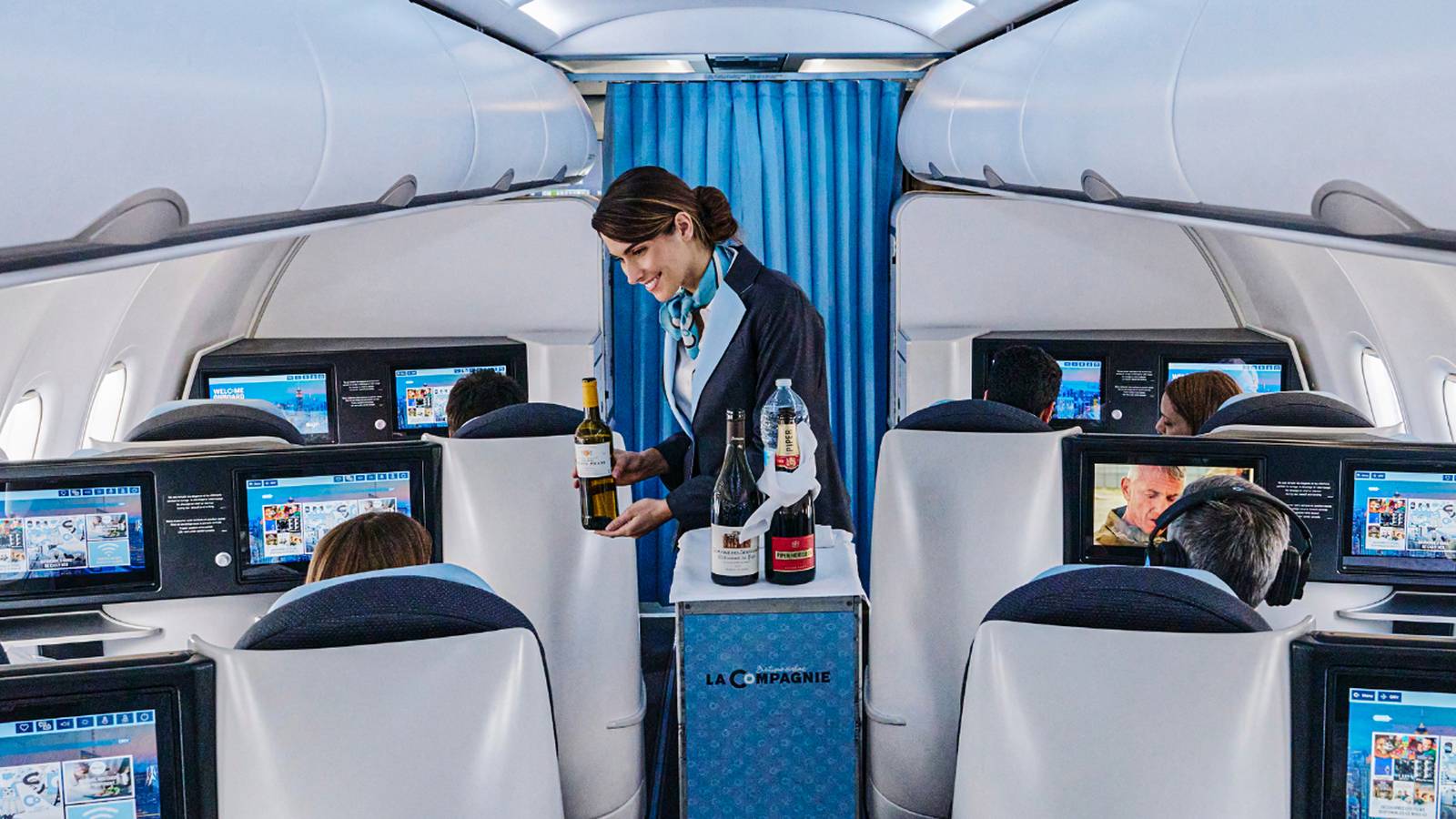
Credit: La Compagnie, Simple Flying Published Nov 7, 2026, 6:01 PM EST Brandon's passion for aviation started at a young age. He became involved in the flight simulator and VATSIM communities, which sparked his interest in aviation and eventually led him to earn his private pilot license. Outside of work, he continues to build flight hours, explore new airports, and stay involved in the aviation community. Lie-flat business class belonged to widebodies until June 15, 2014, when JetBlue Airways launched Mint on a single route between John F. Kennedy International Airport (JFK) and Los Angeles International Airport(LAX). The aircraft was an Airbus A321, a narrowbody that American, Delta, and United flew transcontinental routes with recliner seats at premium fares. JetBlue put flat beds in the front of one and changed what passengers expected from a single-aisle aircraft. A decade later, the A321neo and its long-range derivatives carry lie-flat seats across both US transcontinental routes and the Atlantic. The aircraft's range made that possible. An A321LR can reach London from New York, meaning a narrowbody now competes directly with widebodies on routes that were closed to it a generation ago. The seats themselves have kept pace, with JetBlue fitting the Thompson Aero VantageSOLO in private suites with closing doors and direct aisle access on every Mint seat aboard its A321neo and A321LR fleets. The operators are an unusual group. A US low-cost carrier flies the most A321LR transatlantic routes of any airline. An all-business-class boutique operates the type with 76 flat seats and nothing behind them. Two European flag carriers use it to open thinner North American routes that cannot support a widebody. New York-JFK – Los Angeles Where lie-flat on the A321 started Credit: JetBlue JetBlue launched Mint on June 15, 2014, on the route between New York John F. Kennedy International Airport (JFK) and Los Angeles International Airport (LAX). The transcontinental market was the right place to start because American, Delta, and United charged premium fares for recliner seats on the same city pair. JetBlue undercut them with flat beds and a markedly better onboard product, and the competitive response reshaped premium transcon flying across all four carriers. The current product on the A321neo is a considerable step beyond what launched in 2014. The aircraft carries 16 Mint seats, comprising 14 Mint Suites and two Mint Studios, arranged 1-1, so every passenger has direct aisle access. JetBlue states that every Mint seat on its A321neo with Mint is a private suite with a door, and that all of them convert to a fully lie-flat bed with Tuft & Needle adaptive foam cushions and a T&N-designed pillow and comforter. The two Mint Studios at the front stand out. JetBlue describes the Studio as carrying the largest TV on a US airline at 22 inches, plus a mirrored vanity, extra storage, and a guest seat and table that lets a second Mint passenger visit. The Points Guy measured the Studio bed at just over 82 inches in lie-flat mode, which it called the largest lie-flat bed on any US airline, and paid $199 above the standard Mint fare to book one on the inaugural. Aircraft type matters when booking. JetBlue's older A321 Classic with Mint also carries 16 Mint seats, but only four of them are suites with doors, with the remainder in alternating 2-2 rows. New York-JFK – London Heathrow The same seat, 3,000 miles further Credit: JetBlue The Airbus A321LR is a long-range derivative of the A321neo, which allows JetBlue to fly a narrowbody across the Atlantic. The aircraft carries 24 Mint seats, comprising 22 Mint Suites and two Mint Studios, arranged in the same 1-1 layout as the domestic A321neo. The seat is identical. JetBlue fits the Thompson Aero VantageSOLO across both fleets, which means a passenger flying JFK to Los Angeles and a passenger flying JFK to London Heathrow (LHR) are in the same product. JetBlue serves Heathrow twice daily from JFK for the winter 2026-27 season, alongside JFK to Paris and Boston Logan International Airport (BOS) to both Heathrow and Paris. The wider European network reaches Amsterdam, Dublin and Edinburgh from New York and Boston, with Madrid and Milan added from Boston. That is more A321LR transatlantic routes than any other airline operates, a notable position for a carrier that flew nothing across the Atlantic before 2021. The aircraft changes which routes are viable. A widebody crossing the Atlantic needs enough demand to fill 250 or more seats. An A321LR carries 138 in JetBlue's configuration, 24 of them Mint, which lowers the threshold considerably. That is why the type has opened city pairs between secondary European cities and the US East Coast that no airline served nonstop before. For passengers, it also means the business class cabin on a transatlantic flight may hold 24 seats rather than 60, which changes availability and award space in ways that cut both directions. Newark – Paris Orly 76 lie-flat seats and nothing else Credit: La Compagnie La Compagnie operates an Airbus A321neo with 76 lie-flat business class seats and no other cabin. The airline flies between Newark Liberty International Airport (EWR) and Paris Orly (ORY) as its core route, with the seats arranged 2-2 rather than the 1-1 layout JetBlue uses. That configuration means not every passenger has direct aisle access, which is the trade-off for fitting 76 flat beds into a narrowbody. The aircraft replaced Boeing 757s in 2019, and the upgrade was substantial. The 757s carried angled-flat seats that recline to a sloped position rather than a true horizontal one, and the A321neo brought fully flat beds to a carrier whose entire proposition rests on the business class product. For an all-business-class airline, the seat is not one cabin among several. It is the whole aircraft and the whole business. The economics are what make the route interesting. Simple Flying has described La Compagnie as offering one of the most consistently affordable ways to fly business class across the Atlantic, which works because the airline carries no economy cabin to subsidize and no connecting network to feed. Every seat sold is a business class fare, and the base cost of a single narrowbody is far lower than a widebody running three or four cabins. La Compagnie also serves Milan from Newark and adds Nice seasonally, applying the same model to leisure-weighted markets where premium demand concentrates in specific months. Lisbon – North America The Thompson Vantage on the Atlantic Credit: Markus Mainka | Shutterstock TAP Air Portugal deploys its Airbus A321LRs primarily on routes between Lisbon Humberto Delgado Airport (LIS) and North America, serving destinations in both the United States and Canada. The business class seat is the Thompson Vantage, a lie-flat product that differs from the VantageSOLO JetBlue fits in that it is arranged in a staggered configuration rather than a 1-1 layout with every seat against a window. The aircraft suits what TAP is doing geographically. Lisbon sits further west than any other major European hub, which shortens the Atlantic crossing and places North American cities within comfortable A321LR range. That advantage lets TAP serve secondary North American markets that would not support a widebody from a more easterly European base, and it underpins the airline's strategy of positioning Lisbon as a transfer point between the Americas and Europe. TAP also uses the type beyond the Atlantic. The A321LRs operate to destinations in Africa and Brazil, markets where Portugal's historical links generate demand that is real but frequently too thin for a widebody year-round. A single aircraft type covering North America, Africa and South America from one hub gives TAP flexibility that a larger aircraft would not, and it means the same lie-flat business class cabin appears across a network spanning three continents. For passengers, the practical point is that a TAP long-haul flight may be operated by a narrowbody with a business cabin considerably smaller than the A330neos the airline flies on its denser routes. Scandinavia – North America Three aircraft doing transatlantic work Credit: Ross Howey Photo | Shutterstock Scandinavian Airlines (SAS) operates three Airbus A321LRs, fitting the Thompson Vantage in business class, and uses them on routes between Scandinavia and North America. It is the smallest fleet on this list by a wide margin, and that scarcity defines the operation. Three aircraft cannot cover a network, which means the type appears on specific routes at specific times rather than across the airline's transatlantic schedule. The rationale matches TAP's. Scandinavian cities generate genuine demand for North American service, but frequently not enough to fill a widebody year-round on every city pair. An A321LR lowers the threshold for a nonstop to become viable, allowing SAS to serve markets that would otherwise require a connection through a larger European hub. The lie-flat business cabin makes those routes sellable to premium passengers, who determine whether a long-haul route works financially. The fleet size also reflects SAS's commercial position. The airline entered Chapter 11 in 2024, moved from Star Alliance to SkyTeam in September 2024, and now has Air France-KLM as a shareholder. Three A321LRs are a cautious commitment rather than a strategic bet on the type, and the aircraft function as a tool for specific routes rather than a fleet strategy. For a passenger, the result is that booking SAS to North America may mean a widebody with a large business cabin or a narrowbody with a small one, depending entirely on the route and the day.
5 Airbus A321neo Routes With Lie-Flat Business Class Seats
Full Article
Original Source
Read the full article at Simpleflying →KhanList aggregates and links to publicly available news content. We do not host full articles from third-party sources. Always verify important information with original sources.