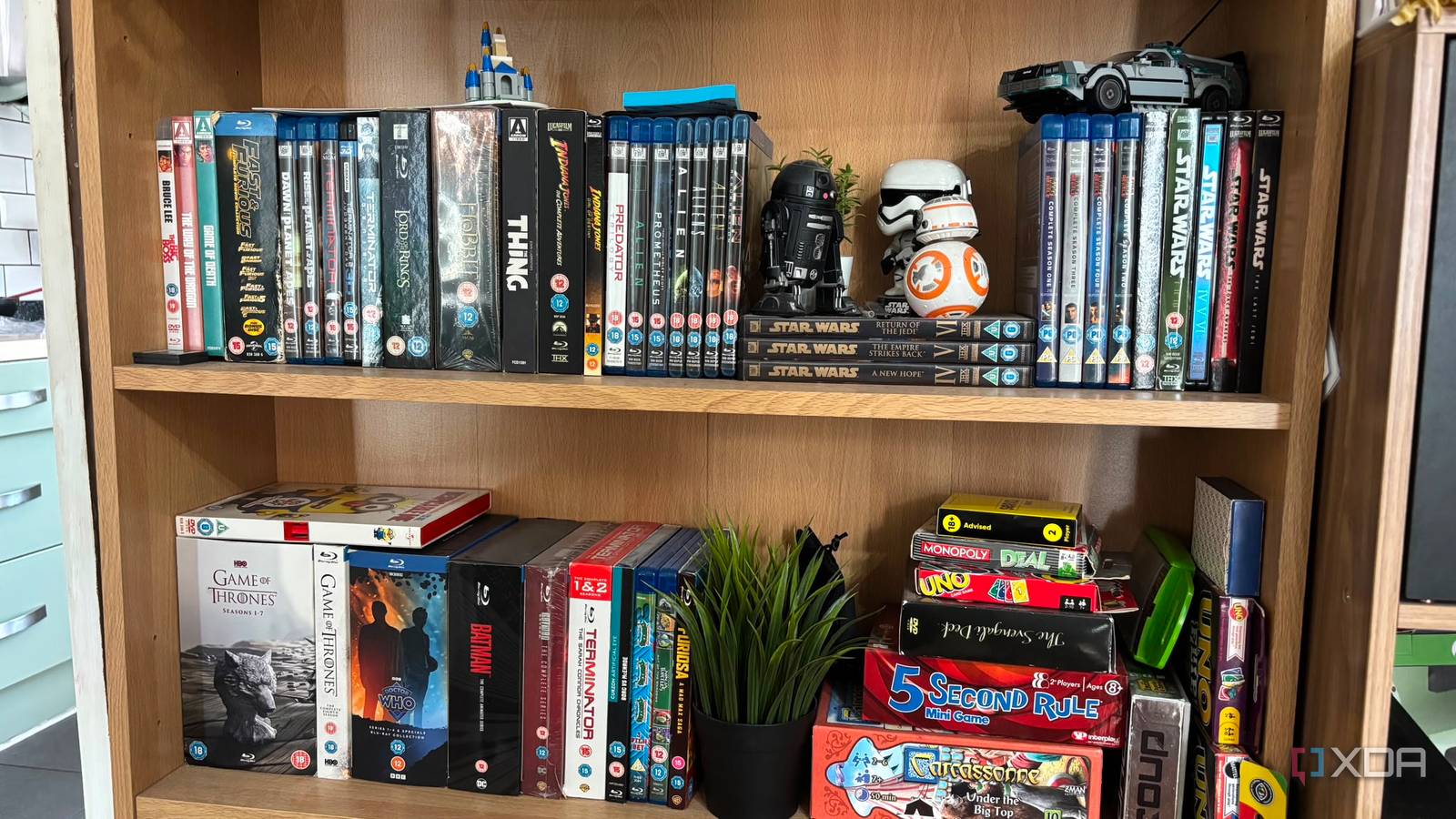
Published Jul 28, 2026, 4:30 PM EDT Jeff's been involved in the IT industry since before the Internet and spent more than 20 years working in technical support, system administration, network administration, and consulting roles. He holds an undergraduate degree in English, a Master's degree in English with a focus on professional writing and editing, and another Master's degree in Computing & Information Systems. After teaching university English and computer science for a few years, Jeff launched his writing career. He's written for Macworld, Tom's Hardware, groovyPost, The Mac Observer, and more before beginning here at XDA. I’d always assumed the eventual replacement for 4K Blu-ray would be easy to recognize. It would arrive with a new logo, a higher resolution nobody had asked for yet, and an expensive first-generation player. Instead, researchers have demonstrated an optical disc that can theoretically hold around 200TB, and movies aren’t even the main reason it exists. The technology is being developed for data centers and archival storage, but it also points toward a version of physical media I’d find far more useful than another resolution bump. This disc makes 4K Blu-ray capacity look tiny Hundreds of recording layers change what one disc holds A triple-layer 4K Blu-ray holds up to 100GB, which is usually enough for a high-bitrate movie, multiple audio tracks, subtitles, menus, and a decent collection of extras. That sounds generous until it’s placed beside this experimental format. The researchers’ disc has a theoretical capacity of 1.6 petabits, or roughly 200,000GB. One of these could hold as much data as around 2,000 of the largest commercial 4K Blu-ray discs. The roughly 200TB capacity comes from a laboratory demonstration, not a finished disc you can buy or use in a standard Blu-ray player. Any commercial version could have a lower capacity once cost, manufacturing, reliability, and read speeds are taken into account. The jump comes from using hundreds of recording layers inside the disc rather than the handful found in existing optical media. The researchers also created much smaller data spots, packing far more information into each layer without making the disc physically enormous. That last part is what got my attention. What really caught my eye is that all of that capacity fits into a disc roughly the same size as the optical media we already use. The movie estimates quickly become ridiculous, although they help explain the scale. Depending on bitrate and compression, a single disc could theoretically store more than 14,000 4K movies. I don’t own anything close to that many, and I’m not sure I could name 14,000 movies without repeating several. A reduced consumer version holding a few dozen or a few hundred full-quality titles would still feel transformative. Physical movie collections could become much easier to manage One durable archive could replace shelves of separate cases The part that interests me isn’t really the prospect of owning one impossibly large disc. It’s what that capacity could do to the awkward physical side of owning media. A large collection means shelves, cases, boxed sets, duplicate editions, and a filing system that works until somebody puts one disc back in the wrong case. Physical ownership is dependable, but it gets messy once the collection needs its own furniture. That’s one reason so many people rip their discs to a media server. The disc remains the purchased copy, while the server provides the interface people actually want to use. Titles are searchable, posters appear in a grid, and nobody has to remember whether a movie was filed under the franchise name or its actual title. It works well, but it also requires storage space, ripping time, backups, and occasional metadata cleanup. A high-capacity optical format could merge those two experiences instead of forcing people to build the bridge themselves. Insert one disc and the player can present a browsable library containing dozens of complete movies, audio tracks, commentaries, and extras. Collectors could still buy steelbooks and limited editions, while ordinary releases became more compact. It wouldn’t make physical media as immediate as streaming, but it would remove one of the irritations that makes streaming feel easier. This technology probably wasn’t designed for your television Data centers need dense offline storage more than movie collectors The catch is that nobody involved appears to be building this as the next home-video format. The research is aimed at archival storage, particularly the enormous amount of data being produced and retained by modern data centers. Those facilities care about density, power use, floor space, and how long information can sit untouched without degrading. Whether the disc remembers where I stopped watching isn’t high on the list of requirements. Optical media has some real advantages for that work. Once written, a disc can sit offline without drawing power, producing heat, or depending on a drive that remains active around the clock. Keeping data disconnected also limits what ransomware, user error, or a badly behaved script can reach. Retrieval may be slower than pulling files from active storage, but archival data often doesn’t need to appear instantly. The reading and writing equipment is also nowhere near ready for a living-room shelf. The system relies on specialized lasers, precise optics, and recording materials that aren’t found in current Blu-ray players. Manufacturing may eventually borrow from existing disc production, but companies can’t simply install a different laser in a current player and call the job finished. There’s a wide gap between proving the storage method works and selling a quiet, reliable player at a reasonable price. The next disc format may solve ownership, not resolution Better physical media doesn’t need another pixel-count upgrade What I like about this research is that it suggests a different definition of progress for physical media. I’m not waiting for 8K Blu-ray, particularly when many movies are still finished using lower-resolution digital intermediates. Another jump in pixel count would be difficult to notice in many living rooms and even harder to justify once hardware prices are revealed. A consumer version wouldn’t need the full 200TB capacity, either, because even two or three terabytes could hold a substantial library of full-quality films. Studios might not be thrilled about selling that much content on one disc. A complete franchise, director collection, or studio archive would create licensing questions, navigation problems, and awkward pricing decisions. Companies also have little incentive to sell a single compact, permanent library when they can spread the same movies across individual releases and streaming subscriptions. The storage technology may be complicated, but the business model would probably be the harder part. A writable version could still be useful even if Hollywood ignored it completely. Large optical discs would make sense for offline copies of personal photos, finished projects, media libraries, and backups that don’t need to remain connected to a NAS. I wouldn’t use optical media as active storage or update the archive every afternoon. For a periodic backup that can be labeled, stored safely, and left unplugged, though, the appeal is easy to understand. Blu-ray’s real successor could arrive without replacing it 4K Blu-ray isn’t suddenly obsolete because a laboratory disc can hold 200TB. The current format already delivers excellent video and audio; its players are established; and this new storage method is still in research rather than a retail product. It may never become a consumer movie format at all. Even so, it makes the repeated claims that optical media has reached a dead end look premature. The capacity number is impressive, but it isn’t the part I keep coming back to. What matters is that a future disc could improve ownership rather than simply adding another badge to the case. It could hold a meaningful library, remain offline when unused, and provide the permanence of physical media without demanding an entire wall of storage. That isn’t the Blu-ray successor I expected, but it’s the first one that sounds genuinely useful.
4K Blu-ray already has a successor, and it isn't what I expected
Full Article
Original Source
Read the full article at Xda-developers →KhanList aggregates and links to publicly available news content. We do not host full articles from third-party sources. Always verify important information with original sources.