
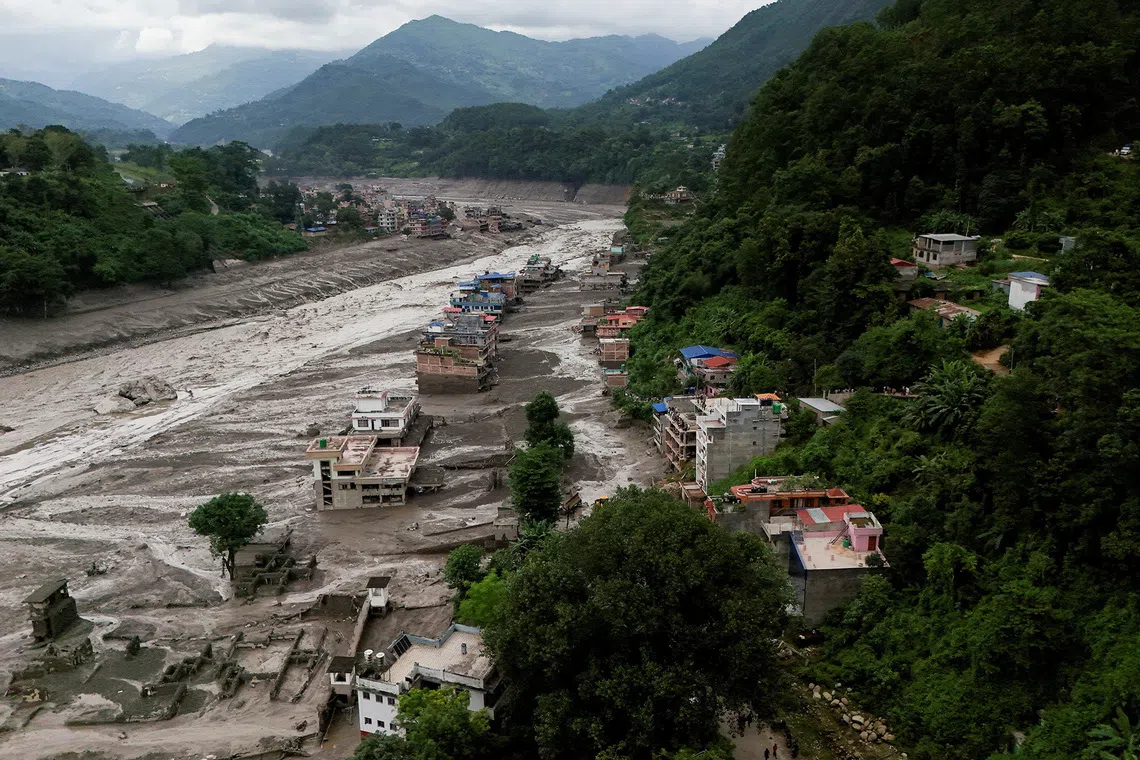
Follow our live coverage.KATHMANDU - At least 160 people have been killed in Nepal after a sudden wall of water and debris tore through the Bhote Koshi river corridor, bringing Nepal’s wider exposure to Himalayan flood disasters into sharp focus.Hundreds remained missing after the flood struck settlements near the Nepal-China border and swept downstream through three districts. The disaster also destroyed bridges, hydropower facilities, roads and other public and private property.The latest flood was probably triggered by an ice-and-rock avalanche from a glacier on the Nepal side, according to an initial assessment cited by the International Centre for Integrated Mountain Development.The avalanche is believed to have blocked the Lhende Khola, a tributary of the Bhote Koshi. The obstruction subsequently released a sudden surge downstream.The emerging evidence does not establish that one of Nepal’s identified potentially dangerous glacial lakes burst. The disaster nevertheless illustrates how events high in the Himalayas can strike downstream settlements with little warning.Nepal flood struck without rainfall warningThe flood first hit Timure near Rasuwagadhi on the morning of Aug 26 before surging through the Bhote Koshi and into the Trishuli river system.No rainfall had been reported in the affected area. Residents were therefore carrying on with their daily routines when the torrent arrived.Hydrological observations showed the exceptional speed and scale of the flood wave. Water in the Trishuli rose by as much as nine metres within half an hour at one stage, ICIMOD experts said.Tourists, local residents and security personnel were among those reported missing. Search, rescue and relief operations continued as authorities tried to establish the full human and physical toll.At least 19 bridges and stretches of road were swept away. Hydropower projects and government and security installations were also hit.47 glacial lakes classified as potentially dangerousBeyond the immediate disaster, an ICIMOD–UNDP inventory has identified 47 potentially dangerous glacial lakes across the Koshi, Gandaki and Karnali river basins.Twenty-one of those lakes are in Nepal. Another 25 are in the Tibet Autonomous Region of China, and one is in India.Their location matters because several sit at the headwaters of river systems flowing through Nepal. A breach outside the country can consequently place Nepali settlements and infrastructure downstream at risk.The Koshi basin contains 42 of the 47 potentially dangerous lakes. Three are in the Gandaki basin and two in the Karnali basin.The lakes were classified by studying the condition of their natural dams, the activity of their source glaciers and the surrounding terrain.Four Nepal glacial lakes prioritised for urgent workNepal’s Department of Hydrology and Meteorology and the United Nations Development Programme have prioritised Thulagi, Lower Barun, Lumding Tsho and Hongu 2 for risk-reduction work.Plans include lowering water levels at the four lakes and expanding monitoring and early-warning systems.Thulagi lies above the Marsyangdi basin in Manang. Lower Barun is in Sankhuwasabha, while Lumding Tsho and Hongu 2 are in Solukhumbu.Nepal has previously carried out risk-reduction work at Tsho Rolpa and Imja Tsho.Cross-border lakes complicate Nepal’s flood defencesThe location of 26 of the 47 potentially dangerous lakes outside Nepal makes monitoring and disaster preparation a transboundary challenge.Rivers originating in or near the Tibetan plateau run through steep valleys towards communities, roads, border facilities and hydropower projects in Nepal. A sudden release upstream can leave people downstream with little time to escape.The Bhote Koshi disaster has now supplied a devastating reminder of that vulnerability. Although its probable trigger was an avalanche rather than a confirmed glacial lake outburst, both hazards can unleash destructive surges through the same mountain river corridors.The tragedy has made monitoring, early warnings and cross-border sharing of information an immediate concern rather than a distant environmental debate. THE STATESMAN/ASIA NEWS NETWORK
47 potentially dangerous glacial lakes pose risk to Nepal’s river corridors as Himalayan hazards back in focus
Full Article
Original Source
Read the full article at Straitstimes →KhanList aggregates and links to publicly available news content. We do not host full articles from third-party sources. Always verify important information with original sources.