
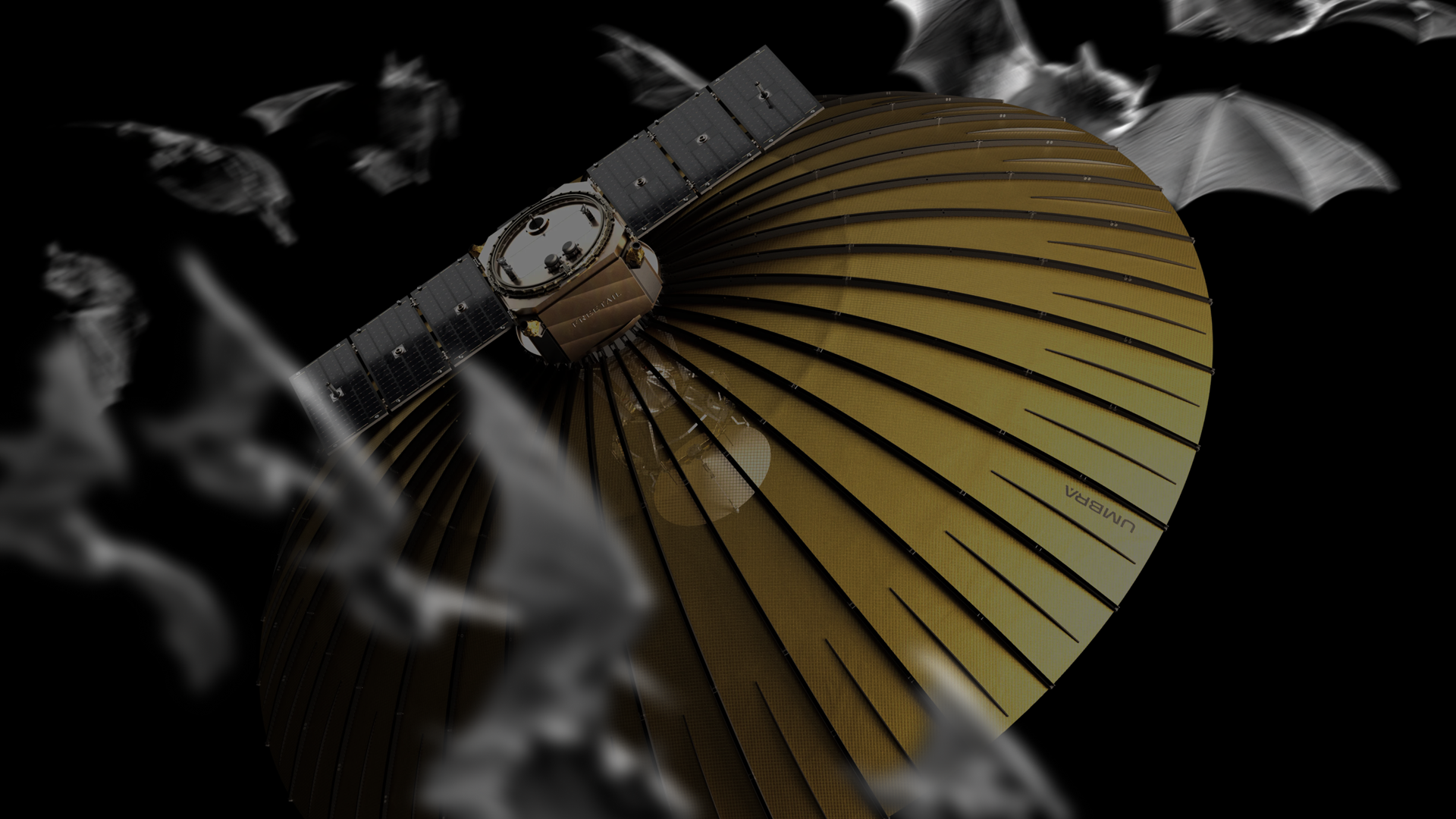
Umbra's Freetail 5 satellite with its giant deployable radar antenna.UmbraKey TakeawaysFreetail 5 combines a 5-metre mesh radar antenna with a 200-kg-class spacecraft.The satellite is designed to capture hundreds of 25-cm images daily, with resolution extending to 5 cm.Umbra is targeting launch readiness in early 2028, with commercial availability by midyear. US space technology company Umbra has unveiled a next-generation radar satellite designed to capture images of Earth’s surface at resolutions as fine as 5 centimeters from orbit. Called Freetail 5 (FT-05), the spacecraft combines a 5-meter high-gain mesh antenna with a software-defined architecture on a satellite weighing approximately 200 kilograms. The company said the system is designed to deliver radar imaging capabilities traditionally associated with much larger spacecraft. The satellite is part of Umbra’s new Freetail family of US-built, multi-mission spacecraft. It features four times the radar power and twice the antenna area of the company’s existing technology, with 20 square meters of deployed antenna area. According to Umbra, the system can produce hundreds of high-quality images at 25-centimeter resolution per satellite each day, with imaging capabilities extending to 5 cm. Its radar payload can also be configured with up to 4 GHz of imaging bandwidth. The first spacecraft is expected to be ready for launch in the first quarter of 2028, with commercial availability targeted for midyear. Radar satellite targets intelligence Unlike conventional optical satellites, synthetic aperture radar (SAR) systems can image the Earth’s surface at night and through cloud cover. This makes them valuable for monitoring locations where darkness, weather or atmospheric conditions can limit conventional satellite imaging. Umbra said Freetail 5 is designed for US and allied defense, intelligence and advanced research missions. Its applications include high-resolution imaging, maritime surveillance, environmental monitoring, disaster response and scientific research. The spacecraft will support single-, dual-, and quad-polarisation image products and operate in both polar and mid-inclination orbits. This is intended to provide global access and more frequent imaging over priority regions. The satellite will also support advanced capabilities such as formation flying, multistatic imaging, single-pass 3D imagery and direct-to-theater data transmission. These features could allow multiple spacecraft to work together to improve imaging and geolocation capabilities. Umbra also plans to support coherent change detection, a technique that compares radar observations to identify subtle changes on the ground. The company says its system can detect changes at sub-centimeter scales. US-built satellite expands capabilities Freetail 5 is being manufactured at Umbra’s 50,000-square-foot facility in Goleta, California. The company said the spacecraft features 100% Umbra-developed flight software and 90% Umbra-built components, representing the highest level of in-house manufacturing integration for one of its satellites. Its bus architecture has been refined over 14 missions and uses selective redundancy across critical subsystems. The spacecraft is also designed to accommodate dedicated launches and rideshare missions through US and international launch providers. “With four times the radar power, twice the antenna area, and hourly global revisit, Freetail 5 is designed to collect more across greater areas to deliver unprecedented operational value,” said David Langan, CEO of Umbra. The company plans to launch the first Freetail 5 spacecraft in early 2028, followed by a larger constellation.With the new platform, Umbra aims to expand the range of missions its satellites can perform while increasing the imaging capabilities of its existing SAR technology.Get the latest in engineering, tech, space & science - delivered daily to your inbox.With over a decade-long career in journalism, Neetika Walter has worked with The Economic Times, ANI, and Hindustan Times, covering politics, business, technology, and the clean energy sector. Passionate about contemporary culture, books, poetry, and storytelling, she brings depth and insight to her writing. When she isn’t chasing stories, she’s likely lost in a book or enjoying the company of her dogs.
441-lb radar satellite aims to capture sharper 5-cm images through clouds and darkness
Full Article
Original Source
Read the full article at Interestingengineering →KhanList aggregates and links to publicly available news content. We do not host full articles from third-party sources. Always verify important information with original sources.