
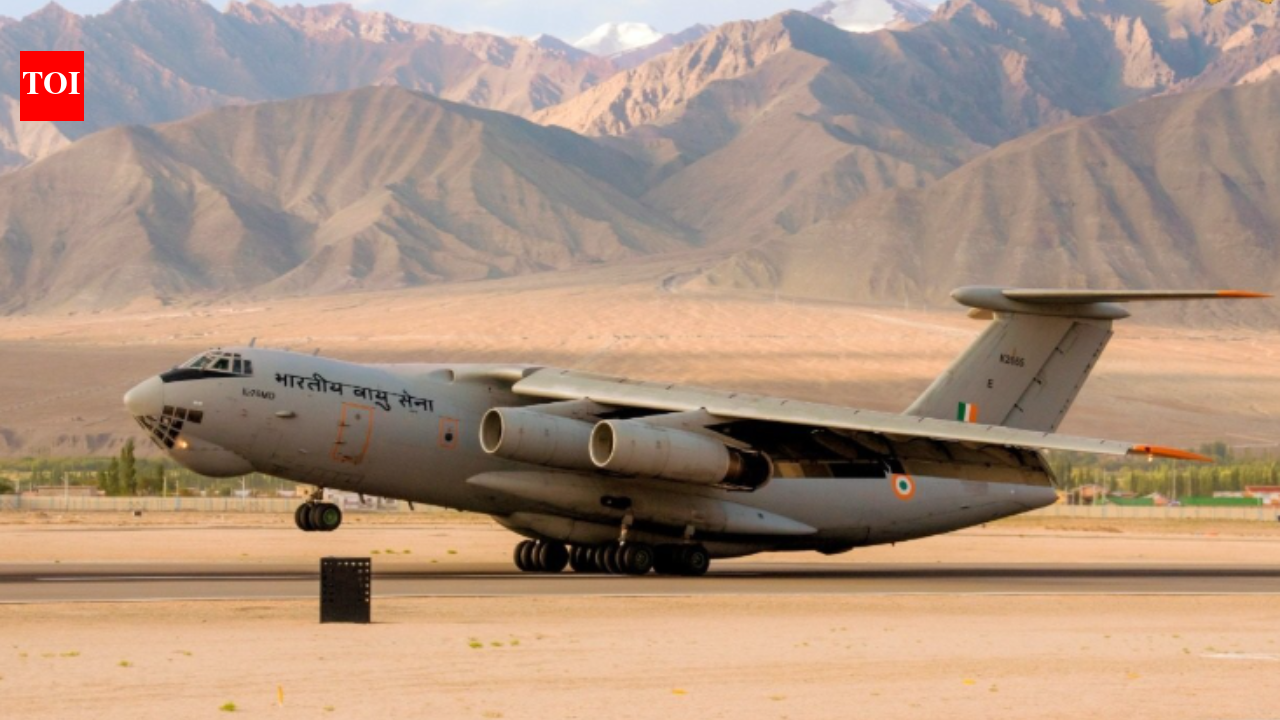
An Il-76 of the IAF lands at the Leh airfield, which is located at an altitude of 10,000 ft. (Image credit: IAF)When the Indian Air Force (IAF) announced on November 7 that an IL-76MD had landed at Nyoma in eastern Ladakh at 13,629 feet, marking the highest-altitude landing by the aircraft type anywhere in the world, the message was about capability. The airfield is around 25 km from the Line of Actual Control (LAC), and the landing demonstrated that India's largest Russian-origin military transport aircraft can still operate close to the frontier.The Gajraj: IAF's heavy-duty workhorseThe IL-76MD, known in the IAF as the Gajraj, was inducted on June 16, 1985, with No. 44 Squadron. India acquired 17 aircraft between 1985 and 1989.It was used in Operation Pawan in Sri Lanka and Operation Cactus in 1988, when it flew paratroopers to the Maldives. It also served during the Kargil conflict, evacuations from crisis zones, Covid-19 supply missions and disaster relief operations overseas.After the Galwan clash, the IAF airlifted more than 68,000 troops, around 90 tanks and nearly 330 infantry combat vehicles. However, the operation also involved C-17 and C-130J aircraft, so the IL-76 cannot take credit for the entire effort.The availability problemThe IL-76 can carry around 40 to 45 tonnes, but that capability depends on keeping the aircraft operational.In a 2017 report, the Comptroller and Auditor General (CAG) found that the fleet's average serviceability between 2010-11 and 2015-16 was just 37.99%, against the IAF's target of 70%.The lowest annual figure was 32.16% in 2010-11, which is the source of the often-quoted claim that barely one-third of the fleet was serviceable. However, this is a historical figure, not a measure of the fleet's current condition. An updated serviceability figure for 2026 could not be independently verified from publicly available information.Spares were the main problem. After the Soviet Union collapsed, the supply chain became fragmented. Fewer than 11% of spare-parts demands were met within 15 days, while more than 22% took over six months.A long-term maintenance agreement with Ilyushin, proposed in 2011, had still not been processed by April 2017. The fleet was subsequently reported to comprise 14 aircraft, primarily based with No. 44 Squadron.What nextIn 2024, the IAF issued a request for proposal to Russia's National Aviation Service Company to assess 11 IL-76MD aircraft and examine whether their operational lives could be extended from 2035 to 2050.The assessment also included the possibility of replacing their existing engines with PS-90A engines and upgrading their avionics. However, the proposal was for a feasibility assessment, not an approved modernisation programme.The IAF's plans to acquire medium transport aircraft in the 18-30 tonne category could replace some of the IL-76's transport roles, but these aircraft would not fully match its heavy-lift capability. The IAF also operates a fleet of just 11 C-17 Globemaster III aircraft.The challenge is no longer just to keep the IL-76 flying. It is to preserve the heavy-lift capability it provides until a suitable replacement is ready.
40 years, a world record, but an uncertain future: What's next for IAF's IL-76?
Full Article
Original Source
Read the full article at Timesofindia →KhanList aggregates and links to publicly available news content. We do not host full articles from third-party sources. Always verify important information with original sources.