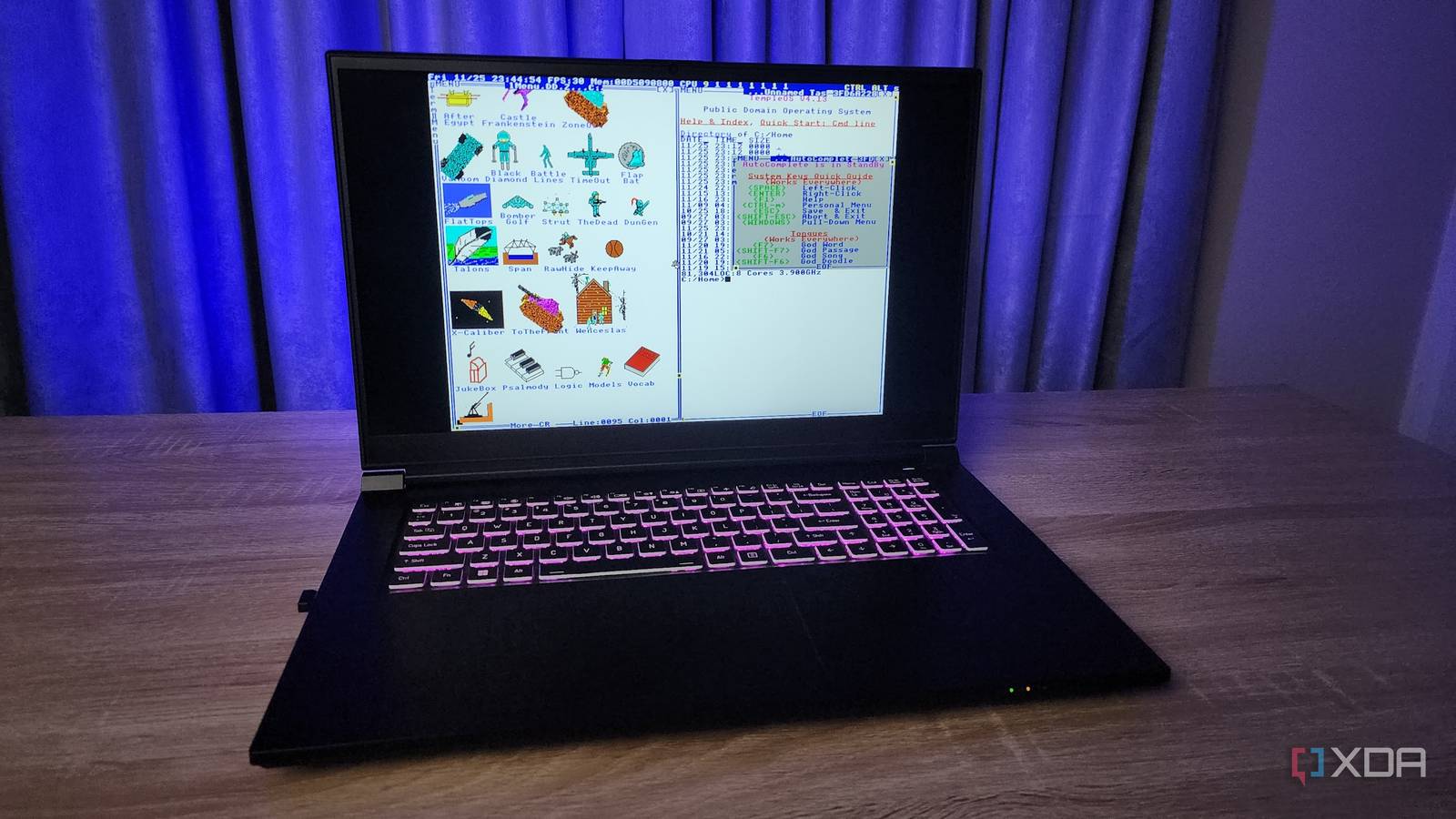
Published Aug 8, 2026, 12:30 PM EDT His love of PCs and their components was born out of trying to squeeze every ounce of performance out of the family computer. Tinkering with his own build at age 10 turned into building PCs for friends and family, fostering a passion that would ultimately take shape as a career path. Besides being the first call for tech support for those close to him, Ty is a computer science student, with his focus being cloud computing and networking. He also competed in semi-pro Counter-Strike for 8 years, making him intimately familiar with everything to do with peripherals. It's a pretty safe assumption to say that virtually all devices that you've owned in the last 20 years have descended from one of the big three operating system families: Windows, Linux, or Unix. Your Mac is basically just BSD underneath, your Windows laptop traces back to Windows NT, your PS5 has roots in FreeBSD, and your router is probably some flavor of Linux. Even the systems marketed as alternatives are usually Unix in a different hat. There are, however, a handful of operating systems that grew from entirely different roots, and several of them can boot on hardware that you already own. Most of them are far from practical for a number of reasons, but they're incredibly fascinating examples of what an operating system can be when you stray from the most-trodden path. Haiku carries BeOS forward An OS you can still run on today's hardware Credit: Source: Haiku OSCredit: Source: Haiku OSCredit: Source: Haiku OS Be Inc. built BeOS from scratch in the 1990s as a media-focused desktop system, and when the company folded, volunteers began rebuilding it. Haiku is the result of all of that work, and its kernel is based on NewOS rather than anything in the Unix universe. It is, by some margin, the most useable system in this list, as it features a package manager, native browser, Wine port, and its current builds run on conventional x86 hardware. It does, however, implement POSIX in addition to networking drivers from FreeBSD through a compatibility layer. The base is still very much its own, but standards have to start and end somewhere, and they clearly opted to draw the line there. The Amiga family runs through Cambridge And is surprisingly still alive At its core, AmigaOS is two things bolted together, with its kernel and process layer coming from two different places. The kernel, Exec, was written independently by Carl Sassenrath and runs unprivileged, with kernel code executing in user mode normally. This is something virtually no operating system does. The disk and process layer, AmigaDOS, comes from TRIPOS, which is a portable OS that came out of the University of Cambridge in the 1970s that was later adapted for the Commodore. At the time, TRIPOS was marketed as an alternative to Unix, which should show you how different the lineage really is. When it all shook out, three branches survived. AROS is open source, runs on x86, and is source-compatible with AmigaOS 3.1 without being binary-compatible, so old Amiga software needs recompiling rather than just running. MorphOS is another branch that is proprietary and unusually alive, with its last version update coming in May 2026. Its supported hardware list is largely 20+ year-old Apple machines like the G4s. AmigaOS itself is at version 4.1, and is available commercially on PowerPC. KolibriOS fits a graphical desktop on a floppy disk An impressive achievement KolibriOS is written entirely in FASM assembly, and the entire system from the graphical desktop, preemptive multitasking, TCP/IP stack, and bundled applications fit on a 1.44MB floppy. It forked from MenuetOS in 2004 and stayed as a 32-bit open-source variant, while the former went 64-bit and proprietary. It's definitely not a toy, but it's not a daily driver either. The browser struggles with anything that's not purely HTTP and raw text. It's nothing more than an interesting relic as of now. TempleOS The OS that God built* TempleOS is a pretty incredible piece of software. It's x86-64, ring-0 only, single address space, non-preemptive, and is not networked. There is no separation between kernel and user code, no memory protection, and no virtual memory, with graphics fixed at 640×480 resolution and 16 colors. It's written in HolyC, a just-in-time compiled C variant that Terry A. Davis, the creator of TempleOS, designed himself that doubles as the system shell. It also uses RedSea, a filesystem he wrote himself. Version 5.03, released in November 2017, is the last official release. Davis built the entire OS alone over the better part of a decade, and he claimed that part of the design came down to religion rather than technical nature. He described the decisions he made in regard to the OS as instructions he received from God. Davis also unfortunately suffered from schizophrenia, and died in 2018. What remains is one of the few complete operating systems in existence with a single author, and it still boots in a virtual machine. These types of operating systems are becoming increasingly rare There's a reason the industry consolidated around the main lineages we have today, and most of it is good. The shared APIs and portable software create a labor market and an audience that mostly knows the same tools. As a consequence of that, we also lose the uniqueness that operating systems once had. It's also clear if you spend any amount of time with any of these in a virtual machine, because while they are fascinating, they're not practical in this age of computing.
4 operating systems that owe nothing to Windows, Linux, or Unix
Full Article
Original Source
Read the full article at Xda-developers →KhanList aggregates and links to publicly available news content. We do not host full articles from third-party sources. Always verify important information with original sources.