
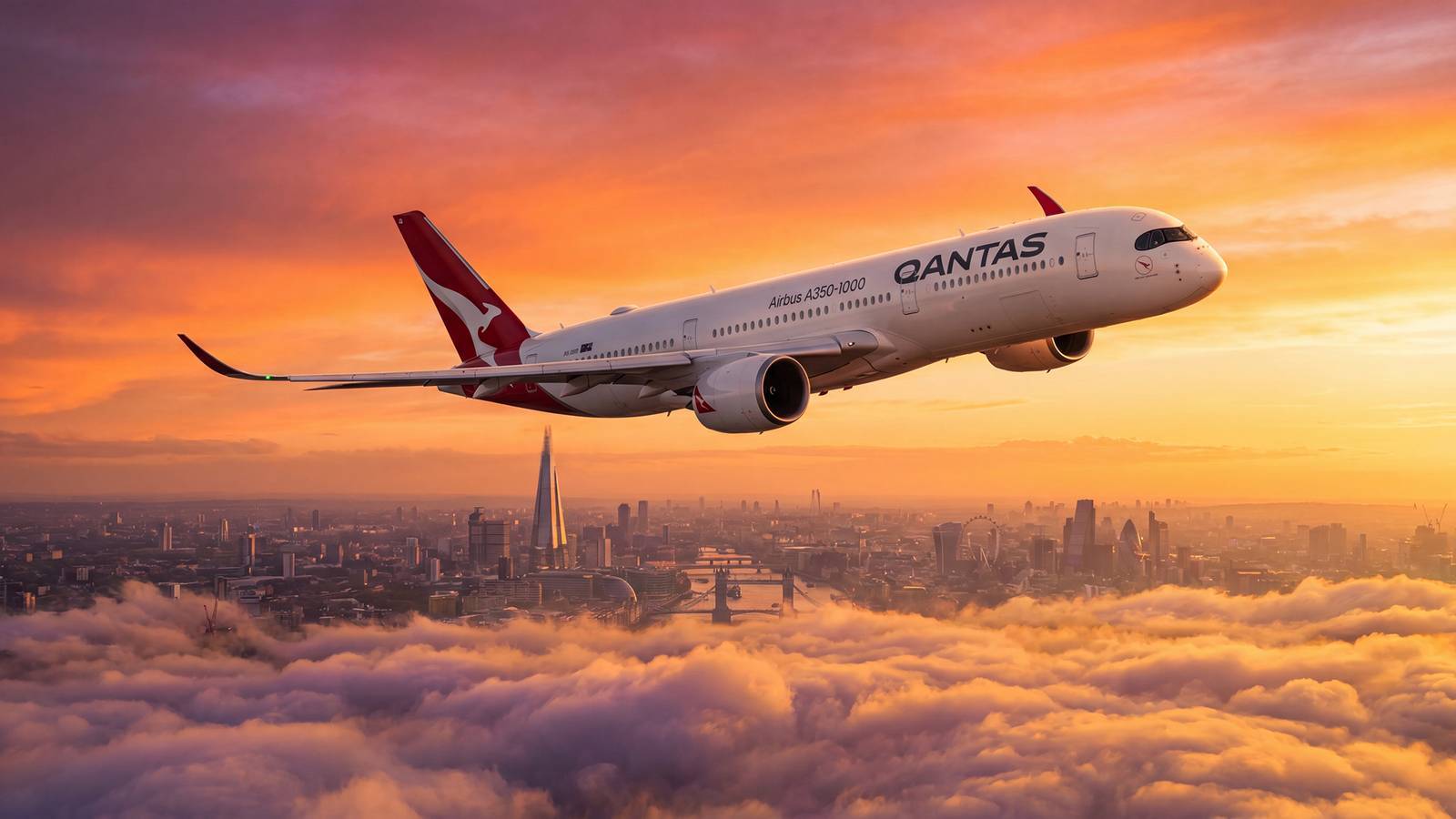
Published Nov 13, 2026, 7:00 AM EST Louis is a military historian and the staff writer for History of War magazine, a leading military history monthly. He also has an interest in private and commercial aviation. Well over 20 hours on a single flight sounds like hell to a lot of passengers. But enduring this will be necessary for those wishing to use Qantas Project Sunrise flights, which are set to begin in 2027 with services from Sydney Kingsford-Smith Airport (SYD) to London Heathrow Airport (LHR). Qantas will also demand a premium, arguing that passengers can expect to save around four hours and avoid the hassle of an international transfer. Despite the clear difficulties that Project Sunrise could pose, particularly for economy class passengers, Qantas is banking on its success. Airways Magazine reports that the airline expects to add AU$400 million ($274 million) in earnings before interest and tax through the services. High demand will be vital to secure such positive results, particularly given that challenges such as high fuel costs, a weakened Australian dollar and higher labor and airport costs have emerged since 2022. Project Sunrise Offers Significant Time Savings Project Sunrise's opening route will be between SYD and LHR, a mammoth route of approximately 9,188 nautical miles (17,000 km). Traveling from Britain to Australia currently usually requires a change, which is often in Singapore or the Middle East. Such stopovers make the route longer, and passengers also have to waste time on the ground. It is expected that Project Sunrise flights will take around 21 hours and 40 minutes. This will save approximately four hours. In return for the time savings and the unique nature of this flight, Qantas expects to receive a 20% higher Revenue per Available Seat Kilometer (RASK) compared with comparable one-stop itineraries. When it arrives in 2027, Project Sunrise will overtake Singapore Airlines Airbus A350-900ULR flights as the world's longest. That will secure Qantas' position as the leading premium airline in Australia and a key player among the airlines that offer ultra-long-haul flying. However, regardless of the added convenience, some passengers will struggle with being on an aircraft for over 20 hours, while others will find the higher price off-putting. It Will Be Most Appealing To Passengers Who Can Afford Premium Travel Credit: Qantas 41% of seats will be in premium cabins, versus 30% in premium cabins for Qantas' Boeing 787-9 and Airbus A380, Airways Mag reports. These seats are divided between first, business, and premium economy class. Such a high number of premium seats takes inspiration from Singapore Airlines' A350-900ULRs, which are exclusively fitted with premium economy and business class seats. It's not surprising that Qantas expects these products to be popular, given that a flight of over 20 hours will give passengers the opportunity to take advantage of the luxury. The table below uses Qantas' data to show the key specifications for the A350-1000ULR. It covers both the aircraft itself and the four cabins onboard. Wingspan (64.75 m) Length (73.79 m) Cruising speed Mach 0.85 Estimated range 9,700-10,000 nautical miles (18,000-18,520 km) Total seats 238 First suites 6 Business suites 52 Premium Economy seats 40 Economy seats 140, of which 42 are Qantas Economy Plus The ultimate in luxury comes from first class, a product that Singapore Airlines has skipped on its A350-900ULR. These six suites are distinguished from business class by a separate armchair and a true flat bed, rather than one that reclines. This class also has a huge entertainment screen, along with a flexible space for eating and working with up to two guests. Behind first class is an enormous 52-seat business class cabin. The suite has a privacy door and totals 42 inches (100 cm) wide. At 80 inches (2 m), the flat bed is one inch (2.5 cm) longer than what Qantas offers on its Airbus A380 business class product. All but the very tallest of guests should find this roomy enough. Finally, customers can choose from within a 40-seat premium economy cabin. These seats are in a 2-4-2 configuration and have 40 inches (100 cm) of pitch. Australian designer David Caon says that “the Premium Economy cabin has been redesigned from the ground up with a focus on ergonomics, entertainment and privacy.” The new headrest wings are the biggest visible difference and will provide passengers with both additional support and a sense of privacy without isolating them from travel companions. Economy Class Could Make For A Brutal Experience Credit: Qantas The main reason that Qantas could fail is an inability to sell economy class seats. Many passengers on a budget would rather take the hit of a longer total travel time for the chance to stretch their legs during a one-stop itinerary. Before the ongoing crisis in the Middle East, it was also popular to use the stop as an excuse to enjoy a short vacation in the region, such as in Dubai, before the main trip to Australia or the United Kingdom. Qantas hopes it can sway wary passengers through a high-quality economy class product. The cabin has 140 seats, with 42 in Economy Plus. These seats are in a 3-3-3 configuration. A relatively generous 33 inches (83.8 cm) of pitch was initially promised, although Qantas has now backtracked to saying the pitch will vary in different parts of the aircraft. Class Seat pitch Seat width Entertainment touchscreen size First class 80 inches (200 cm) flat bed 22 inches (56 cm) in the separate reclining armchair 32 inches (81 cm) Business class 80 inches (200 cm) flat bed 25 inches (64 cm) wide flat bed and seat 18 inches (46 cm) Premium economy class 40 inches (102 cm) Unknown 13.3 inches (34 cm) Economy class 33 inches (84 cm) Unknown 13.3 inches (34 cm) A six-way adjustable headrest gives a greater degree of customization compared to what you can usually expect in economy class. Two fast-charging outlets per seat also means that your entertainment won't run out. Economy Plus will be broadly the same but with priority boarding and access to overhead lockers, as well as a little bit more legroom. The table above uses Qantas' data to compare the seat dimensions that you can enjoy, or suffer in, across each class. However, initial predictions are that Qantas will attract strong demand for its economy class seats aboard Project Sunrise, partly because it has intentionally produced a small economy class cabin. Executive Traveller's case study predicts a load factor of 85%. This is lower than what is expected in the premium classes, but still more than enough to sustain the service. The Wellbeing Zone Alters The Ultra-Long-Haul Economy Class Equation Credit: Qantas Regardless of the quality of the economy class, you would still be spending over 20 hours in a seat designed for affordability rather than comfort. Some airlines that fly ultra-long-haul routes are getting creative, such as United Airlines' Relax Row, which makes lying flat in economy class possible. The Australian carrier's answer to make such a long time in economy class possible is its Wellbeing Zone, which is available to both economy and premium economy class passengers. Qantas calls it "an on board destination to promote movement, stretching and hydration throughout your flight." Within the Wellbeing Zone, you'll find a selection of beverages and refreshments available through self-service. The area will also have monitors to guide you through movements, ensuring you can stay mobile during the flight. "Sculpted surfaces and integrated handles" will also facilitate stretching. Qantas Group Chief Executive Officer Alan Joyce said that: “Fewer seats translate to more space for each customer and a dedicated Wellbeing Zone for travellers to stretch, help themselves to a snack and spend time out of their seat. We are the only airline in the world that will have a bespoke designed onboard stretch and movement space,". Qantas' Investment Means That Project Sunrise Has To Succeed Credit: Qantas Qantas has made a vast investment to order 12 bespoke A350-1000ULR aircraft that will carry out the services. However, it is also investing time and personnel to get Project Sunrise off the ground. It will train over 360 pilots and 1,200 cabin crew, or 30 pilots and 100 cabin crew per aircraft, in the unique skills required for these services. Such a substantial training operation is needed because of regulatory arrangements Qantas has made with the Civil Aviation Safety Authority, requiring far more crew members aboard every Project Sunrise flight. The Project Sunrise pilot training is occurring at a simulator in Sydney. It is Australia's first A350 simulator, which was installed ahead of the first A350-1000ULR's arrival. The first cohort has been drawn from Qantas' current A330 pilots, with 40 involved in the first wave. That decision was made because of numerous commonalities between the A350 and the A330. It's a race against time to get the crews ready for the expected first A350-1000ULR delivery in April 2027. It is currently expected that this first aircraft will fly to New Zealand to take training out of the simulator and familiarize the crew with its operations. The jet will then be pressed into regular service to the United Kingdom and, later, the US.
4 Hours Saved, 20 Hours In The Air: Will Passengers Choose Qantas’ Project Sunrise?
Full Article
Original Source
Read the full article at Simpleflying →KhanList aggregates and links to publicly available news content. We do not host full articles from third-party sources. Always verify important information with original sources.