
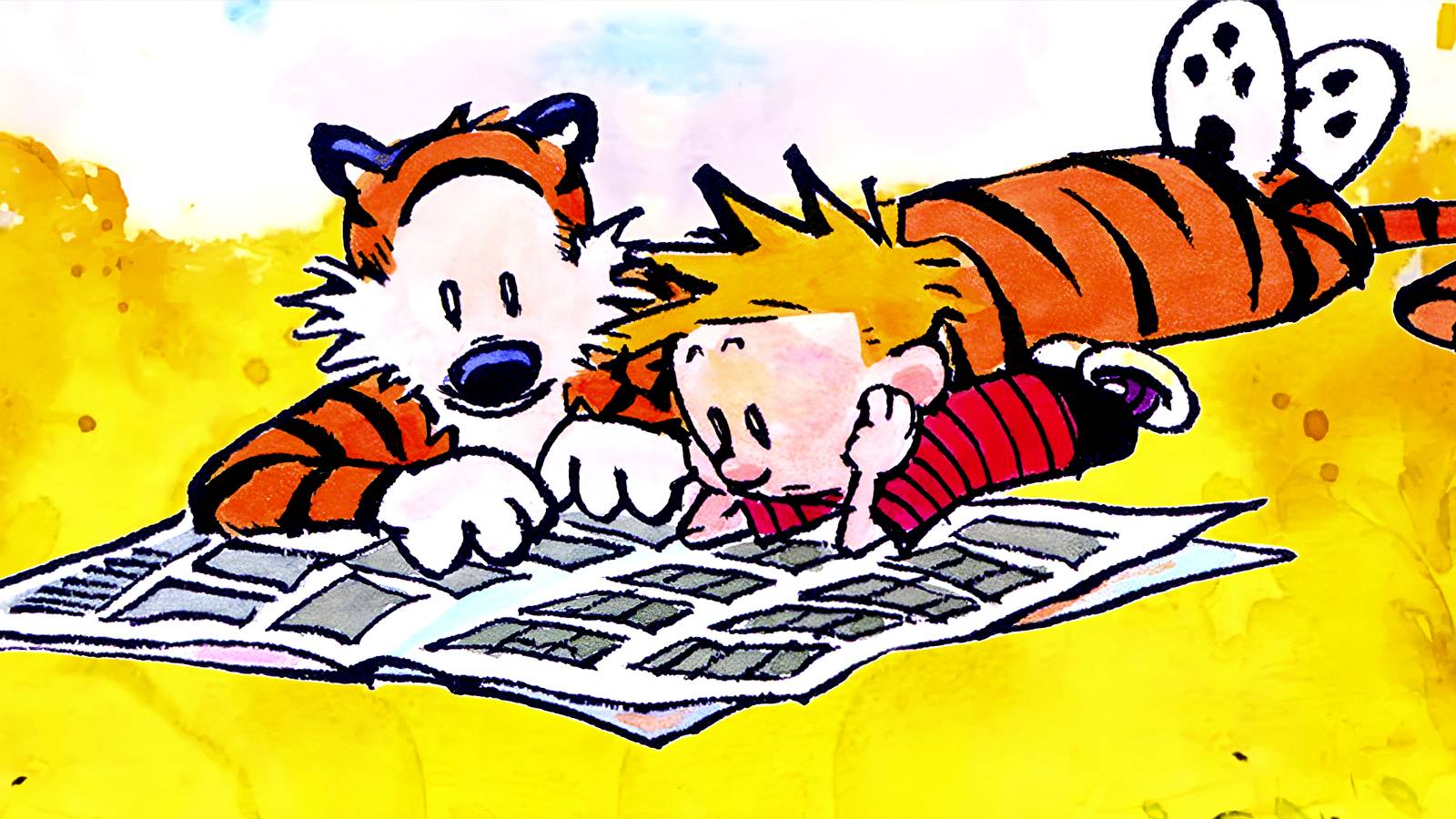
Published Aug 29, 2026, 5:00 PM EDT Nicolas Ayala is a Senior Writer for the Comics team at ScreenRant, with over five years of experience writing about Superhero media, action movies, and TV shows. The best Calvin and Hobbes strips withstand the test of time, especially when their meaning changes when seen through the eyes of an adult. The heart of Calvin and Hobbes' humor lies in the fiercely independent and rebelliously creative perspective of a child whose imagination transforms his mundane reality into an endless frontier of adventure. Calvin challenges the rigid grid of adult rules and societal expectations, and Hobbes is the living manifestation of Calvin’s pure soul. When adults look at Calvin and Hobbes, they see a regular child playing pretend with his stuffed tiger toy. From Calvin's perspective, the world is a playground for him and his loyal anthropomorphic best friend. The universe created by Bill Watterson centers almost exclusively on Calvin and Hobbes' two main characters, which mimics how children focus on their immediate personal environment. While adults remain mostly off-screen, worrying about the stressors of the larger world, Calvin centers his intense creative energy around finding an adventure in the most casual of everyday situations. The adult world is framed as a rather flat, uninspiring void of routine chores, if it's ever addressed at all. When Calvin's parents do appear in the Calvin and Hobbes comics, their idea of an adventure is almost nonexistent, even though they understand how much it means to their child. If the perpetually six-year-old Calvin had aged in real time since his first appearance in 1985, he would be forty-seven years old now. Calvin and Hobbes' readers aren't bound by comic strip rules, meaning that the way they interpret Calvin's adventures evolves with time. 4 Calvin Learns Adults Aren't Motivated By Fun Adult Life Is An Endless Pursuit Of Rewards And Good Performance If there's any activity that describes Calvin's life accurately, it's playing. Whether playing with toys, embarking on a backyard adventure with Hobbes, or simply being mischievous at school or around the neighborhood, Calvin is always motivated by the fun he can get out of anything he does. For a child, the idea of stepping into the outdoors strictly to track numbers or intentionally suffer through exhausting activities without any element of creative play seems completely alien. Hence why it's so hard for Calvin to imagine why his father would do exercise without playing a game or getting paid for it. Beyond the immediate comparison to unpaid work, Calvin's exercise talk with his father touches on a melancholic transition where adults gradually trade their innate sense of fun in exchange for valuable but monotonous self-improvement. In the adult world, actions usually lose their intrinsic value unless they're guided by measurable performance and external rewards, and as Calvin's father notes, sometimes those rewards don't even manifest. As responsibilities mount and free time becomes increasingly rare, maintaining both long-term physical health and financial stability in the long run must take priority over amusement. 3 Calvin's Questions Receive No Answers Calvin Must Keep His Complaints To Himself One day, Calvin grows tired of carrying the burden of childhood duties on his shoulders, and he starts shouting his existential school anxieties to the heavens, only to be physically launched out the front door into a snowy abyss by his mother's hands. Calvin’s concluding line captures the narrow perspective of childhood innocence, reducing his mother’s refusal to engage with his deep existential dread to a simple lack of early-morning patience. To a child, this sequence plays out as pure relatable slapstick, with a parent who acts as a grumpy authority figure unwilling to tolerate a loud whining session. When viewed through an adult perspective, however, the mother’s swift ejection of Calvin is something of a personification of life itself. Calvin's questions are valid, and they're still relatable for most adults. However, life provides no explanations or comforting reassurances when anyone, adult or child, stops to complain. The truth is that life never stops, and the world never stops moving, as difficult as those responsibilities and injustices may be. No matter how logical or technically correct someone's existential grievances might be, life ultimately forces the individual to step into the cold and keep moving forward. 2 Calvin And Hobbes Are Left Speechless By The Concept Of Mortality As Mature As They May Try To Be, Death Still Affects Calvin And Hobbes Calvin and Hobbes' encounter with a dead bird tackles the heavy existential realization of mortality. Confronted by the sudden corpse of a small bird that probably hit a window, Calvin and Hobbes immediately pivot from their usual chaotic play to engage in an uncharacteristically mature dialogue about the fragile nature of life. Calvin and Hobbes have an uncharacteristically serious talk about the bittersweet idea that life is precious precisely because it's brief. But even though they attempt to vocalize complex adult concepts, their experience ultimately leaves them entirely speechless and deeply thoughtful for the rest of the day, lying under a tree, watching the rest of the living birds. The resonance of Calvin and Hobbes' first encounter with death may change dramatically depending on the age and life experience of the person reading it. To a young child, a bird's accidental death may be the saddest part of the strip, and Calvin and Hobbes' conversation can be a first lesson on the true value of life. When an adult revisits these exact same panels, they may recognize that growing up provides absolutely zero clarity or reassuring answers to Calvin’s existential questions, and that adults are often just as confused, frightened, and prone to taking the miracle of life for granted as the little boy pondering under the tree's shadow. 1 Calvin's Father Enjoys A Break From Work To Play With Calvin Above All, Calvin's Parents Love Him A masterful exercise in silent storytelling, one of Calvin and Hobbes' most emotional strips captures a rare instance where the fluid magic of childhood triumphs over the confines of adult obligations. Bill Watterson crafts a dialogue-free sequence of panels that isolates the father at a cramped wooden desk, completely buried under towering stacks of paperwork. After rejecting his son's invitation to play, dad realizes that work can wait, and he enjoys a nice time playing in the snow with Calvin. The cherry on top is the last panel, where Calvin's mom lifts him up so he can kiss his dad on the forehead. To a young child reading the page, Calvin's brief time playing in the snow with his busy father might be a relatable representation of everyday life. When an adult revisits these panels, or if an older Calvin looks back on this afternoon, it's clear that a parent actively walking away from the crushing pressures of work to prioritize a brief moment of joy with their child is an exceptionally rare and beautiful act of love. The same kids wishing to spend a little portion of the day playing with their parents often become the parents who forget to take some time to create valuable family memories that last for a lifetime. Which Calvin and Hobbes strip do you find most relatable as an adult? Writer Bill Watterson Colorist Bill Watterson Publisher Andrews McMeel Publishing
4 Calvin And Hobbes Strips That Hit Way Harder When You're An Adult
Full Article
Original Source
Read the full article at Screenrant →KhanList aggregates and links to publicly available news content. We do not host full articles from third-party sources. Always verify important information with original sources.