
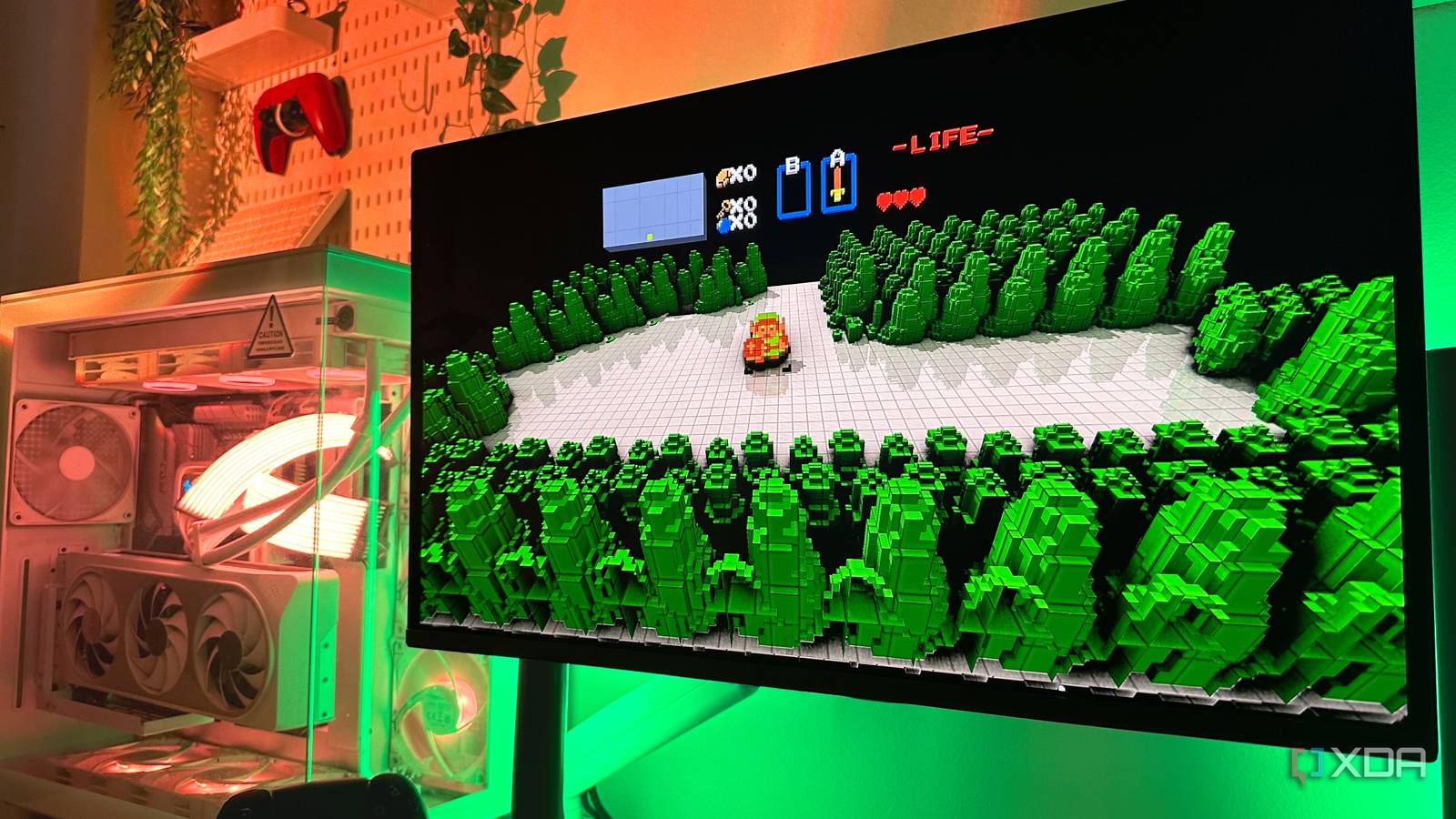
Published Nov 15, 2026, 11:30 AM EST Gaming has been Samarveer’s greatest passion, and the Literature graduate in him takes immense joy in dissecting games for their themes, messages, and impact. Samarveer holds a deep appreciation of gaming, and considers the platform to be the most immersive and impactful across all media. He can be found engaging with gaming communities online, always ready to debate the finer points of ray tracing or itching to write an 8-page collegiate thesis on any game that impacts him emotionally. I've tried out about a dozen different ways to play the NES games I grew up with, and each one has always felt rewarding in a different way. I've played NES classics on knock-off handhelds, on my phone through emulation, and on commercialized HDMI sticks with cheap controllers, but one thing remains constant: how fun they are. Of course, on PC, RetroArch's CRT filters truly lend my retro games a new degree of authenticity. And yet, nothing has ever been quite like 3dSen — the most unique NES emulator that takes old, flat 2D NES ROMs and turns them into 3D dioramas. After trying it out over a weekend, I can safely say that no amount of filter overlays can ever come close to matching the sheer wonder of seeing 30-year-old games (or more) transformed into entirely new visual experiences. 3dSen is not your ordinary filter It changes the perspective, not the game I've tried Nestopia, Mesen, and even RetroArch for NES emulation, and I frequently switch among them, depending on the mood. Each emulator has its own settings and unique feature set. However, 3dSen takes the exact opposite approach. It doesn't try to simulate an old display or upscale the graphics with neural rendering. Instead, it completely rebuilds supported NES games as playable 3D voxel dioramas, complete with volume, dynamic lighting, shadows, and a freely movable camera. If you're thinking 3dSen rebuilds these old NES games, you'd be wrong. 3dSen keeps the original engine, physics, controls, and frame-by-frame timing intact. All it changes is how the game's sprites and backgrounds are rendered. Having just played Super Mario Bros. a week ago on an HDMI stick, I felt no difference in the core gameplay — our favorite plumber still jumped exactly as he did on the NES, but this time, I could pan, tilt, rotate, and zoom around him instead of staring at a flat 2D image. Each 3D NES diorama is hand-tuned in 3dSen Every game needs its own 3D reconstruction The one aspect in which 3dSen differs from regular NES emulators, though, is that you can't just throw all your NES ROMs into it and expect the pixels to magically grow legs. The software relies on hand-tuned profiles that tell it how individual sprites and scenes should be reconstructed in three dimensions. At the moment, 101 games currently have these meticulously-designed profiles, but thankfully, they include most of the biggest hits that anyone would go for first — Super Mario Bros., The Legend of Zelda, Tetris (of course), Road Fighter, and Contra. Under the hood, 3dSen interprets the NES game's 2D output and rebuilds it as volumetric voxel geometry in real time. The hand-tuned profile for that game defines how the sprites inside are shaped, positioned, and given depth, while the engine adds lighting and shadows around those reconstructed objects. The scene is literally being assembled as the game runs, which is nothing if not incredibly impressive. That's why the 3D results vary wildly between games when you're running 3dSen. Some lend themselves beautifully to a miniature 3D world, while others require considerably more interpretation. Oh, and if you don't find your favorite NES game in the list of supported titles, there's also 3dSenMaker, which lets the community build its own profile instead of waiting for an official one. The sheer amount of work involved becomes obvious when you compare the original game with its 3dSen reconstruction side by side. Someone has effectively taught the emulator what those pixels are supposed to be in three-dimensional space, and that level of effort left me reeling in awe. This is far more than a novelty emulator I've never seen more QoL features in an NES emulator I was even more surprised to see that 3dSen packs a load of genuinely useful features as well. As transformative and different as the games look and feel, they still benefit from regular emulation features like quick saves, frame rewind, and fast-forwarding. The party tricks, however, were animated skyboxes, 3D scene export, and by far my personal favorite — a first-person camera view, although that's exclusive to 3dSenMaker, the free editor for creating the community-made profiles for other NES titles. 3dSen also runs on Windows, Linux, and Mac, which genuinely makes it considerably more than a novelty you fire up once for a few screenshots. This emulator spent a full five years in Early Access before officially launching as version 1.0 in June 2025, following more than a decade of development. I picked it up in a recent Steam sale, expecting an elaborate visual gimmick, but the moment I moved the camera around in Road Fighter, it became obvious that I was experiencing something I never had before. It was the same game I'd played decades ago, viewed from an entirely new dimension. This is the kind of novelty that refuses to wear off I'm playing my childhood games from a completely new perspective Like with any new emulator with a fresh USP, I expected the novelty of 3dSen to disappear rather quickly. When it comes to emulation in general, I've found that the initial excitement usually fades once the novelty of seeing something familiar presented differently wears off. 3dSen, however, does the opposite. Every time I loaded another game I knew by heart, I found myself moving the camera around just to see what had been done with it. The reason is that this really doesn't feel like a "remaster," and it most definitely isn't trying to make an NES game look like a PS2 game or change its aesthetic. The chunky voxel aesthetic remains unmistakably 8-bit, only now those familiar pixels have physical volume. Some games do look better than others, and they're not all perfect, and I did find that the occasional camera angle exposed the illusion. However, that really makes the good ones more impressive by comparison. I've already spent hours jumping between my favorite NES titles, and now, instead of moving on, I've found myself wondering what the next one would look like. 3dSen has effectively provided me with a reason to revisit games I thought I already knew from every possible angel, and somehow, seeing a familiar level become a tiny interactive diorama still manages to make me feel like a kid discovering it for the first time. Old games just need a new way to surprise us At this point, we've all seen every last drop of nostalgia squeezed from NES games. 3dSen, however, has given gamers another reason to care about the ROM collection. Castlevania II hasn't received better textures, neural rendering, or ray tracing, but in presenting it from an angle Nintendo never intended, 3dSen achieves what no other emulator has. The exact same game files that ran comfortably on any NES emulator now have an added third dimension, all thanks to 3dSen. It lets me discover little details I stopped noticing or caring about years ago. Now, if only SNES games got the same treatment, I'd play Super Punch Out and Ken Griffey Jr. Presents MLB in a heartbeat. 3dSen
3dSen turns old NES games into 3D dioramas, and it's more interesting than another graphics filter
Full Article
Original Source
Read the full article at Xda-developers →KhanList aggregates and links to publicly available news content. We do not host full articles from third-party sources. Always verify important information with original sources.