
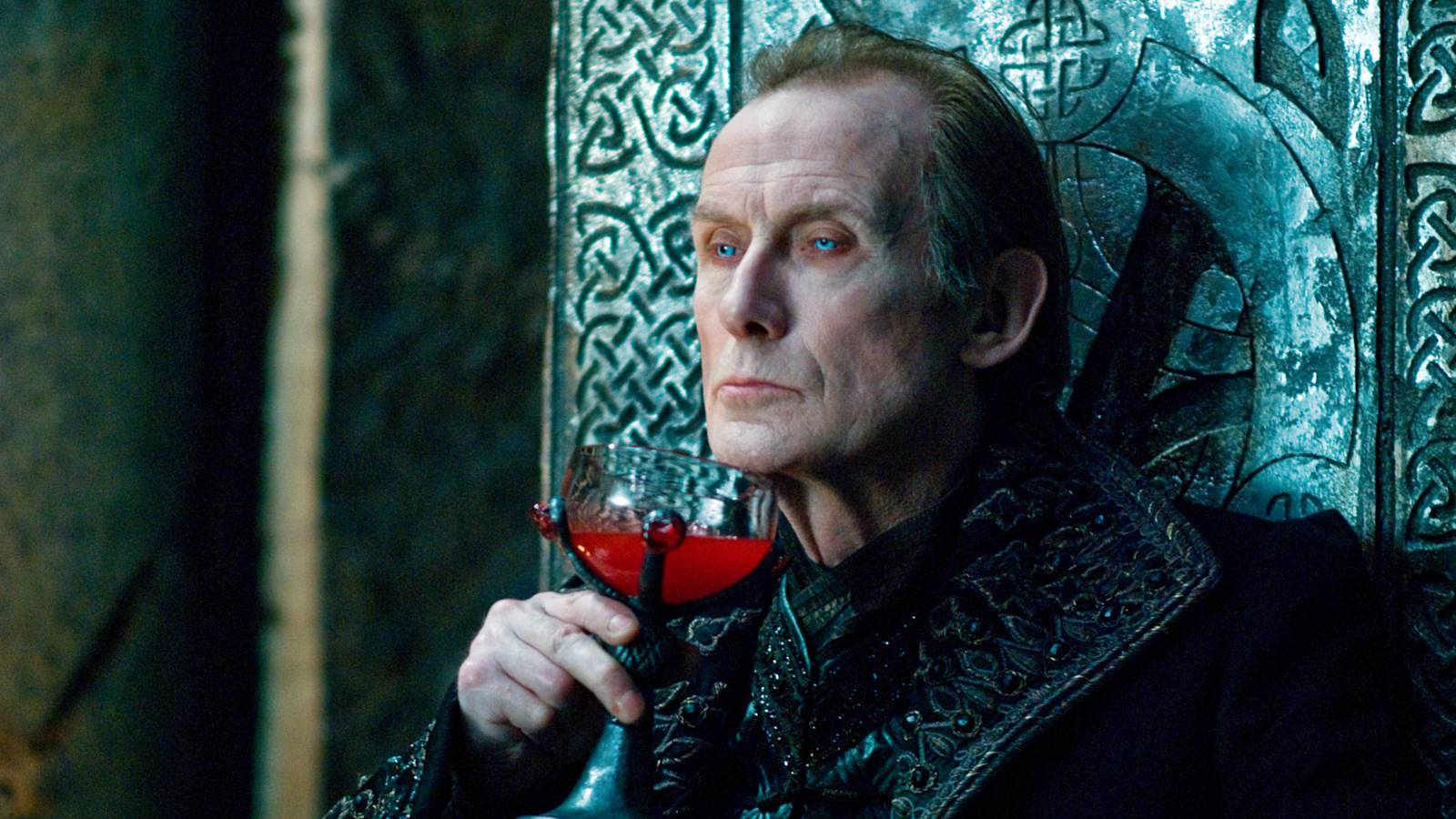
One of the funniest scenes in Taika Waititi's 2014 vampire mockumentary, What We Do in the Shadows, happens when the central group of vamps bump into a rival werewolf gang on a late-night stroll. "Look out guys, don't catch fleas," one of the vampires remarks, leading to an escalating exchange of insults, snarking, and howling, but no actual violence. (In this world, neither vampires nor werewolves are particularly brave, despite their extraordinary powers.) At the time, the interaction, while hilarious, also made perfect sense. Popular culture was deep in the thrall of Stephenie Meyer’s Twilight, which famously pits a vampire and a werewolf against each other for the affections of a human girl. But a decade later, the idea that vampires and werewolves would be natural enemies seems a bit odd. Having grown up in the early 2000s, I’ve always seen vampires and werewolves as mortal enemies. Yet, as someone fascinated with them both (though I’ll admit that, as a dog lover, I’m a little more partial to werewolves than vampires), I’ve always wondered: where did the supernatural beef between two of horror's most iconic creatures even come from? The answer reveals that while this rivalry isn't as old as you might think, it's also an inevitable outcome based on the origins of these two classic monsters. Vampires and werewolves are more alike than you think Photo: Paramount Pictures When you turn to classic literature for answers about the feud between vampires and werewolves, you first have to look back at their origins. To be frank, this is impossible: ancient mythology and cultures around the world are vast and varied. Pinpointing a single location, person, or story as their origin is ludicrous. Instead, we have to explore a selection of stories — and boy, is there plenty to choose from. Ancient mythology is full of stories in which humans are transformed into wolves as punishment. In the Epic of Gilgamesh, Gilgamesh refuses to mate with the goddess Ishtar because she had previously turned a shepherd into a wolf. And in Greek mythology, Zeus transforms King Lycaon into a wolf after the cheeky king attempts to trick the god into eating Lycaon’s son, Nyctimus. Meanwhile, John William Polidori’s 1819 novel The Vampyre portrays vampires as specters of desire, corruption, and manipulation, with Lord Ruthven in The Vampyre and Bram Stoker’s Dracula using their powers to kill and seduce in equal measure. In both cases, these creatures are clearly associated with the very concept of evil. Similarly, both undergo a transformation. The vampire, once human, dies and is reborn, with a craving for blood and, depending on the source, otherworldly abilities such as transformation (Dracula literally turns into a wolf in Stoker’s novel) and flight. The werewolf, however, is still very much alive but loses its humanity when it transforms and is reduced to lupine instincts. Who is to blame for the vampires vs. werewolves feud? Photo: Summit Entertainment Given their many similarities, how did vampires and werewolves come to be seen as natural enemies by the 2000s? There are two very different explanations. The first comes from the world of tabletop games, specifically publisher White Wolf's The World of Darkness series, which includes 1991's Vampire: The Masquerade and 1992's Werewolf: The Apocalypse. Although Vampire: The Masquerade mainly focuses on politics among vampire clans, the conflict between vampires and werewolves also plays a significant role. The hostility, however, seems unequal: werewolves hate vampires far more than vampires hate werewolves. Vampires are too busy obsessing over one another to pay any attention to their lupine enemies. Image: Sony However, vampire and werewolf fans often point to another answer when discussing the feud: the action-horror fantasy movie series Underworld, created by Kevin Grevioux, Len Wiseman, and Danny McBride. The films mostly follow Selene (Kate Beckinsale), a vampire death dealer caught up in the centuries-long war between the two factions. With stilted acting and an overreliance on skin-tight leather outfits, the Underworld franchise has aged pretty terribly, but no one can deny that the 2003 film was the perfect vehicle for popularizing the rivalry White Wolf had already established. Indeed, White Wolf even tried to sue Sony Pictures over it. With Underworld’s popularity at the time (the first film grossed about $95.7 million worldwide), it seemed that more and more media began portraying the two creatures’ hatred as an ancient blood feud. The origin of this rivalry often differs by IP, but it still largely comes back to the creatures being foils for each other, right down to how they present themselves. Vampires are often portrayed as aristocratic, in control, and free-thinking. They may have an insatiable desire for blood, but they can blend into everyday society well enough, with their monstrosity often hidden in the shadows. On the other hand, werewolves are depicted as savages, unable to control themselves and fueled by a rage and hunger driven by the Moon. Image: Summit Entertainment In Underworld, vampires live in a mansion, throw fancy parties, and follow a structure that resembles nobility. Werewolves, by contrast, live in the sewers. Though they also have a leader, the pack structure means its members are generally considered equals. There’s also something to be said for the sheer hype of watching two otherworldly creatures battle. As someone who’s turned my nose up at people getting worked up over Godzilla movies (it’s just two big creatures fighting! What’s the big deal?), I have to sheepishly admit that vampires versus werewolves can get me just as worked up. Sometimes, you just want fantasy creatures ripping each other limb from limb, and it’s even better when it’s two creatures portrayed as hating one another for years. Vampires vs. werewolves now Image: Rory Mulvey/Focus Features/Everett Collection Decades have passed since the early 2000s, and while many of those years were defined by the clash between these two supernatural creatures, recent years have shown less interest in exploring that same scrap. That’s not to say people have lost interest in the topic. AMC’s adaptation of Interview with the Vampire remains beloved by viewers, while director and writer Robert Eggers’ Nosferatu enchanted plenty of horror fans in 2024. This year, Eggers hopes to do the same for werewolf fans with Werwulf. Interest in the fantastical worlds of vampires and werewolves has not faded, not by a long shot. (And maybe if we're lucky, Eggers' next movie will pit his two monsters against each other.) Whether the vampire-versus-werewolf beef will ever be renewed to the extent it was in the early 2000s, however, remains to be seen. Netflix is developing an animated series adaptation of Midnight Sun, which is Twilight from Edward Cullen's perspective, and Underworld creator Len Wiseman recently gave a positive update on production of an Underworld TV series. If any IPs can rekindle the vampires-versus-werewolves wars, they’re these two. (Sadly, the What We Do in the Shadows werewolf spinoff, We're Wolves, has been stuck in development hell for years.) Whether we need or want that to be the case, however, is another matter entirely. For the moment, the quarrel between the two creatures is largely in the past. Could Hollywood move forward and instead see the two monstrous factions pair up? Weirder things have happened.
35 Years Later, Hollywood’s Deadliest Feud Is Still Its Most Reliable Fantasy Formula
Full Article
Original Source
Read the full article at Polygon →KhanList aggregates and links to publicly available news content. We do not host full articles from third-party sources. Always verify important information with original sources.