
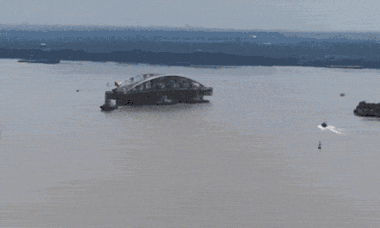
A steel arch in the form of a nipa palm leaf was towed from Vung Tau on a 124-km journey before arriving at Bach Dang Wharf in central Ho Chi Minh City on Monday afternoon to complete a pedestrian bridge across the Saigon River. The barge carrying the arch arrives at the bridge construction site along Bach Dang Wharf in central Ho Chi Minh City at around 3 p.m. on Monday, ending the journey from Vung Tau. A foreign man watches as the arch approaches Bach Dang Wharf. The arch, which weighs 3,400 tons and spans 187 meters, arrives at Nha Rong Wharf in the city's center at around 2:45 p.m. The arch arrives at Khanh Hoi Port in the former District 4 at 2 p.m. At 12:10 p.m., the barge carrying the steel arch departed from the Diamond Island area toward central Ho Chi Minh City. Dai Dung Group, the manufacturer responsible for transporting the structure to the construction site, stated the convoy was expected to reach Nha Rong–Khanh Hoi Port by 1:30 p.m. and arrive at Bach Dang Wharf around 2:00 p.m. About an hour earlier, the barge had passed more than a kilometer beyond Phu My Bridge as it headed toward Bach Dang Wharf. In the background stood the Landmark 81 Tower, currently the tallest structural work in Vietnam, located in Thanh My Tay Ward, formerly part of Binh Thanh District. About an hour earlier, the barge had passed more than a kilometer beyond Phu My Bridge as it headed toward Bach Dang Wharf. In the background stood the Landmark 81 Tower, currently the tallest structural work in Vietnam, located in Thanh My Tay Ward, formerly part of Binh Thanh District. About an hour earlier, the barge had passed more than a kilometer beyond Phu My Bridge as it headed toward Bach Dang Wharf. In the background stood the Landmark 81 Tower, currently the tallest structural work in Vietnam, located in Thanh My Tay Ward, formerly part of Binh Thanh District. The towing convoy passed under Phu My Bridge across the Saigon River at 10:35 a.m. Construction of the 720-meter-long pedestrian bridge across the Saigon River began in March 2025. The structure is 6 to 11 meters wide and costs nearly VND1 trillion (US$38 million), funded by dairy company Nutifood. Its steel arch takes inspiration from the nipa palm leaf, a familiar natural feature of southern Vietnam. Once completed, the bridge will connect the Nguyen Hue Pedestrian Street with the Thu Thiem urban area at Bach Dang Wharf Park, creating new public space along the riverfront. Many commuters stopped in the motorcycle lane of Phu My Bridge to record the steel arch being towed past. “I heard the bridge section was being towed past here, so I came to the bridge early this morning to wait. This is the first time I've seen a bridge section shaped like a nipa palm leaf. It's beautiful and impressive,” said Phuc Sinh, a resident of Thu Duc, as he photographed the barge. “I am a civil engineer, so I am interested in the pedestrian bridge across the Saigon River. In the coming days, when the two sides of the bridge are joined, I will come and see it in person,” said Vo Trong Nghia, 37. Three hours earlier, the towing convoy had passed under Binh Khanh Bridge on the Ben Luc–Long Thanh Expressway, linking the Mekong Delta region with HCMC and Dong Nai City. The bridge has a navigational clearance of 55 m, among the highest in Vietnam. Three hours earlier, the towing convoy had passed under Binh Khanh Bridge on the Ben Luc–Long Thanh Expressway, linking the Mekong Delta region with HCMC and Dong Nai City. The bridge has a navigational clearance of 55 m, among the highest in Vietnam. Three hours earlier, the towing convoy had passed under Binh Khanh Bridge on the Ben Luc–Long Thanh Expressway, linking the Mekong Delta region with HCMC and Dong Nai City. The bridge has a navigational clearance of 55 m, among the highest in Vietnam. At 5:20 a.m. on Oct. 18, tugboat horns sounded as workers removed the final mooring cables. The convoy departed a temporary dock at the Dai Dung Shipyard in Dong Xuyen Industrial Park, located in Vung Tau's Rach Dua Ward, beginning its 124-kilometer journey to Bach Dang Wharf. The route for towing the bridge span from Dong Xuyen Port to central Ho Chi Minh City. Graphic by Tam Thao
3,400-ton nipa palm-inspired arch completes 30-hour sea journey to form pedestrian bridge in Ho Chi Minh City center
Full Article
Original Source
Read the full article at E →KhanList aggregates and links to publicly available news content. We do not host full articles from third-party sources. Always verify important information with original sources.