
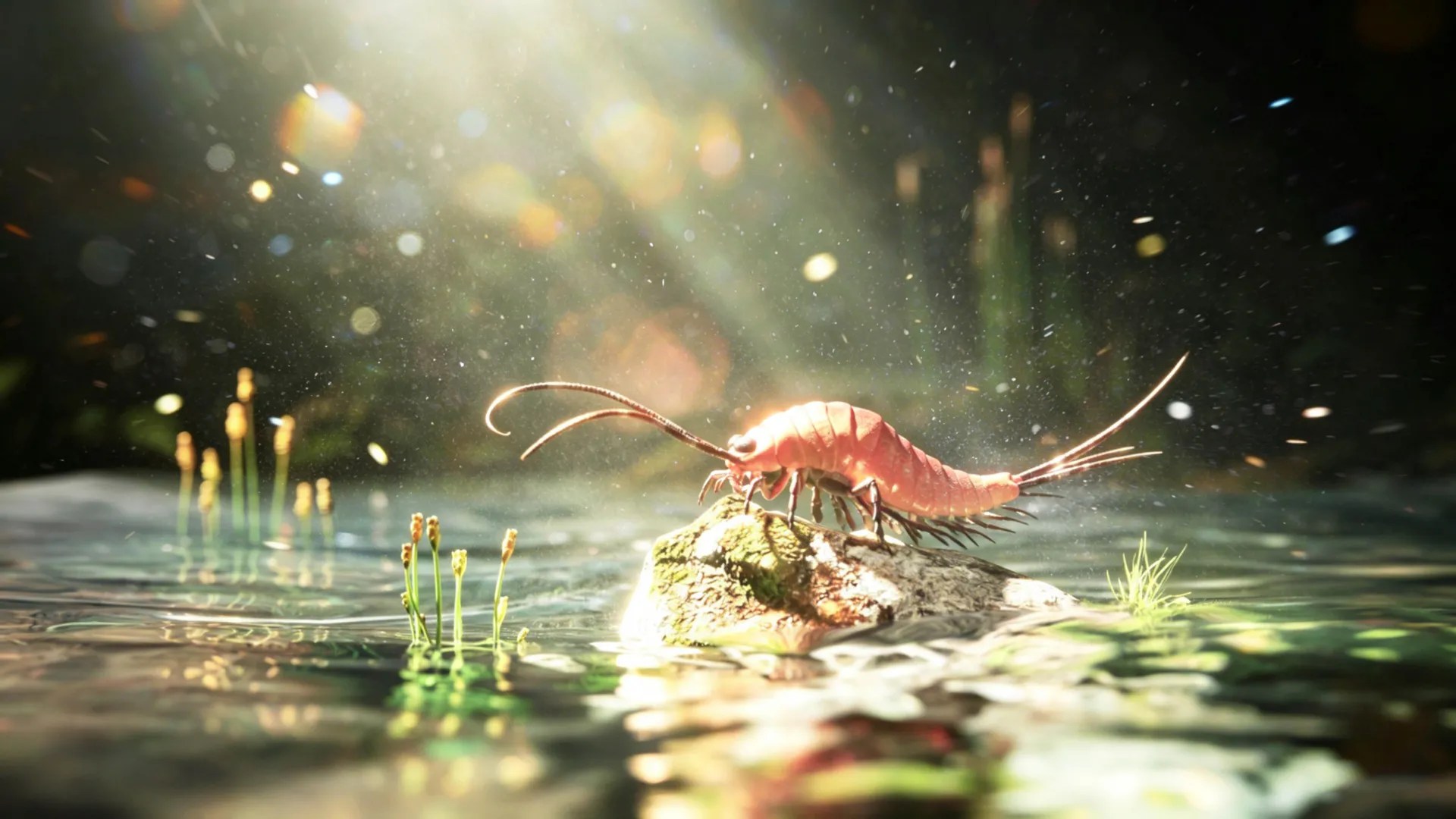
Insects are one of the most species-rich groups on Earth. A new study on a 324-million-year-old fossil suggests that they did not make a sudden jump from water to land, but transitioned gradually through an extended amphibious/semi-aquatic phase. For a long time, this fossil sat in museum archives under a quiet case of mistaken identity. Paleontologists thought it held the routine juvenile remains of an ancient crustacean. They were wrong. Using cross-polarized light imaging to pierce through the glare of the dark rock, an international research team revealed that the fossil wasn’t a baby crab or shrimp at all. It was a previously unknown, 24-limbed stem insect now named Chosha praecursor. The remains were unearthed from 324-million-year-old Late Mississippian deposits in the Tesnus Formation of western Texas. The fossil examination done by researchers from the Nanjing Institute of Geology and Paleontology (NIGPAS) and the University of Cambridge presents the missing link in insect evolution. The ancient creature’s paddle-like abdominal limbs provide direct fossil evidence that insects conquered land through a prolonged semi-aquatic phase rather than an abrupt transition. The bizarre body plan Before this discovery, there was a puzzling 80-million-year gap in the fossil record. Genetics suggested early insects split from marine ancestors during the Cambrian-Ordovician era, yet fully land-adapted insect fossils didn’t appear in abundance until much later. Chosha praecursor bridges that void. The creature’s body plan tells a bizarre story. Measuring 49.66 millimeters in total length, the streamlined species combined classic hexapod traits, including walking legs, a caudal filament, and an ovipositor. Roughly two inches long, including its tail, it was an anatomical hybrid. Further back, things got weird. Instead of a clean, sleek abdomen, segments 1 through 9 sprouted abdominal appendages, with the rear limbs modified into broad, paddle-like oars. No living insect has anything like them. These paddles weren’t designed for sprinting across dry soil, but were built to swim. Found in sediments from ancient near-shore coastal deltas, this unique anatomy confirms that C. praecursor lived an amphibious, semi-aquatic lifestyle along the boundary between land and water. It paddled through shallow waters and crawled along humid shorelines, feeding on decaying plants and fungal spores. The missing link Researchers identified the oldest known stem lineage of insects by re-evaluating Chosha praecursor alongside Scotland’s Leverhulmia and an unnamed Mazon Creek hexapod, successfully filling the long-standing 80-million-year “hexapod gap.” This discovery pushes the timeline for early insect diversification back from the Late Carboniferous into the Early Devonian. It narrows the longstanding discrepancy between physical fossil evidence and genetic molecular clock estimates while offering a clear snapshot of an intermediate evolutionary phase. Over millions of years, those extra abdominal oars were simplified, repurposed, and eventually erased entirely, leaving behind the streamlined six-legged architects of Earth’s terrestrial ecosystems. In addition, the preservation of an ovipositor in C. praecursor reveals that early insects had already evolved specialized egg-laying structures. It helped develop an anatomical groundwork to exploit diverse terrestrial microhabitats and spur their massive diversification. The findings were published in the journal Nature on August 26. Get the latest in engineering, tech, space & science - delivered daily to your inbox.Mrigakshi is a science journalist who enjoys writing about space exploration, biology, and technological innovations. Her work has been featured in well-known publications including Nature India, Supercluster, The Weather Channel and Astronomy magazine. If you have pitches in mind, please do not hesitate to email her.
324-million-year-old 24-legged fossil shows how insects transitioned to land
Full Article
Original Source
Read the full article at Interestingengineering →KhanList aggregates and links to publicly available news content. We do not host full articles from third-party sources. Always verify important information with original sources.