
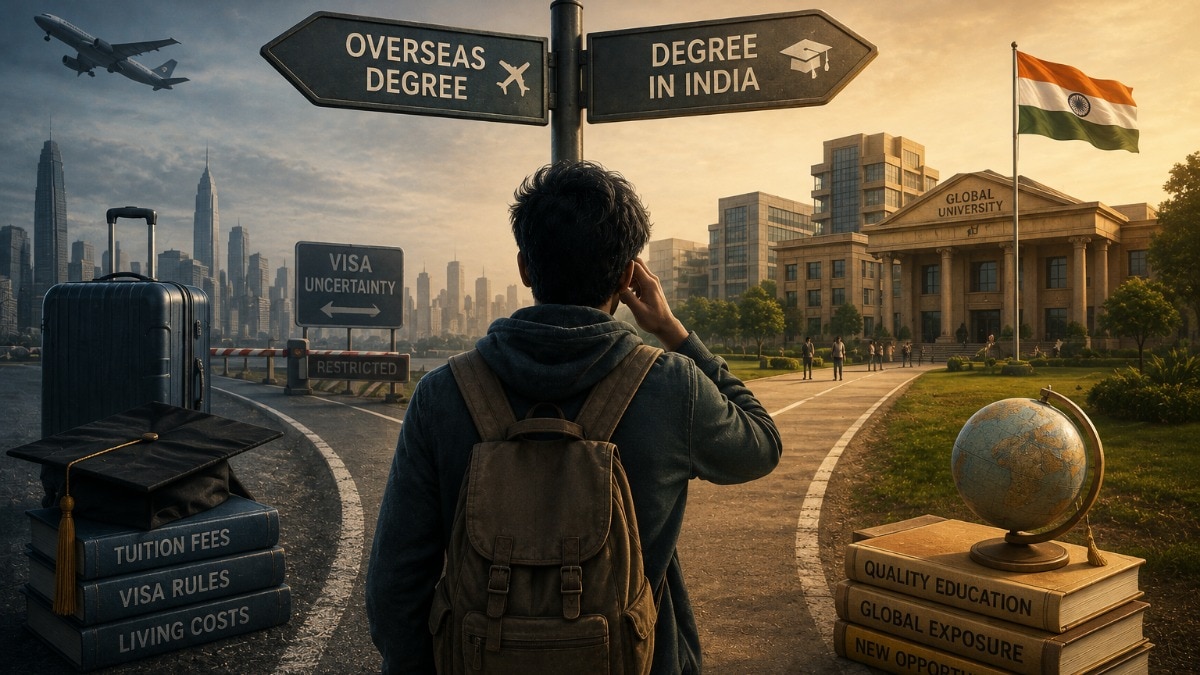
The foreign degree was once seen as a ticket to better jobs, global exposure and a new life. Now, with foreign universities coming to India amid tighter visa and immigration rules, Indian families are asking a harder question: Is the overseas degree still worth the price and uncertainty?Is the overseas degree still worth the price and uncertainty? (AI-generated-image)Indian students are still interested in global education, but the old idea of “study abroad at any cost” is changing. Rising expenses, uncertain visas and tougher questions about jobs are making families pause. At the same time, foreign universities are bringing their degrees to India. So, is the overseas degree losing its appeal, or are students simply becoming more selective?The number of Indians travelling abroad for education fell from 8,94,758 in 2023 to 7,60,060 in 2024 and 6,19,264 in 2025, according to Bureau of Immigration data cited by the Ministry of Education. That is a fall of nearly 31% from 2023 to 2025.The drop comes after a sharp post-pandemic rise. In 2021, only 4,45,580 Indians reported education as their purpose of travel. The number rose to 7,52,100 in 2022 and peaked at 8,94,758 in 2023.So, this is not simply a story of students losing interest in foreign universities. It is also a story of families reassessing a decision that became extremely popular after the pandemic. Lakshmi Iyer, Chief Client Officer and Chairperson, StudyIN India, says the change is being driven by several factors.“It’s a mix of both, though visa unpredictability stands out as the sharper trigger,” Iyer said. She pointed to tighter immigration rules in major destinations such as the United States, United Kingdom, Canada and Australia. A weaker rupee has also increased the cost of tuition and living abroad.But money is not the only concern.“Families are now scrutinising job outcomes and return-on-investment far more critically than they did during the post-pandemic rush abroad,” Iyer said. The foreign universities are coming to India giving students choice THE QUESTION IS NO LONGER JUST ‘WHERE?’For students, the decision has become more practical.Earlier, getting into a foreign university itself could feel like the main goal. Now, families are looking at what comes after the degree: Will there be a job? Can the student recover the cost? What happens if visa rules change? Is there a reliable post-study work route?The Ministry of Education has also listed affordability, access to finance, exposure to foreign societies and a student's interest in a particular field among the factors that influence the decision to study abroad.At the same time, India's own higher education system is changing. The number of Indian institutions in the QS World University Rankings 2027 has risen to 52, from 11 in 2015, according to the government.That does not mean Indian universities can replace every foreign option. But it does give students more choices than they had a decade ago. The study abroad dream is taking a U turn WHAT IF THE FOREIGN UNIVERSITY COMES HOME?This is perhaps the biggest change in the study-abroad story.The University Grants Commission has issued 16 Letters of Intent (LOI) to 15 foreign higher education institutions from Australia, Italy, the United Kingdom and the United States. The LoIs cover institutions in Karnataka, Maharashtra, Delhi National Capital Region and Tamil Nadu.Four foreign universities, the University of York, University of Bristol, University of Aberdeen and Illinois Institute of Technology, have received approval to start academic operations in Mumbai. The University of Southampton and University of New South Wales have already established campuses in Gurugram and Bengaluru respectively.For some students, that could offer the middle path: a foreign university degree without paying the full cost of living overseas or dealing with a foreign student visa.“This works well for students who want the international label without the financial or visa risk,” Iyer said. But she does not see these campuses as a complete replacement.“They still can’t offer the lived experience of a foreign job market, cultural immersion, or a pathway to settling abroad,” she said.That distinction matters. A student wanting a global degree may stay in India. A student wanting to build a career and life overseas will still need to leave. The US degrees are also seeing a downfall from India THE US SHOWS WHY STUDENTS ARE THINKING TWICEThe United States remains a major draw for Indian students. Open Doors 2025 recorded 3,63,019 Indian students in the US in 2024-25, up 10% from the previous year, making India the largest source of international students there.But fresh data suggests the wider US market could face a difficult year.A NAFSA and JB International analysis released in August 2026 projects up to 1,11,000 fewer international students in Fall 2026. The report links the expected decline to falling applications, visa appointment delays and tighter immigration policies. It estimates that the loss could cost the US economy up to US$3.4 billion and nearly 40,000 jobs.Saurabh Arora, Founder and CEO, University Living, says this should not be read as students giving up on international education.“What we are seeing is a recalibration in how students evaluate global education destinations,” Arora said.For Indian students, he said, university rankings are no longer enough. “Visa uncertainty, tighter immigration policies and questions around post-study pathways are now being considered alongside university rankings and academic reputation.”The US remains attractive for its universities, research and career opportunities. But students are now also looking at visa processing, employment after graduation, affordability and living costs.And they have more alternatives. The UK, Australia, Ireland and Germany are all competing for international students, giving Indian applicants more destinations to compare. Some students might still choose foreign degrees WHO WILL STILL CHOOSE TO GO ABROAD?The fall is unlikely to affect every student equally.Iyer expects students pursuing advanced STEM, research-heavy programmes, PhDs and certain medical and design courses to continue going abroad. These are areas where Indian institutions and the new foreign campuses may not yet offer the same depth.Students from financially secure families are also more likely to continue.The bigger change could come among students choosing generic postgraduate degrees mainly to improve their career profile.For them, spending heavily on tuition and living costs abroad becomes harder to justify when the job market and visa pathway are uncertain.THE FOREIGN DEGREE HAS NOT DISAPPEARED, IT HAS BEEN REPRICEDThe 31% fall does not mean Indian students have stopped wanting international education. The data suggests something more interesting: they are becoming more careful about buying it.The decision is increasingly about the full package: fees, visa, jobs, career growth, immigration options and the quality of the degree.And now there is another option: get the foreign university without leaving India.That may be the real shift in India's study-abroad story. The next phase of study abroad may therefore be less about “going abroad at any cost” and more about choosing the destination that offers the right mix of degree, career, affordability and certainty.The foreign degree still has a pull. It just has to justify its price now.- EndsPublished By: Princy ShuklaPublished On: Aug 15, 2026 16:37 IST
31% fewer students went abroad in 2 years. Where did India's study-abroad rush go?
Full Article
Original Source
Read the full article at Indiatoday →KhanList aggregates and links to publicly available news content. We do not host full articles from third-party sources. Always verify important information with original sources.