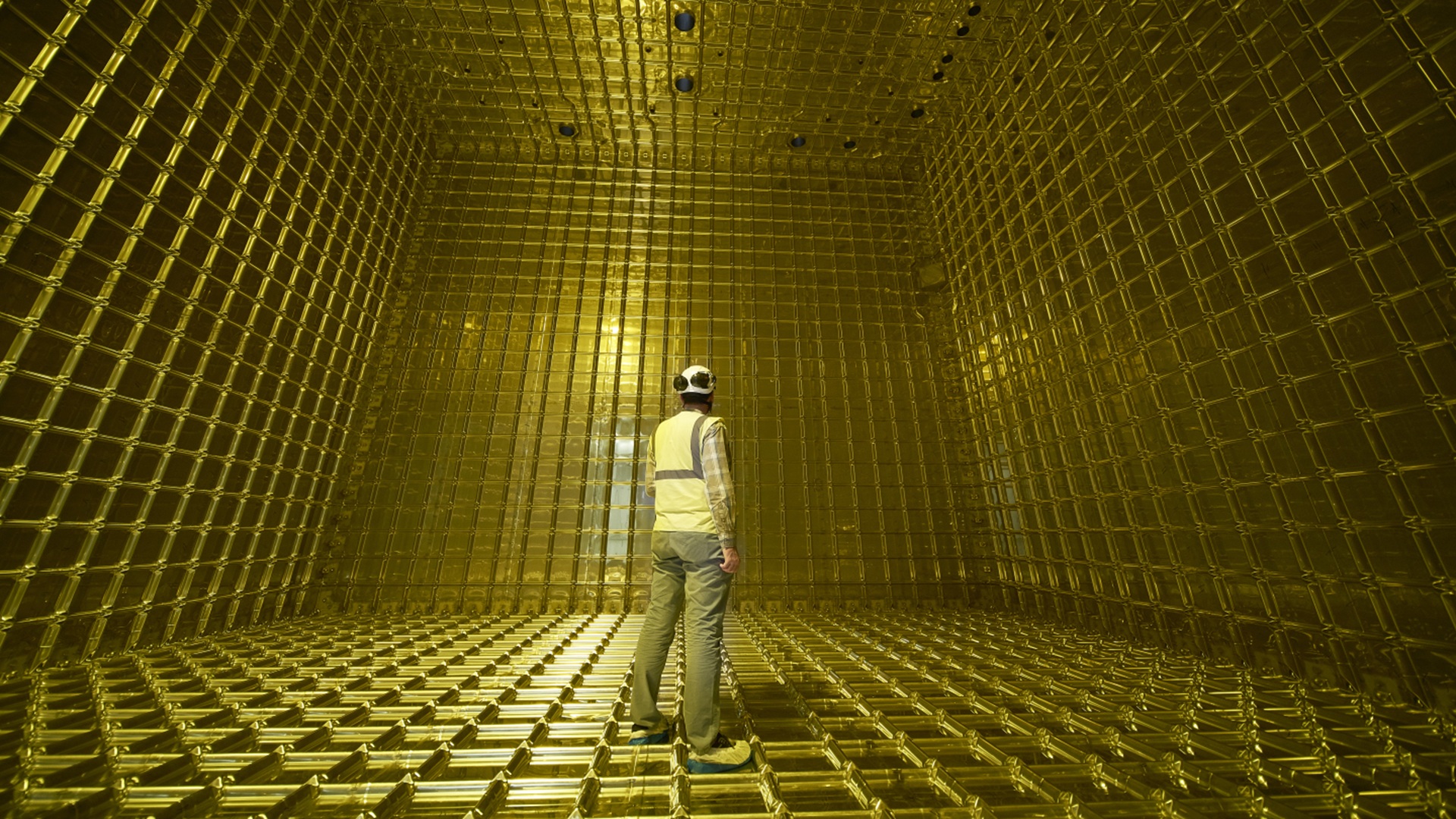
Scientists have been testing the limits of the world’s largest neutrino experiment after they subjected the prototype detector to an extreme 300,000-volt stress trial, before it is installed deep underground in the US. The test for the Deep Underground Neutrino Experiment (DUNE) was carried out at CERN’s Neutrino Platform located on the Prévessin site in France. The project is led by the US Department of Energy’s Fermi National Accelerator Laboratory, or Fermilab. DUNE is set to become one of the most ambitious particle physics experiments ever built. Once it goes online, it will study the mysterious behavior of neutrinos and search for clues about why the universe has more matter than antimatter. There are currently two 770-ton prototype neutrino detectors called ProtoDUNEs at CERN. They are playing a key role in demonstrating the technologies planned for DUNE. “The work at ProtoDUNE going into demonstrating the technology is heroic,” Sowjanya Gollapinni, PhD, Los Alamos senior scientist, stated. Testing detector limits Because the experiment’s detector components will remain submerged in liquid argon and inaccessible for decades after installation, the scientists must ensure every system is built to last. That’s why, to verify the technology they are using a full-scale prototype called ProtoDUNE Vertical Drift. The prototype replaces traditional wire-based readout planes with commercially made printed circuit boards. This makes the detector easier to build and records more neutrino interactions with fewer detector parts. The new design doubles the distance electrons travel through liquid argon. The single-phase ProtoDUNE detector at CERN.Credit: CERN However, this also requires a much higher voltage to keep the electric field strong enough to guide the electrons to the detector before they disappear. That’s why the researchers are generating an electric field of about 300,000 volts (V). “A battery that you can hold in your hand has one and a half volts between the two ends,” Steve Kettell, PhD, a scientist at Brookhaven National Laboratory and one of DUNE’s technical coordinators, noted. “We are taking that same concept and scaling it up to 300,000 volts.” Preparing for underground Kettell stressed that the team is deliberately pushing the detector to its limits. “It’s like building a lightning storm inside of a detector, but we don’t actually want the physical lightning strikes,” he said. “If we see sparks, it will allow us to study how all of the various components react.” The collaboration began commissioning the new prototype in 2025. The ongoing stress test, which began in May 2026, should determine whether the system can reliably maintain the high voltage for extended periods under realistic operating conditions. The DUNE detectors will be installed nearly a mile underground at the Sanford Underground Research Facility in South Dakota. They will be filled with liquid argon to capture the neutrinos’ rare interactions. The ProtoDUNE team at CERN is testing technology for the Deep Underground Neutrino Experiment (DUNE) in the US.Credit: CERN When a neutrino collides with an argon atom, it produces charged particles that leave tiny trails of ionization. The detector’s sensitive electronics will record these signals and allow the scientists to reconstruct the particle’s energy, direction and identity. DUNE will also observe neutrinos arriving from space that escape exploding stars before visible light. This could potentially give astronomers advance warning of nearby supernovae. The team also hopes the experiment will reveal why matter survived and antimatter largely disappeared after the Big Bang. The current stress test at CERN is set to continue through the fall. If successful, it will confirm that the detector can operate reliably for decades underground. “If all the components survive, that’s very encouraging,” Kettell concluded in a press statement. Recommended ArticlesGet the latest in engineering, tech, space & science - delivered daily to your inbox.Based in Skopje, North Macedonia. Her work has appeared in Daily Mail, Mirror, Daily Star, Yahoo, NationalWorld, Newsweek, Press Gazette and others. She covers stories on batteries, wind energy, sustainable shipping and new discoveries. When she's not chasing the next big science story, she's traveling, exploring new cultures, or enjoying good food with even better wine.
300,000 volts: US team puts world’s largest neutrino detector through extreme stress test
Full Article
Original Source
Read the full article at Interestingengineering →KhanList aggregates and links to publicly available news content. We do not host full articles from third-party sources. Always verify important information with original sources.