
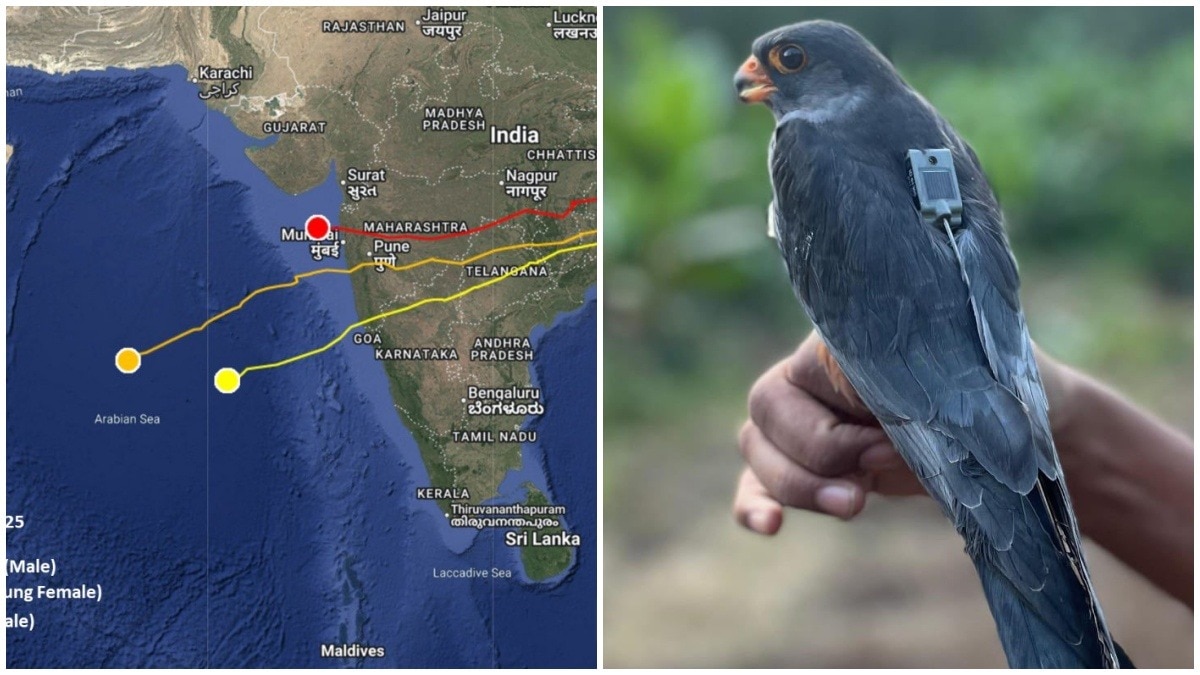
Satellite-tagged Amur Falcons Apapang and Alang have resumed their migration from Manipur towards Somalia. Their route includes a nearly 3,000-kilometre non-stop crossing of the Arabian Sea.The latest satellite tracking data reveals that the two birds are taking slightly different routes. (Photo: X)New Delhi,Nov 20, 2026 13:19 ISTTwo tiny migratory birds weighing barely 150 grams each are preparing for one of nature's most extraordinary journeys. Satellite-tagged Amur Falcons, Apapang and Alang, have resumed their migration towards Africa after spending nearly 25 days at Chiuluan in Manipur's Tamenglong district.Their next challenge is a nearly 3,000-kilometre non-stop flight across the Arabian Sea, with Somalia as their destination.The latest satellite tracking data reveals that the two birds are taking slightly different routes. Apapang, the adult male, has crossed peninsular India and reached the western coast near Goa. Alang, the young female, has already ventured far out over the Arabian Sea. Photo: X/@supriyasahuias The ocean crossing is among the most challenging legs of their annual migration, as the birds will have no opportunity to land, rest or replenish their energy reserves until they reach the African coast. HOW DO THESE TINY BIRDS MANAGE THE OCEAN CROSSING?Amur Falcons (Falco amurensis) are among the world's remarkable long-distance migratory birds. They breed in parts of eastern Russia, northeastern China and Mongolia before travelling thousands of kilometres to their wintering grounds in southern Africa.Their stopover in northeastern India is crucial to this journey. During their stay in Manipur and Nagaland, the birds feed extensively on termites and other insects, building the fat reserves needed to fuel their demanding migration. Scientists from the Wildlife Institute of India (WII) fitted Apapang, Alang and another falcon, Ahu, with satellite transmitters in November 2025 to understand their migratory routes and behaviour.Their previous migration offered a glimpse of their extraordinary endurance. Apapang covered approximately 6,100 kilometres in six days and eight hours to reach Tanzania, while Alang travelled around 5,600 kilometres in six days and 14 hours to reach Kenya. Ahu covered nearly 5,100 kilometres in five days to reach northern Somalia. The ocean crossing is among the most challenging legs of their annual migration. (Photo: Getty) A JOURNEY SCIENTISTS ARE WATCHING CLOSELYThe latest tracking updates, shared by Supriya Sahu, Additional Chief Secretary, EDII, Tamil Nadu, have brought the birds back into focus.Satellite telemetry allows researchers to monitor their movements, flight duration and stopover locations, providing valuable information about migratory corridors.Their journey also highlights the importance of protecting traditional roosting sites in northeastern India, where local communities have played a crucial role in conserving these birds.As Apapang and Alang head towards Somalia, their tiny wings are carrying them across one of the planet's most formidable natural barriers. For now, the world is watching their flight across the Arabian Sea.- Ends
3,000 km nonstop flight: Tiny Amur leave India for daring voyage to Africa
Full Article
Original Source
Read the full article at Indiatoday →KhanList aggregates and links to publicly available news content. We do not host full articles from third-party sources. Always verify important information with original sources.