
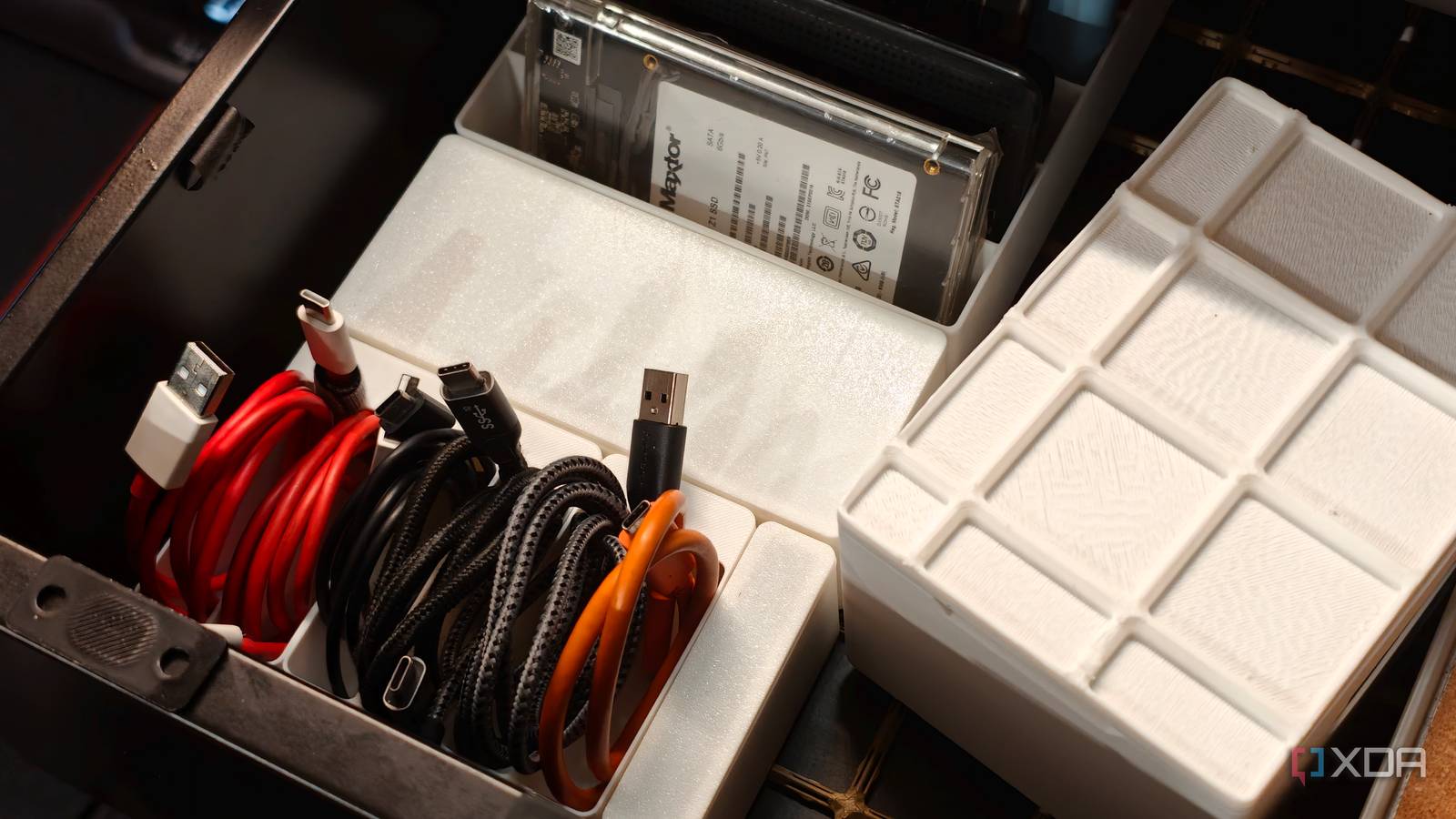
Published Sep 18, 2026, 11:00 AM EDT Dhruv Bhutani has been writing about consumer technology since 2008, offering deep insights into the personal technology landscape through features and opinion pieces. He writes for XDA-Developers, where he focuses on topics like productivity, networking, self-hosting, and more. Over the years, his work has also appeared in leading publications such as Android Police, Android Authority, CNET, PCMag, and more. Outside of his professional work, Dhruv is an avid fan of horror media spanning films and literature, enjoys fitness activities, collects vinyl records, and plays the guitar. You know the drill. The first time you buy a 3D printer, it's understood that you'll be going down a rabbit hole of home accessories to print. But, as stereotypical as that might sound, there are plenty of small items that I just don't buy from Amazon anymore. These items aren't necessarily expensive, but printing out a replacement at home using my 3D printer is simply faster. Lately, I've been using my 3D printer to solve small, annoying problems around my home, especially problems that can be easily solved with a simple piece of plastic and under an hour of free time. While there are dozens of such examples, and I'm sure I'm missing dozens more, here are three things that I printed just this week that solved daily frustrations. Custom trays and organizers for my desk Designing storage around my workspace Every weekend I clear out my work desk, and by Monday, it is in bad shape already. My desk accumulates small pieces of tech faster than I can store them away. From adapters to memory cards, cables and other tidbits. Conventional desk organizers can help, but most aren't really designed around my own desk setup. This means either wasted space or a shape and size that's too big or not very useful for my own space. I don't need multiple slots for pens, just two. USB storage, on the other hand, I need multiples of. This is where printed trays and organizers come in handy. To begin with, I can design and print a tray that fits into a specific part of my desk instead of trying to find one with the dimensions that are best suited to my desk. If I have a narrow gap beside a monitor, for example, I can use that space instead of leaving it blank. The same applies to compartments. I recently decided to dive into the Gridfinity bandwagon and printed out a full end-to-end grid for my two desk drawers. While I haven't printed out bins that fully occupy the space just yet, that's precisely the beauty of it. I can print as I go and shape the drawers for optimal space usage. So far, I've got a bin with compartments to store hard drives, a bin with a lid for USB drives and a bin specifically designed to keep USB cables organized. That's better than anything I could ever just purchase off Amazon. Print a bag clip or a dozen A small print saves me a trip to the store Bag clips are one of the first household items that made me realise how useful a 3D printer can be. It's something we always have a need for, and in a decent amount to boot. Look, I go through a lot of packets of snacks, coffee and cereal in the kitchen. My usual solution is to fold the packet over or use whatever clip I can find lying around. The problem with that is the former isn't particularly convenient. Folded bags have a tendency to pop open. Meanwhile, clips have a tendency to get lost. As it turns out, instead of buying more clips, I can just print them out. The useful part here isn't that a 3D-printed clip is better than one I could just buy off Amazon. Instead, the convenience is in the fact that I can print one or a dozen out any time I want. These are small prints that use very little filament and don't take long to finish printing. Plus, I can print several at once any time I know I'm running low. That's a huge upgrade over buying them from shops. For one, I don't have to wait for shipping every time I need an extra clip. Nor do I have to think about the cost or environmental impact of shipping something as basic as a single bag clip. Every time I need a spare, I end up printing a dozen and keep them around the kitchen. Every time one breaks or disappears, I just print another dozen. Simple. Custom stands for headphones (and masks) Height and size as I want them Stands are another category where I just print out things instead of buying them anymore. The problem is pretty straightforward. I get a lot of headphones for testing, and there's no way I can keep enough stands just sitting around. Sure, I have a few, but any time I have more headphones than stands, I just print them out. Similarly, I've got a collection of interesting masks. But any time I want to display them, I struggle to find a stand that's the right size. Some are too big, some too small. Others are not very aesthetic. So, I just print them out instead. I even got a lovely bronze-colored filament to give them a look that would fit perfectly in my decor. It's easier to print the small stuff Look, a 3D printer isn't going to replace every purchase. For example, I'm not going to print an oversized storage bin because the economics and time commitment of that just don't work out. But small, simple objects that solve specific problems are fair game in my books. I don't need to waste time waiting for an order to get delivered or rummage through drawers to find a bag clip. Printing it is just quicker, cheaper and a lot more fun. That's why, for a lot of these things, I just don't bother buying anymore. Bambu Labs A2L The Bambu A2L is a large-format bedslinger 3D printer capable of printing large volumes, and in multiple colors with AMS compatibility.
3 household items I no longer buy from Amazon because 3D-printing them takes 40 minutes
Full Article
Original Source
Read the full article at Xda-developers →KhanList aggregates and links to publicly available news content. We do not host full articles from third-party sources. Always verify important information with original sources.