
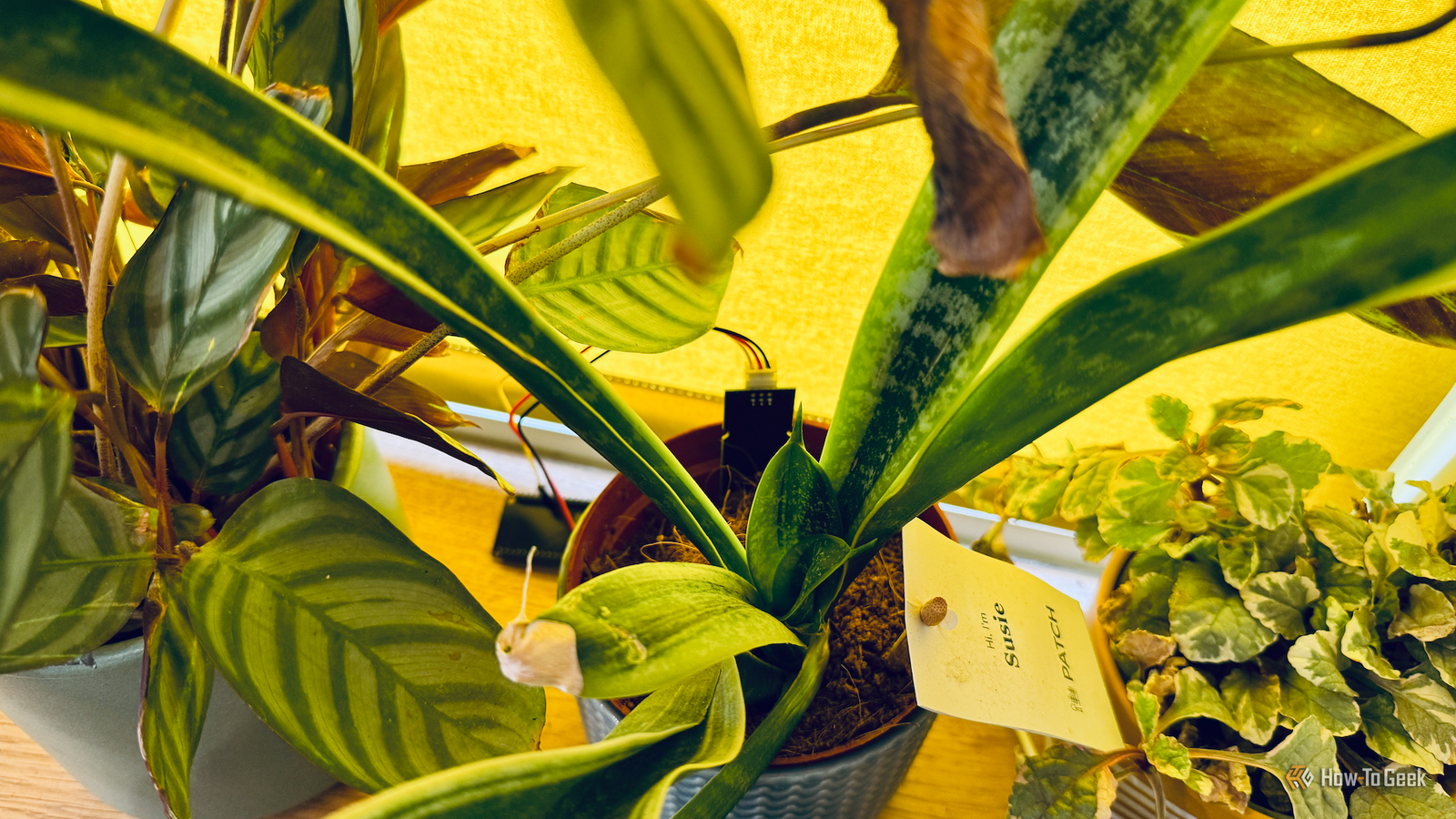
Published Oct 7, 2026, 3:30 PM EDT Adam has a degree in Engineering and has a life-long interest in technology. He has been writing for over a decade for various print and online publications, with a focus on consumer tech. He joined How-To Geek in 2024 while working at Pocket-lint. As well as being a long-term fan of Apple products, he also has a strong interest in smart home tech, running a Home Assistant server at home to automate all his smart home devices. He believes that the ideal smart home should work with minimal interaction from the user, with automations running as if by magic rather than requiring you to push buttons on a control panel. You can find more of his work on Muck Rack. Sign in to your How-To Geek account Home Assistant doesn't have to be solely about technology. You can use it for a much wider range of purposes, including helping you to keep your houseplants alive. These projects cover everything from simple monitoring to a fully automated plant-watering system. Build a plant monitor that knows when you're nearby A single ESP32 can provide plant monitoring and presence detection Building a soil moisture sensor is one of the simplest ESP32 projects you can do. You can hook up capacitive moisture sensors to an ESP32 without any soldering and use ESPHome to pull the data into Home Assistant to alert you when your plants need watering. You can even skip Home Assistant entirely and have the ESP32 flash when the soil gets too dry. One user has taken this idea a little further by using an ESP32-C6 and sensors to measure soil moisture, ambient light, battery voltage, USB power state, and even the ESP32's internal temperature. The ESP32 is also connected to an mmWave presence sensor. This sensor means that the RGB lighting that indicates when the plant needs watering can react when someone is in the room, triggering animations before returning to its previous state when they leave. There's even a night mode that keeps the LEDs off until presence is detected. Home Assistant handles all the moisture logic, lighting modes, and presence automation. The user's post includes useful information, such as a list of the hardware they used and wiring details. The 3D-printed housing files weren't available at the time of writing, so you may need to design them yourself. Give a plant lamp a Home Assistant brain ESPHome can replace the lamp's physical controls Credit: ToMiDevelop / Home Assistant Community Forum Ensuring that your plants are properly watered is only one factor in keeping them alive. Your plants also need enough light if they're going to thrive. You can buy grow lights for indoor plants to provide additional light if the ambient light in your home isn't enough. Many cheap plant lamps require manual control via simple controls for changing lighting modes and brightness, as well as timer settings. One Home Assistant user decided to make a generic plant lamp controllable via an automation instead. The project uses an ESP32-S3, with GPIO pins connected to the plant lamp's control pads. Using ESPHome, you can trigger the same functions that happen when you press the physical buttons. A Home Assistant automation can turn the lamp on and off and adjust the light color and brightness to help give the plant the light that it needs. The ESP32 is also connected to a soil moisture sensor, so that the whole setup can not only control the plant light but also determine when the plant needs watering. If you want to recreate the project, the wiring details and control logic are in the user's GitHub repo, including diagrams to help identify the correct control pads on the plant light's circuit board. Build a system that waters your plants for you Take the biggest point of failure out of the loop Credit: Chris Lee While the plant lamp can be automated using the project above, the soil moisture sensor is still purely for information. The ESP32 can't take over the job of watering the plant; it can only control the connected lamp. One Home Assistant user also decided to automate watering. The Plant1337 project, which builds off the original Plant133 project, is an ESP32-based plant watering system that can provide water to up to four plants from a single water reservoir. The system uses four capacitive moisture sensors to monitor the soil moisture for each plant. Four small aquarium pumps are used to pump water from the reservoir into each plant's soil when the moisture levels get too low. The watering system is more sophisticated than simply adding water until the soil moisture reaches a set level. Water takes time to diffuse through the soil, so pumping until moisture hits a specific level can lead to overwatering. Instead, the system uses pulsed watering, which gives water time to soak into the soil before deciding whether more is needed. The system also filters signals to reject noise and uses a float switch to detect when the reservoir has run dry. The creator estimates they fill the reservoir about once a week, and the system handles everything else automatically. Full instructions for building the system, including a parts list and KiCad files for the custom PCB that runs the system, are available on the user's GitHub repository. Home Assistant can help to keep your plants alive Each of these projects helps you to keep your houseplants from dying, with varying degrees of obsession. A simple soil moisture monitor can be effective, and you don't need to add presence sensing for it to be useful. Automating a grow light is a step up, but if you really want to automate (almost) everything, then building your own smart plant watering system is about as obsessive as you can get.
3 Home Assistant projects to stop your plants dying this weekend (Oct 9-11)
Full Article
Original Source
Read the full article at Howtogeek →KhanList aggregates and links to publicly available news content. We do not host full articles from third-party sources. Always verify important information with original sources.