
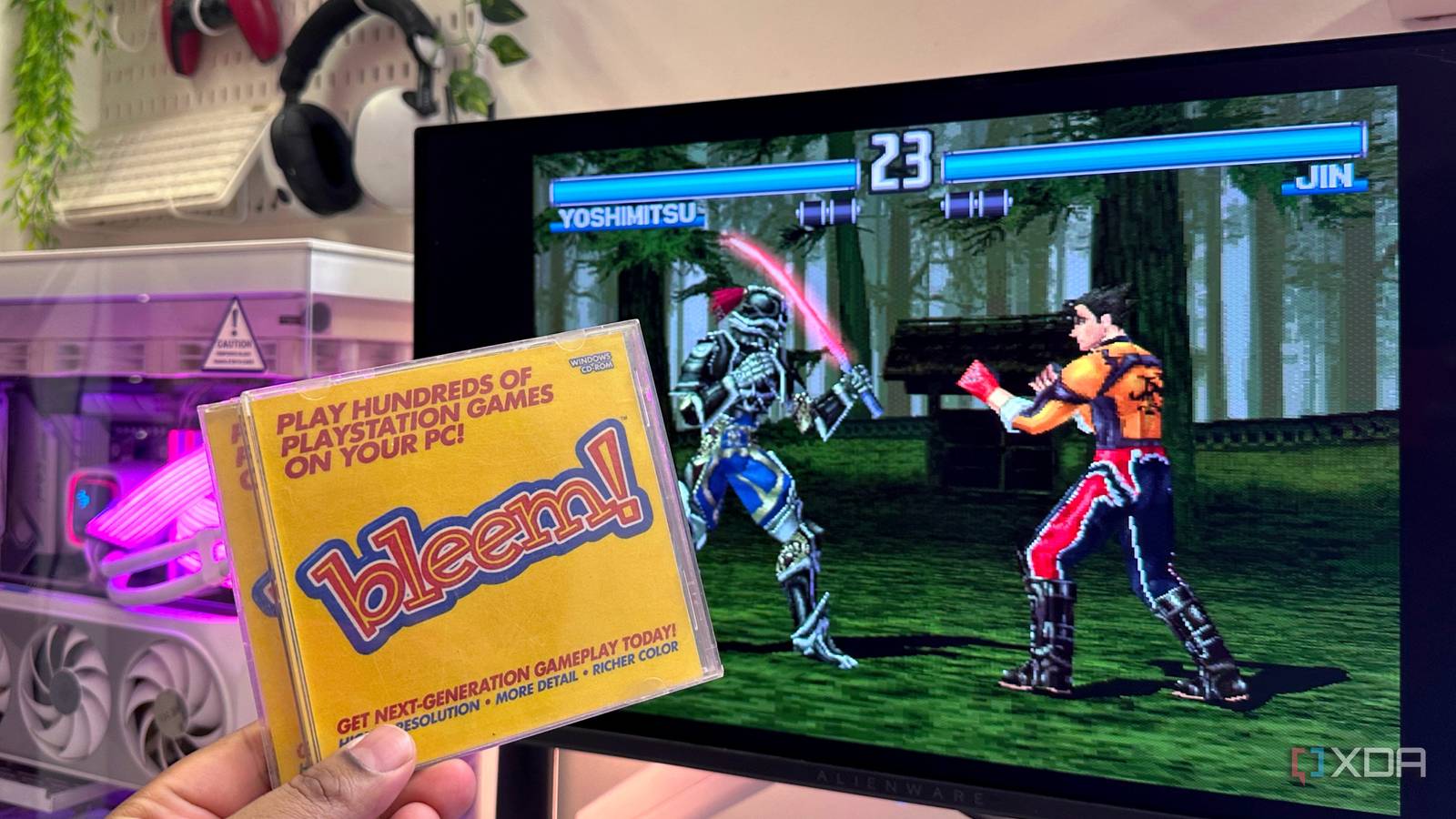
Published Nov 25, 2026, 8:30 AM EST Gaming has been Samarveer’s greatest passion, and the Literature graduate in him takes immense joy in dissecting games for their themes, messages, and impact. Samarveer holds a deep appreciation of gaming, and considers the platform to be the most immersive and impactful across all media. He can be found engaging with gaming communities online, always ready to debate the finer points of ray tracing or itching to write an 8-page collegiate thesis on any game that impacts him emotionally. Modern game preservation has reached a wonderfully strange point today. We've got fans tearing apart old console games, rebuilding them for modern hardware, and sometimes making them look better in the process. We now treat these projects as impressive technical feats, but nearly three decades ago, someone was already doing something remarkably similar with PlayStation games. In 1999, Bleem! let you play PS1 games on a PC by dynamically translating their code to run on completely different hardware. The most interesting part, though, was that it was a commercially sold PlayStation emulator, and you could walk into a store and buy it. Bleem! has to be one of the most fascinating pieces of software in gaming history, and it's a shame that it attracted the wrong kind of attention from Sony, who really didn't like what it was doing. Yes, you could actually buy a PlayStation emulator Bleem! made PlayStation games look better on a PC Recompilation can make old console games feel almost native on different hardware. Bleem! was doing something remarkably similar in spirit back in 1999, except instead of downloading a simple zip file from a GitHub repo, you could walk into a store and buy the emulator. Created by programmer Randy Linden and entrepreneur David Herpolsheimer, Bleem! was released for Windows in April 1999. It dynamically recompiled PlayStation code into x86 instructions, allowing PS1 games to run on PCs without Sony's hardware or software. Programmer Randy Linden says he wrote the emulator entirely in x86 assembly, including a runtime-optimizing recompiler. Furthermore, instead of just making PS games playable, Bleem! could use a PC's 3D accelerator to render them at higher resolutions with filtered textures and other enhancements. People's late-'90s PCs were making some PlayStation games look considerably cleaner. The compatibility wasn't perfect, but the technical achievement alone was ridiculous for something that could run on a Pentium 166MHz with about 16MB of RAM. And Bleem! wasn't some dodgy download passed around on IRC. The software was commercially distributed by Navarre and reached major retailers including CompUSA, Fry's, Electronics Boutique, Hastings, and Virgin Megastores. The retail version cost $29.99, turning PlayStation emulation into something you could quite literally pick up alongside your other PC games. Bleem! effectively (and single-handedly) set out to prove that emulation itself could be a legitimate commercial product, and for the most part, succeeded. That achievement, though, was rather short-lived, since Sony was about to take a very expensive interest in that idea. The emulator survived the lawsuits, but not the cost of fighting them It's not hard to see that Sony wasn't particularly amused by the idea of people buying software that could turn a PC into a better-looking PlayStation. It sued Bleem! in April 1999, before the emulator's full commercial release, arguing that the company was infringing Sony's intellectual property. Sony's problem, however, was that Bleem! had done absolutely nothing wrong, and the software had been deliberately designed to avoid the obvious legal tripwires. Bleem! didn't ship Sony's BIOS, PlayStation games, or Sony's copyrighted code. Its developers had reverse-engineered the console's behavior and written their own software to reproduce it. For quite a while, Sony struggled to prove that Bleem! itself was actually infringing something Sony actually owned. The courts repeatedly declined to simply shut Bleem! down, allowing the emulator to remain on sale while the legal fight continued. Bleem! even turned the tables by countersuing Sony, arguing that Sony's campaign was harming its business. That sounds like a victory, but winning in court and surviving in business are two very different things. Bleem! was a tiny company taking on one of the world's biggest gaming corporations, and every legal victory still meant another bill from its lawyers. Effectively speaking, Sony never proved that Bleem! was illegal. However, Sony still managed to make the emulator disappear by making it impossibly expensive to defend. Bleem! also went after the Dreamcast Bleemcast! turned Sega's console into an unlikely PlayStation Bleem! wasn't content with bringing PlayStation games to PCs. It eventually set its sights on Sega's Dreamcast, whose considerably more powerful hardware made it an excellent target for running enhanced PS1 games. The result was Bleemcast!, a heavily optimized version of the emulator designed specifically for Sega's console. And yes, you could actually buy that too. The Dreamcast's hardware gave Bleem! considerably more headroom than the original PlayStation, allowing games to look dramatically cleaner while retaining the original software. The idea was to put a PlayStation disc into a Dreamcast, boot Bleemcast!, and play the game with higher-resolution visuals and improved texture filtering. Sadly, that idea never came to full fruition, since Sega decided to part ways with the Bleem! team. Thankfully, even Microsoft showed interest in the project, according to Randy Linden. Linden has said Microsoft wanted to know whether Bleem's technology could help bring PlayStation games to the hardware that would eventually become the original Xbox, and that Bleem! received an offer from Microsoft that it ultimately rejected. But Bleem! never got the chance to turn that interest into another business. Only a handful of Bleemcast! titles reached consumers before the company's finances collapsed. Even though Bleem! survived Sony's courtroom assault, it were running out of money, and that was the biggest problem. Bleem! won the fight but lost the war Sony didn't have to beat it in court to take it off the shelves Credit: Mayuki Sawatari via Wikimedia Commons The irony of Bleem!'s downfall is that Sony never needed a decisive courtroom victory. Bleem! had spent millions defending itself, with one account putting legal fees at roughly a quarter of Bleem!'s $5.4 million in sales. In fact, Bleem! even alleged that Sony pressured retailers by threatening their PS2 allocations if they carried its products, although that remained an allegation rather than a court finding. By November 2001, Bleem! was finished, and its equipment was eventually auctioned off on eBay. The Dreamcast's collapse only made things worse. Sega discontinued the console in March 2001, removing the platform Bleemcast! was supposed to exploit just as Bleem! was fighting for survival. The company's shutdown page reportedly showed Sonic holding a flower beside a Bleem! gravestone, which is an almost comically bleak way to end a software company. And yet, Bleem! left behind something far more valuable than what you might find in sales figures. Its technology proved that sophisticated console software could be translated to entirely different hardware without simply copying the original code. In one final twist, programmer Randy Linden himself later went to work at Sony. The company that fought his emulator eventually became part of his career in PlayStation technology. The recompiler that arrived decades too early For anyone interested in game preservation, Bleem! is impossible not to admire. It arrived before the technology, business models, and legal expectations around preserving old games had settled into anything resembling normality. That makes Bleem! feel less like an obscure footnote and more like an early warning. The technical barriers that once made old games prisoners of their original consoles have steadily fallen, but the uncomfortable questions around ownership haven't disappeared. If anything, modern recompilations are proving just how much life remains in software whose creators stopped supporting it decades ago. Bleem! simply figured that out first. Sony S1700 All Region Blu-Ray DVD Player Dimensions 10.75" x 10.67" x 2.6" Connective Technology HDMI Brand Sony What's Included Blu-Ray DVD player, remote, HDMI cable The Sony S1700 supports Blu-Ray, DVD, and even CDs, so you can use it for all your physical media needs. It's also all region/region-free, meaning it can play discs from anywhere in the world.
27 years ago, you could buy a PlayStation emulator in stores, but Sony’s lawsuits killed it
Full Article
Original Source
Read the full article at Xda-developers →KhanList aggregates and links to publicly available news content. We do not host full articles from third-party sources. Always verify important information with original sources.