
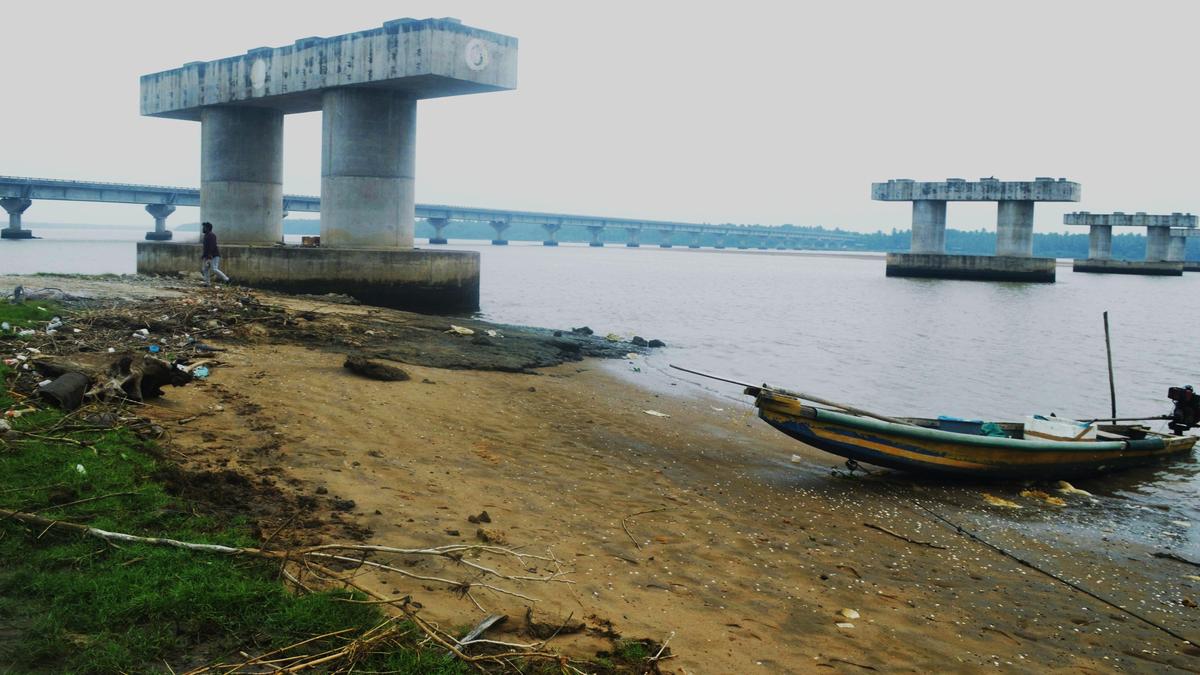
More than two decades ago, India’s first Dalit Lok Sabha Speaker, G.M.C. Balayogi — son of the Konaseema region — envisioned a 57-km-long Kotipalli–Narsapur railway line. Designed to connect Andhra Pradesh’s rice bowl to Narsapuram railway station via the towns of Amalapuram and Razole, the Konaseema Railway Line promised connectivity and better trade and commerce opportunities.The ambitious railway line was aligned to pass through the region’s coconut orchards and lush green paddy fields, stretching across the sacred Godavari River’s three mighty branches: the Gouthami, Vynateya, and Vasista.The project coincided with Chief Minister N. Chandrababu Naidu’s Vision-2020 initiative during his 1999–2004 term. On November 16, 2000, then-Railway Minister Mamata Banerjee laid the foundation stone for the Kotipalli–Narsapur line in Amalapuram town, along with Mr. Balayogi and Mr. Naidu.For the farmers of the Godavari Delta, the line was supposed to bring affordable transport right to their doorsteps, offering a direct lifeline to market their paddy, coconut, and banana crops.Yet, nearly twenty-five years later, that promise remains unfulfilled. While construction has progressed in fragmented stretches, persistent hurdles in the form of land acquisition and other obstacles left this crucial project stalled.For Koripalli Sambasiva, a 70-year-old farmer from Senipalli Lanka village on the banks of Gouthami in Dr. B.R. Ambedkar Konaseema district, the hope of one day seeing a train reach Konaseema is still alive. “I am still committed to parting with our family’s ten kunchams of land (one acre) thriving with coconut and banana orchards,” he says.“Like my fellow farmers 25 years ago, my family and relatives also respected the word of G.M.C. Balayogi and parted with 4.5 acres after his assurance of suitable compensation,” he adds.The excited farmers parted with their fertile lands, despite it having thrived with crops since the days of British General and Irrigation Engineer Sir Arthur Cotton, who proposed, designed, executed, and completed the construction of the Dowleswaram Anicut on the Godavari River in 1852.The Konaseema Railway Line, which was progressing efficiently, soon faced its first setback with the sudden death of Mr. Balayogi in a helicopter crash in West Godavari on March 3, 2002.“After the death of Mr. Balayogi, the erstwhile East Godavari district officials offered ₹2 lakh compensation per acre, which I did not accept. A few years ago, I approached the court for fair compensation, as the government did not initiate talks to reach a consensus,” Mr. Sambasiva says. He was not alone in seeking justice; many farmers from Inavalli Mandal also approached the court with similar appeals. These cases remain in the trial stage.Former A. Vemavaram Panchayat Sarpanch Daasam Gopala Krishna, farmer Durga Venkata Reddy Naidu, and others from the Amalapuram Rural Mandal have individually approached the Andhra Pradesh High Court for fair compensation and collectively express their desire for the railway line to become a reality.“Except for fair compensation, none of the farmers oppose the project on any other grounds. We are not strictly demanding the implementation of the Right to Fair Compensation and Transparency in Land Acquisition, Rehabilitation, and Resettlement Act, 2013, in letter and spirit. Any reasonable compensation offer in place of the 2001–02 package is acceptable. However, the government has not proposed any new package to settle the cases,” they say.RoadblocksAccording to officials, the project was planned in three phases: Kotipalli–Amalapuram (12.70 km), Amalapuram–Chinchinada (33.88 km), and Chinchinada–Narsapur (10 km), featuring major bridges across the Gouthami, Vynateya, and Vasista, according to the South Central Railway (SCR) officials. At present, the SCR has completed over 98% of the substructure construction, including bridge pillars.In some stretches the work has moved ahead, in others, it remains stalled. In the West Godavari district, 113.96 acres required for the project were acquired by the State government and handed over to South Central Railway by May 2019 for the Chinchinada–Narsapur phase. However, the government had proposed a realignment of the Amalapuram–Chinchinada route between Amalapuram and Pasarlapudi via Peruru, citing the need to avoid residential displacement due to rapid expansion in recent years.That is where the project hit another hurdle in the form of protests by the locals. They halted the resurvey by the SCR and moved the High Court against the realignment plan. Much to their dismay, in July 2025, the High Court vacated the stay issued on the land resurvey, ruling that route alignment was a government policy decision.After the court ruling, the SCR completed the land survey for the proposed realignment plan. “We have completed the land resurvey along the Amalapuram–Chinchinada route per the directives of the High Court of Andhra Pradesh and submitted the report,” says K. Sridhar, Deputy Chief Engineer of the South Central Railway.The survey numbers and funding of the project highlight the extent of the challenge. The Deputy Chief Engineer says that the State government has committed to handing over 238 hectares of land free of cost. “We are waiting to proceed with the next phase of work once the State government hands over the land,” he adds.According to Union Minister for Railways Ashwini Vaishnaw, the sanctioned cost of the project was ₹2,120 crore on a cost-sharing basis, with the Government of Andhra Pradesh required to provide 25% of the total cost. However, over the past 24 years, the State government has deposited only ₹52.69 crore for the project, while the Ministry of Railways spent ₹1,181.19 crore as of March 2024.The consequences extend beyond land acquisition and funding, with locals calling out the elected representatives of the region for failing to address the issue.The 57-km railway line spans the Narsapuram Parliamentary constituency—represented by Union Minister of State for Heavy Industries Bhupathiraju Srinivas Varma (BJP)—and Amalapuram, represented by G.M. Harish Balayogi (TDP), the son of the late G.M.C. Balayogi. Mr. Srinivas Varma’s office did not respond to requests for comments on the project’s status. The Godavari region elected 33 NDA MLAs (21 TDP, 11 Jana Sena, and 1 BJP) in the 2024 general elections. Three hold cabinet portfolios—Irrigation, Labour, and Tourism—in Mr. Naidu’s government, alongside Deputy Speaker R. Raghurama Krishna Raju.The locals allege that the project’s quarter-century delay is the root cause of the lack of political resolve, while the elected representatives cite court cases and other fictional hurdles as the reason.“Landowners and farmers are being persuaded to withdraw their cases with the assurance of fair compensation. Last week, the State government earmarked ₹150 crore for land acquisition and is prepared to release further funds as needed,” MP Harish Balayogi says, adding that every opportunity for additional Central funding for infrastructure is being explored to expedite the project. “The total estimated cost now stands at ₹3,950 crore. This project was my father’s dream, and I am committed to making it a reality,” he adds.No end to the waitFor those living along the proposed alignment route, the process has meant years of uncertainty. “Had the railway line been commissioned years ago, Amalapuram would have seen urban and commercial expansion on par with neighbouring cities like Kakinada and Rajamahendravaram,” says K. Tataji, president of the Amalapuram Chamber of Commerce.Nearly 80% of the population in the Konaseema region are farmers. Currently, the transport cost per tender coconut from Amalapuram to Hyderabad is ₹4 by road. “By train, the transport cost would drop to barely 10 paise per coconut. Farmers could sell directly in major cities like Hyderabad, where a single coconut fetches ₹50. This is an economic advantage that Konaseema farmers cannot afford,” he says. Dr. B.R. Ambedkar Konaeema district produces 5.66 lakh metric tonnes of coconut annually. | Photo Credit: T. APPALA NAIDU In Dr. B.R. Ambedkar Konaseema district alone, annual banana production exceeds 3.47 lakh metric tonnes, while coconut production across 41,604 hectares reaches 5.66 lakh metric tonnes—most of which is shipped out of the State. “Taking into account the surge in trade, passenger transport, and domestic exports of bananas and coconuts, the railways can recover the project’s operational costs within five years,” Tataji adds.It is not just about economic advantages, but also about better connectivity. “Amalapuram is the headquarters of Dr. B.R. Ambedkar Konaseema district, which is nearly 60 kilometers from Rajamahendravaram railway station and 64 kilometers from Samarlakota railway station on the main Chennai–Howrah route,” says E.R. Subramanyam, Convener of the Konaseema Railway Line Sadhana Samithi (KRSS).A retired lecturer based in Amalapuram, Subramanyam says “The railway line passing through the Godavari Delta would benefit the coastal belt as an alternative route between Chennai and Howrah if extended to Machilipatnam and Bapatla via Repalle. Once commissioned, it will attract agro-based and natural gas industries, boost tourism, and lower transportation costs for agricultural exports.”The locals say that the completion of the project could also serve as a vital link to the ports. The proposed Konaseema Railway Line provides direct connectivity to four regional ports in the Krishna–Godavari belt. Machilipatnam Port and Kona Port in the Kakinada SEZ—both within 100 kilometers—are expected to become operational within a year. In 2021, the Agricultural and Processed Food Products Export Development Authority (APEDA) initiated rice exports from Kakinada Deep Sea Port, while Kakinada Anchorage Port remains a key hub for India’s non-Basmati rice exports to Africa.Dr. B.R. Ambedkar Konaseema District In-Charge Collector Waikhom Nydia Devi says that she is yet to receive directives from the State government and is awaiting its land acquisition policy.For residents along the route, the wait continues. Vepati Subbayamma, who lives in a thatched house in a coconut orchard adjacent to the proposed station site, says, “I may not live to see trains pass through these fields.” Meanwhile, Polisetti Sivaji, a coconut exporter and aqua farmer, adds, “After waiting for 25 years, I doubt even Sir Arthur Cotton could convince today’s government to complete the project.”
25 years on, Konaseema Railway Line project yet to get on track
Full Article
Original Source
Read the full article at Thehindu →KhanList aggregates and links to publicly available news content. We do not host full articles from third-party sources. Always verify important information with original sources.