
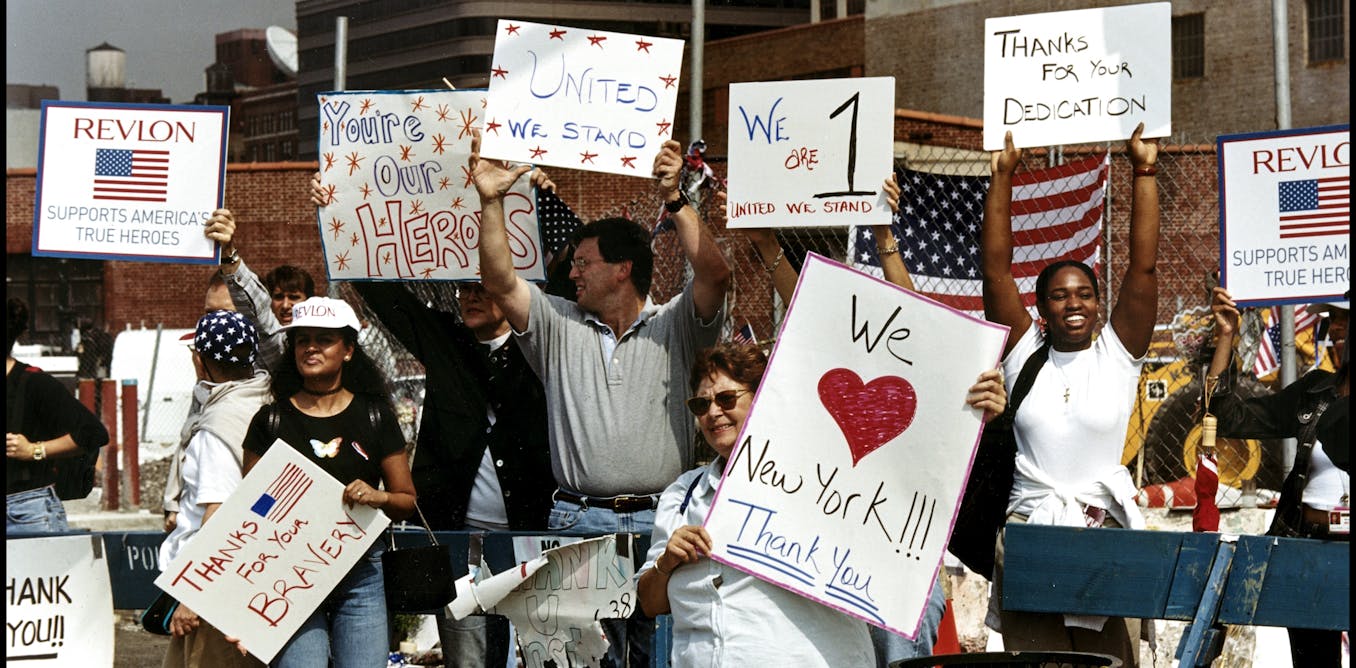
Many Americans will pause on the 25th anniversary of the 9/11 attacks to remember the nearly 3,000 people who were killed that day. The attacks became a shared national tragedy, the impact of which reached far beyond those who experienced them firsthand. The aftermath of such a disaster can place enormous strain on a community. If disruption is prolonged, support is inadequate and the economic and social structures that hold a community together are damaged. Relationships can fracture, trust can erode, and conflict can emerge. Disaster researchers describe this pattern as a “corrosive community.” As a social work researcher who has studied disaster recovery and worked alongside disaster-affected communities for more than two decades, I have witnessed another side of the human response to catastrophe: Amid tremendous hardship and loss, people reach for connection and find strength in community. What happens after a disaster A national survey conducted just after 9/11 found that about half of Americans had responded to the crisis by giving to charity, and nearly a quarter donated or tried to donate blood. Volunteer sign-ups surged. The research I conducted with colleagues on marriage and divorce following 9/11 offered another window into the disaster’s effects. We examined divorce rates across all 62 New York counties, comparing the four years after the attacks with the decade before them. Divorce rates were significantly lower than expected in three of those four years. Even by 2005, the statewide divorce rate remained about 8% below what the previous decade’s trend would have predicted. These patterns point to something I have observed in the decades since: During collective crises, people often turn toward family and social relationships. I saw that instinct again in 2005, after Hurricane Katrina, which killed nearly 1,400 people and caused more than US$125 billion in damage, making it one of the costliest natural disasters in U.S. history. Amid enormous devastation and displacement, families took in relatives, and volunteers and organizations from across the country stepped forward. In our research on more than 7,200 children and adolescents from Louisiana communities heavily affected by Katrina, we found that two years after the storm, disruptions such as separation from family and community were among the experiences associated with greater post-traumatic stress symptoms. In our work with crisis counselors in Louisiana, we found that people who had experienced significant losses themselves described finding meaning and healing through helping others recover. Recovery happens together The National Oceanic and Atmospheric Administration has documented a sharp rise in billion-dollar disasters in recent decades. In 2024, the last year for which NOAA shared data, the U.S. saw 27 such disasters, compared with an average of about nine a year since 1980. As these events grow more frequent, understanding what helps communities recover will become more urgent. For some communities – like those on the Gulf Coast – disasters are not isolated events but repeated experiences. Following the Deepwater Horizon oil spill in 2010 – the largest marine oil spill in U.S. history, which released 134 million gallons of oil into the Gulf – I asked 41 residents what advice they would give others facing similar crises. Many of them had endured multiple disasters, including Hurricanes Katrina, Rita and Gustav. Their advice was striking in its simplicity: Lean on your faith and find strength in community. Years later, I heard the same message thousands of miles away when I visited Hawaii after the 2023 Maui wildfires, which destroyed the town of Lahaina and killed more than 100 people, making it the deadliest U.S. wildfire in more than a century. During my research for a book about community resilience, residents spoke to me not about individual survival, but about community and a shared commitment to rebuilding. These were different disasters, places and decades, yet the message was remarkably similar. Volunteers deliver food and bottled water to elderly residents impacted by the 2023 wildfires in Lahaina, Hawaii. AP Photo/Jae C. Hong Corrosive communities Recognizing the strength within a community does not diminish its losses or lessen the responsibility to support it. People recovering from catastrophe need housing, economic assistance, mental health services and sustained investment. Without adequate resources to rebuild, the connections that help people move forward can themselves become strained, contributing to a corrosive community. The 1989 Exxon Valdez oil spill was one of the largest environmental disasters in U.S. history. It killed hundreds of thousands of birds and other wildlife and billions of fish eggs, driving families and businesses dependent on fishing into bankruptcy. In its aftermath, the community of Cordova, Alaska, experienced years of economic loss, prolonged litigation and uncertainty. Researchers documented declining trust, weakened social connections, conflict and population decline – effects that, in some cases, persisted for decades. A corrosive community becomes more likely when recovery is prolonged, resources are inadequate or uneven, and trust erodes. Communities are more likely to cohere when support is adequate, resources are distributed fairly and institutions are trusted. In my assessment, recovery is rarely an individual accomplishment; instead, it happens through families, neighbors, community organizations, volunteers and, sometimes, strangers. What disasters reveal about us The American Psychological Association reports that 62% of adults identify divisions in society as a significant source of stress. And despite being more connected than ever through technology and social media, roughly half of Americans show signs of loneliness. Our differences do not disappear after catastrophes, but people find ways to connect despite them. Research following Hurricane Maria, a 2017 storm estimated to have killed nearly 3,000 people, found that survivors extended help beyond their social circles, crossing political, socioeconomic and religious divides and even past conflicts. Disaster solidarity may be temporary, but it reveals something enduring: Our capacity for connection does not appear when a hurricane makes landfall, wildfire spreads or an unimaginable act of violence like 9/11 occurs. It’s already there. There is something to learn from a disaster that can help in the everyday moments that test us, too.
25 years after 9/11, what disasters reveal about Americans’ ability to reconnect
Full Article
Original Source
Read the full article at Theconversation →KhanList aggregates and links to publicly available news content. We do not host full articles from third-party sources. Always verify important information with original sources.