
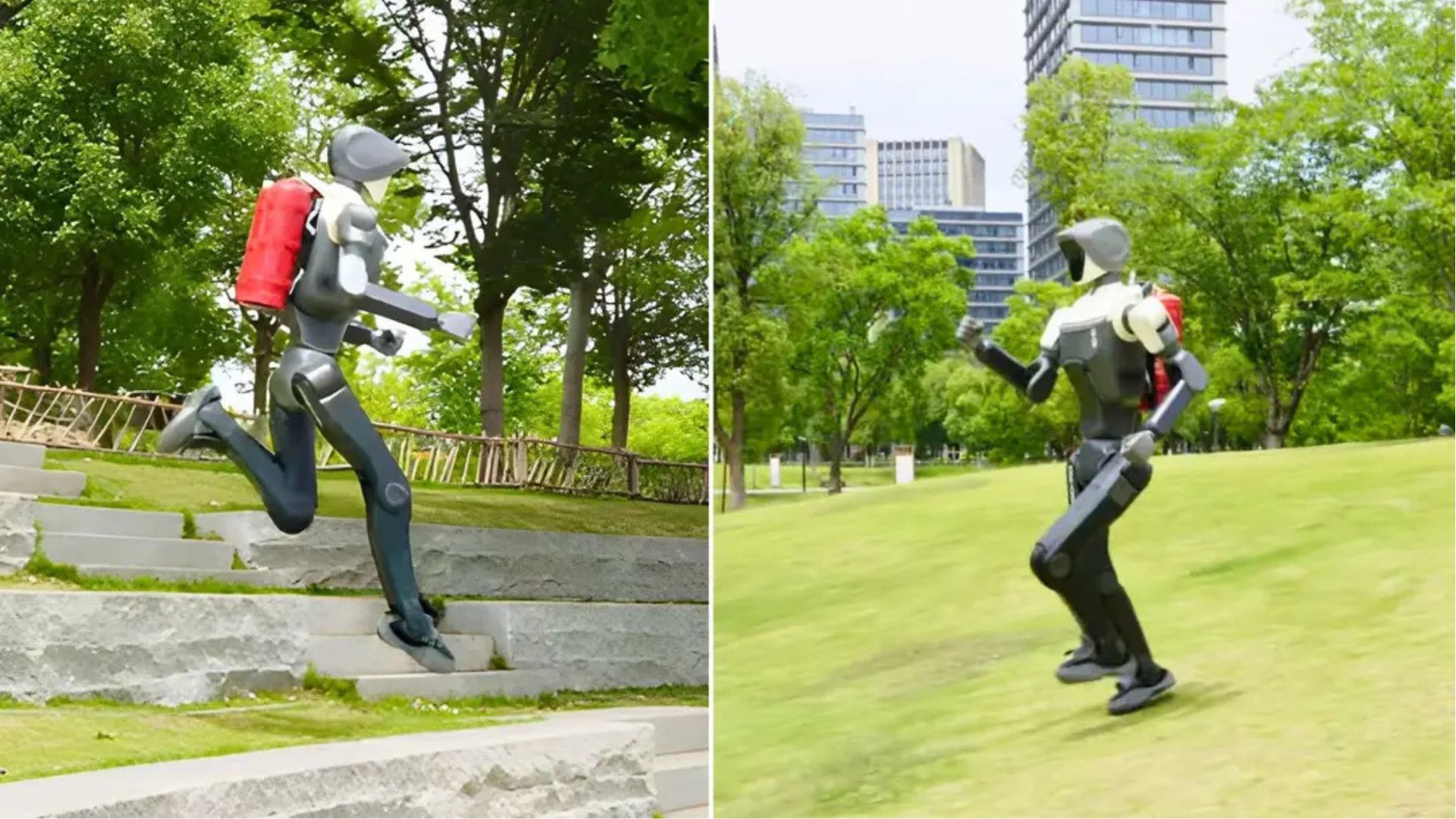
Twenty-three humanoid robot teams competed in a simulated firefighting and rescue mission in Beijing on Sunday. The exercise was part of testing their ability to operate in complex, real-world conditions at the second World Humanoid Robot Games. The emergency management event was held at a real fire brigade rather than a controlled indoor mock-up, requiring robots to navigate realistic scenarios and perform practical tasks. The second World Humanoid Robot Games is slated to bring 2,056 robots from 666 teams and 16 countries to Beijing, featuring new long jump, weightlifting, tug-of-war and table tennis events. Humanoids test rescue The second World Humanoid Robot Games in Beijing saw 23 robots being assigned a simulated firefighting mission designed to test their performance in realistic conditions. Unlike last year’s competition, this year’s scenario-based events emphasize “realistic simulation,” with the firefighting challenge held at a real fire brigade rather than in a model room setting, reports Global Times (GT). Each robot was given 30 minutes to complete three tasks: identify hazardous materials, shut off valves, and extinguish a fire. Robots had to identify two randomly placed simulated hazardous substances and report their types through images, locate and close three randomly selected valves, then find a fire extinguisher and spray it until the fire was put out. Human firefighters helped stage the exercise by lighting the fire and monitoring whether robots handled the extinguishers correctly. The challenge highlighted the difficulties robots still face outside controlled environments. Rain, changing lighting and outdoor conditions affected visual recognition and manipulation. UniX AI’s robot completed its run within the time limit but moved considerably slower than human firefighters and needed two attempts to align its hand with the extinguisher target. Of the 12 teams that competed Sunday, only three completed the full challenge, underscoring the gap between laboratory demonstrations and reliable real-world deployment. Humanoids battle complexity The second edition of the event, co-hosted by the Beijing Municipal Government and China Media Group, has expanded from three to five days, with competitions running in the afternoon and evening. The games now feature 30 competitive and 21 scenario-based events, up from 26 events at the inaugural edition. The number of participating teams has risen 138 percent, while robot participation has quadrupled, highlighting the rapid expansion of the event. The firefighting challenge highlighted how humanoid robots still struggle to translate laboratory capabilities into reliable performance in unpredictable environments. Rain, changing light, and outdoor conditions affected visual recognition and manipulation, with failures in either perception or motion planning capable of derailing an entire run. Robots had to identify objects, select the correct actions, and coordinate multiple joints precisely while maintaining balance, reports GT. The test also exposed the complexity of humanoid hardware. Different tasks require a combination of high-precision joints for dexterous hand movements and high-torque actuators for strength, stability and locomotion. Some robots used omnidirectional wheels instead of conventional feet, while multi-jointed hands were designed for more precise manipulation. Teleoperation remains an important part of the technology stack. Some teams used VR headsets to remotely control robots shortly before or during their runs, with operators receiving first-person views from onboard cameras and guiding movements in real time. Several teams used China-developed joint modules, with servo actuators offering torque levels ranging from low-force precision control to high-force movements.Experts say real-world competitions generate valuable failure data that can help improve robots’ perception, motion-planning and AI systems.Get the latest in engineering, tech, space & science - delivered daily to your inbox.Jijo is an automotive and business journalist based in India. Armed with a BA in History (Honors) from St. Stephen's College, Delhi University, and a PG diploma in Journalism from the Indian Institute of Mass Communication, Delhi, he has worked for news agencies, national newspapers, and automotive magazines. In his spare time, he likes to go off-roading, engage in political discourse, travel, and teach languages.
23 droid teams try to put out fire under 30 minutes in World Humanoid Robot Games
Full Article
Original Source
Read the full article at Interestingengineering →KhanList aggregates and links to publicly available news content. We do not host full articles from third-party sources. Always verify important information with original sources.