
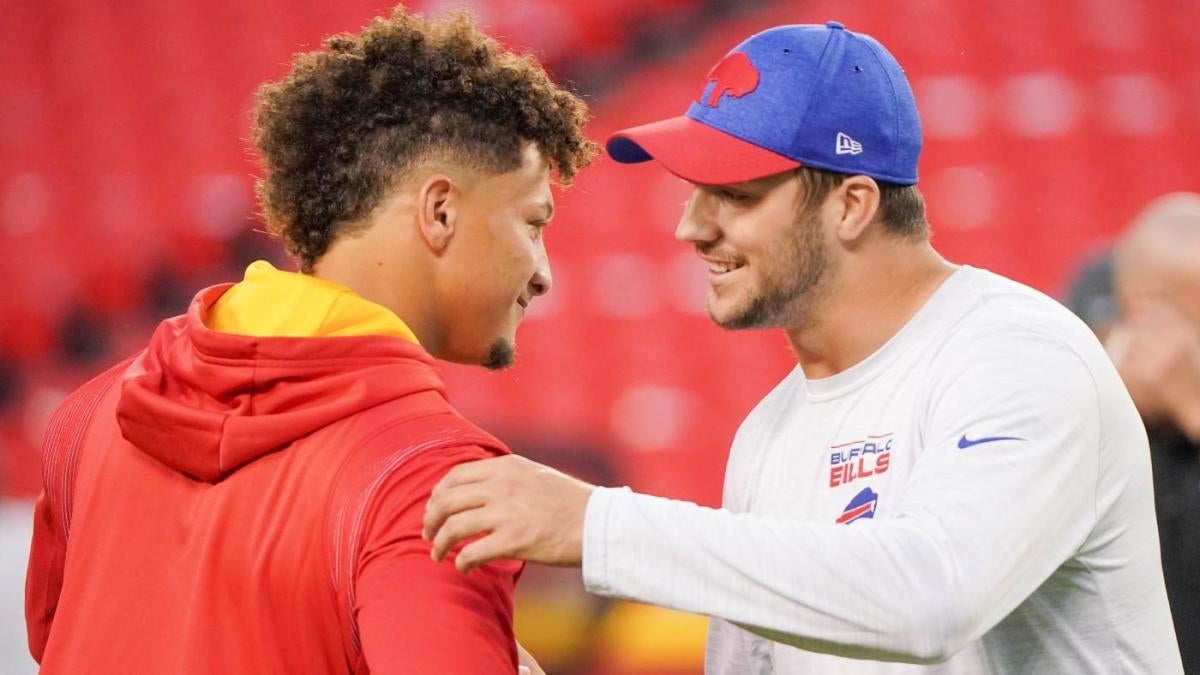
This is part of an ongoing look at the 2027 quarterback class, combining my scouting reports with more than a decade of historical data. We've already looked at why this supposedly loaded class may be closer to 2025 than 2024.Patrick Mahomes was the Air Raid system quarterback. Josh Allen was the traits bet. Jordan Love was the raw passer from Utah State who threw 17 interceptions in his final season. Daniel Jones was the quarterback the Giants reached for at No. 6. Drake Maye entered his final year at North Carolina in the conversation for the No. 1 pick, wasn't nearly as good as he'd been the season before and still went third overall.We remember those evaluations for different reasons, but they tend to get lumped into the same general conversation: quarterbacks NFL teams were willing to gamble on despite unconventional college resumes, uneven production or questions that made them more projection than finished product. Go back through the numbers, though, and something interesting happens. Most of these quarterbacks weren't nearly the historical outliers we remember them as.That was one of the biggest things I found while researching the 2027 quarterback class. For that, I created something we'll call the First-Round Readiness Score -- FRED for short -- to answer a specific question: How close is a quarterback to looking like the players who historically become first-round picks? FRED looks at the things that have historically separated first-round quarterbacks -- passing efficiency, touchdown and interception rates, QBR, experience and, importantly, a quarterback's best three- and five-game stretches. The idea isn't to predict whether he'll succeed in the NFL; it's to measure how much his college performance, at that point in his career, resembles what we've historically seen from future first-round picks.The scale is intentionally easy to read: 50 is the historical first-round threshold. But for what we're trying to learn here, when a quarterback gets there may be just as important as whether he gets there at all. The most revealing FRED score turned out to be the one before his final college season because it tells us which quarterbacks had already started playing like future top picks with another season still to go.Here's why: 22 quarterbacks in our historical sample had played enough football to reach a FRED score of 50 before their final seasons. All 22 became first-round picks. And when I went looking for first-round quarterbacks who had played extensively but remained below 50 before their final seasons, I found three -- although all three were right on the doorstep. Jayden Daniels was at 49.5 before his final season, Zach Wilson was at 48.9 and Josh Rosen was at 48.5. That's interesting on its own. It gets considerably more interesting when you look at who some of those 22 quarterbacks were.The 'projection' QBs who had already shown more than we remember Let's start with Mahomes because there may not be a better example of how much hindsight can distort the way we view a prospect.He entered his final season at Texas Tech with a FRED score of 55.7, already comfortably above the historical first-round benchmark, though that's not how the conversation around him felt at the time. He played for Kliff Kingsbury in an Air Raid offense that led to some absurd passing production -- and still, Texas Tech went just 13-19 in his 32 starts. There were questions about how much of that production belonged to Mahomes and how much was a function of the system. But the quarterback himself wasn't nearly as unusual as the circumstances around him. Mahomes' career EPA/dropback ranked in the 84th percentile among the QBs in our historical data, going back to 2015. His QBR was in the 90th percentile, and he had already attempted more than 1,100 passes. Texas Tech's offense was excellent; the team just didn't win very much. So, yes, the record looked unconventional for a future top-10 quarterback, but the quarterback's stat line did not.In the 2017 draft, Kansas City eventually traded up from No. 27 to No. 10 for Mahomes. Since then, the Chiefs have made five Super Bowl appearances, winning three times. Allen got there from a completely different direction. Wyoming was never confused with Texas Tech. He wasn't throwing for 5,000 yards in a wide-open offense, his traditional passing numbers weren't overwhelming and his final season gave evaluators even more to worry about. Accuracy was a major question throughout the draft process, and the Bills ultimately traded up for a quarterback whose completion percentage had fallen to 56.3% in his final college season. And still … Allen had already logged a FRED score of 51.6 before that 2017 season.That's what surprised me when I went back through this. The model wasn't telling us Allen was a polished passer or that his accuracy concerns didn't matter. It was telling us that calling him a pure traits bet undersold what he'd already done. Wyoming wasn't particularly good around him, but Allen still had other things working in his favor -- passing efficiency, his ability as a runner, winning and experience -- that had already pushed him into a historical group made up entirely of future first-round picks.Put differently: Allen wasn't asking the NFL to ignore three years of evidence because he was 6-foot-5 with a huge arm. His play was already pointing in the same direction as the traits. And then there's Daniel Jones. Jones may be an even more useful example because no one remembers the Duke quarterback as an obvious top-10 prospect before his final season. Yet his FRED score as a sophomore was 54.5, and he followed that with a score of 47.4 as a junior before declaring for the draft. He didn't have Mahomes' passing numbers or Allen's physical profile, and Duke's offense wasn't especially impressive. But Jones had gained a ton of experience and added another dimension as a runner.Then the Giants took him sixth overall.You can disagree with what Jones ultimately became in the NFL and still recognize what the model is telling us about the evaluation at the time: The pick surprised plenty of people, but Jones' college profile fit the first-round mold better than we may remember.What happens after a QB has already shown enough?It gets better. Of those 22 quarterbacks who reached a FRED score of at least 50 before their final college seasons, nine saw their scores decline in their final year. QBPre-final FREDFinal FREDDraft slotBryce Young81.763.6No. 1Drake Maye78.055.9No. 3Trevor Lawrence72.463.0No. 1Jordan Love61.248.9No. 26Tua Tagovailoa87.179.9No. 5Deshaun Watson62.157.4No. 12Josh Allen51.649.7No. 7Michael Penix Jr.68.667.5No. 8Daniel Jones54.547.4No. 6That's 41% of the group, and seven of the nine were still selected in the top 12. Bryce Young and Trevor Lawrence went No. 1 overall. Maye went third. Allen seventh. Penix eighth.Maye remains a fantastic recent example. His 2022 season was the one that made him look like a future top pick, and his FRED score of 78.0 confirmed as much. Then it all came back to earth in 2023. His FRED score dropped to 55.9 -- still above the 50 threshold, but a regression from the previous year. His touchdown total fell from 38 to 24. North Carolina went from nine wins to eight, and during the pre-draft process there was plenty to debate about Maye's spot in the first-round pecking order that also included names like Caleb Williams and Jayden Daniels.The Patriots still took him No. 3 overall.Jordan Love's version was more extreme. He was at 61.2 following his breakout 2018 season, then fell below the threshold to 48.9 as a junior while throwing those 17 interceptions on an offense that had lost its running game and revamped its offensive line. Green Bay still traded up to take him 26th overall.That's important because quarterback development isn't always linear, and a player's best season isn't necessarily his last one. Sometimes our evaluation of a player becomes too dependent on whatever we saw most recently. A worse final season matters, but it shouldn't erase what came before it.When the reputation really did outrun the evidenceOf course, first-round buzz doesn't mean the numbers support it, and the quarterbacks who never got there tell us something, too.Think about Sam Howell, Will Levis and Quinn Ewers. All three spent time in Round 1 conversations before their final college seasons. Unlike Mahomes, Allen, Love and even Jones, none had posted FRED scores suggesting they'd already played like future top picks.Far from it, in fact. Howell had a FRED score of 29.2 before his final season at North Carolina. Levis, meanwhile, was at 5.4 before his last year at Kentucky. And Ewers entered his final Texas season at just 9.2.The 2026 class gave us three more examples.Cade Klubnik entered his final Clemson season with a FRED score of 36.4. That was an improvement from where he'd been earlier in his career -- but still nearly 14 points short of the historical first-round line. Instead of making another leap in 2025, he regressed -- in part due to injuries and a Tigers offense that sputtered for much of the season -- and eventually went in Round 4 to the Jets.Carson Beck posted a FRED score of 21.2 in his final season at Georgia before transferring to Miami for his last year of college football. In 2025, he improved to 31.9 -- still well short of 50 -- before the Cardinals selected him in the third round.Drew Allar continues this same theme. The size and arm talent kept evaluators intrigued into the fall, but the numbers never came close to matching the expectations. His FRED score was just 8.0 in 2023 and improved to 27.4 in 2024, but he still entered his final season well short of 50 before an injury ended his 2025 campaign after just six games. In one of the biggest surprises of the draft, the Steelers took him in the third round.And, yes, injuries complicate the evaluation, but they don't change the larger point: The first-round reputation was always running well ahead of what he'd actually shown.When you put the groups next to each other, the distinction is hard to miss:QBFRED before final seasonDraftPatrick Mahomes55.7Round 1 (No. 10)Jordan Love61.2Round 1 (No. 26)Josh Allen51.6Round 1 (No. 7)Daniel Jones54.5Round 1 (No. 6)Cade Klubnik36.4Round 4Sam Howell29.2Round 5Drew Allar27.4Round 3Carson Beck21.2Round 3Quinn Ewers9.2Round 7Will Levis5.4Round 2The point isn't that FRED could have predicted Mahomes' NFL career, that Allen would fix his accuracy issues or that Jones would justify the sixth pick. That's not the model's job.What it does show is an important difference between the two groups. Mahomes, Allen, Love and Jones may have been unconventional prospects for different reasons, but they'd already played like future first-round picks. Howell, Levis, Ewers, Klubnik, Beck and Allar hadn't.And then there's the guy who actually broke the pattern The NFL Draft wouldn't be nearly as interesting if history explained everything. Cam Ward is the reminder that there are always exceptions.Ward had played plenty of football before his final season. He began his college journey at Incarnate Word and transferred to Washington State, where he attempted more than 1,100 passes before arriving at Miami in 2024.His FRED score at that point? 6.8.Then Ward produced one of the most dramatic one-year improvements in the data. He went from 6.8 to 49.3. His adjusted YPA improved from 8.1 to 10.4. His QBR jumped from 62.7 to 84.0, and Miami's Offensive SP+ (Bill Connelly's opponent-adjusted measure of overall offensive efficiency) went from 31.0 to 44.2. Ward got considerably better, and the Hurricanes offense made the leap right along with him.And he still never reached a FRED score of 50. Tennessee took him No. 1 anyway.What makes Ward even more unusual is how far away he was before that final season. The other experienced first-round QBs who sat below 50 before their final years -- Jayden Daniels, Zach Wilson and Josh Rosen -- were all right on the doorstep, between 48.5 and 49.5. Ward was different: He had played a ton of college ball, and the model had years of evidence telling us he didn't look like a typical first-round quarterback.That's why we shouldn't treat any of this like a de facto big board. NFL teams saw things FRED doesn't measure: the arm talent, creativity, pocket movement, ability to make throws from different platforms and the improvement showing up on tape. Ward's '24 season gave teams enough reason to believe the player he'd become mattered more than the historical profile he'd built before it.For all the questions surrounding Mahomes, Allen, Love, Jones and Maye, they'd already shown the type of production we see from future first-rounders. Ward hadn't -- and he really was the outlier.And maybe that's the larger lesson here. Projection will always be a big part of evaluating quarterbacks, in part because it's never just about the production. The point of all this is trying to figure out who the player will be two, three, five years from now.But before we dismiss the concerns about the next quarterback by pointing to Mahomes or Allen, ask this: Had he already shown what they had?
2027 NFL Draft: Patrick Mahomes, Josh Allen and the myth about betting on traits
Full Article
Original Source
Read the full article at Cbssports →KhanList aggregates and links to publicly available news content. We do not host full articles from third-party sources. Always verify important information with original sources.