
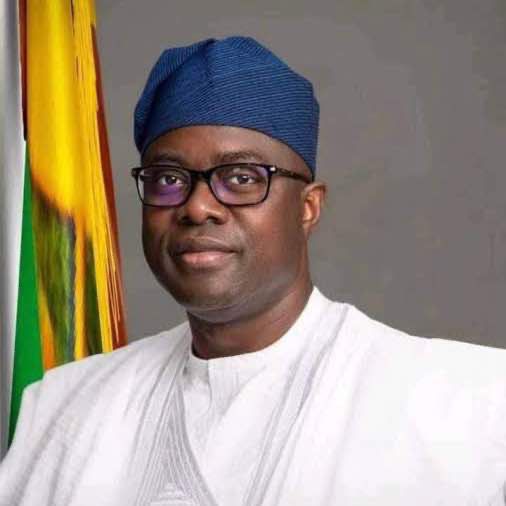
Restates four years transitional government of national unity Chuks Okocha in Abuja The presidential candidate of the Allied Peoples Movement (APM), Governor Seyi Makinde of Oyo State, yesterday unveiled his RESET NIGERIA manifesto stating that his microeconomic reforms would lead to the overall welfare of Nigerians and not the present poverty and hunger in the country.He also hinted at overhauling the present political system to address the social challenges in the country. He explained that this was why his four-year tenure, if elected, would be transitional to reset the polity, but added that, as a serving President, “I will not be a beneficiary.” Addressing party chieftains in Abuja, Makinde said, “For us, macroeconomic reforms must translate into improvements in people’s lives.“I think it was one Kanu Adamu who, in a post about two days ago, said that microeconomic stability should mean having access to affordable food. What does macroeconomic stability mean if it does not improve the living conditions of ordinary Nigerians?“Macroeconomic stability must have a direct impact on the people through job creation, improved incomes and a lower cost of living. These are issues we cannot shy away from,” he stressed. According to the APM presidential candidate, “The second concern is that government must take responsibility for results or the lack of them.“I have been trying to explain particularly that we dare not reinforce the system that produced the current situation. Let us leave that discussion until 2027.“In 2027, within the first two weeks, we will begin to address the issues and set the process in motion. “Nigeria has the resources and the capacity to achieve greatness. Nigeria is rich in natural resources and human resources, but our leaders are poor in ideas.“Thirdly, our institutions must work across our differences rather than allowing division and bribery to obstruct national development.“It should not matter which political party you belong to or who you know. What should matter is national development and the commitment to improving the lives of our people,” he stated. According to Governor Makinde, “We want a situation where some of the ideas contained in our manifesto will be brought into the open and discussed.“However, I would like to emphasise that we did not come up with these ideas on our own. They are the outcome of extensive consultations. We held town hall meetings across all the geopolitical zones of Nigeria and listened to the people. We asked them: What would you like to see? What kind of Nigeria are you thinking about? “The outcome of those consultations informed our agenda. I remember that, somewhere in the North-East, somebody asked me: Can you give us the Tafawa Balewa of our time? Are you going to be the Awolowo of our time or the Azikiwe of our time? “I remember the passion with which that question was asked and the expectations it carried. It made me realise the weight of the responsibility before us. Therefore, we must take this responsibility seriously. We must not disappoint Nigeria,” he stressed. He said that these ideas were not his alone, as they were the ideas of Nigeria’s founding fathers. According to him, “Somewhere along the line, in the way a relay race is conducted, one person runs the first lap before handing over the baton to another runner. I think we dropped the baton somewhere along the line. Therefore, we must now return to rebuilding the Nigeria our founding fathers envisioned.”Talking about the Nigeria of his dream, Governor Makinde said, “We want a Nigeria that works for every Nigerian, irrespective of the part of the country they come from, their religious background or their ethnic identity. “Our founding fathers understood that we had differences and rivalries in this country. That was why they organised constitutional conferences and engaged in discussions about the future of Nigeria. I believe our founding fathers were undoubtedly among the best this country had to offer at that time.“When you go to the universities, you see students graduating at the top of their classes. In the past, many of those who excelled academically went into the public service. “Today, however, the best of the best no longer want to work in the public sector. They prefer to work in the private sector because of the financial opportunities available there. “You cannot blame them for that because it is a simple proposition. I do not want to complicate things. I do not want a situation where I start using big grammar such as price modulation to explain issues that should be straightforward.” In view of this, he said, “My simple proposition is that government must make life easier for the people. That is all. “We must develop people’s abilities and expand their access to opportunities. We must also have institutions that work. “Concrete promises alone are not enough. Every promise must be linked to a responsible institution, a delivery plan and measurable results that citizens can verify. It is not enough to say we have this or that and then engage in arguments. What matters is that citizens can verify the results. That is the standard behind our Reset Agenda. “There are four major concerns that have shaped my decision to seek the presidency. I did not just wake up one day and suddenly decide to become President of Nigeria. There are four fundamental issues driving my decision, and they form the basis of the Reset Agenda. “As the vice-presidential candidate said, we held discussions despite coming from completely different backgrounds and different parts of Nigeria. I am Yoruba, from the South-West, while he is Hausa. “Let me also use this opportunity to appreciate our national leaders from the different parts of the country. During the process, they made contributions and sacrifices, even when it meant having to lose sleep at night. “Our leaders from the North-East and the North-Central also contributed immensely to the process. “The first concern is the emphasis on macroeconomic reforms to the detriment of broad-based economic growth. “It is almost like someone saying, ‘This family has a lot of money in its savings account,’ without considering the welfare of the people who make up that family,” he stated. On the need for political realignment, Makinde said, “Political parties will come and go, but our national development plans and the things we must do for our people must remain constant. We must continue to implement them, irrespective of the political party in power. “Fourthly, more than half of Nigeria’s population lives in poverty. These people must be at the centre of government decisions. They should never be treated as an afterthought. “All four issues I have mentioned are interconnected, and they require a coordinated response. This is why Nigeria needs a Reset Agenda.”According to the APM presidential candidate, “So, let us get to the heart of the Reset Agenda. “Our economic agenda focuses on reducing the structural cost of living. We must lower the cost of production and enable Nigerian businesses to become competitive. “For instance, no matter how hard I try, a manufacturer who relies on generators powered by diesel will continue to incur high production costs. We must make it possible for manufacturers to connect to the national electricity grid and access electricity at a lower cost. “Of course, the cost of energy remains a major burden on businesses. We export plastics and many other products to the Republic of Benin. Today, some businesses are leaving Nigeria because our operating environment is not competitive enough. “So, what do we mean by the structural cost of living? We are talking about avoidable costs that make essential goods and services more expensive for you and me.” On the Tuesday US midterm elections, he said, “By the way, this week, I was watching developments in the United States when I left the house, and what I saw irritated me. In the US, one political party can gain control of Congress, the Senate and the House of Representatives. That is the kind of democracy we want to practise. “However, because of developments affecting democracy in the United States, oil prices declined by about one per cent. For most of last week, crude oil traded at about $100 per barrel. “As the price of crude oil rises in the international market, more money is taken from the pockets of Nigerians and transferred into the Federation Account.“I know how this works because, for several years now, I have participated in the process of federal allocations. Every month, state commissioners of finance come to Abuja for the allocation process. “In fact, someone once said that state allocations were given to us by the Federal Government. That is not the case. The money is paid into the Federation Account and must constitutionally be shared among the different tiers of government. “Therefore, nobody should say that the President gave you this money or that money. These are revenues belonging to the Federation and are shared in accordance with the Constitution. “So, when crude oil sells at a higher price in the international market, what happens? More money is taken from the pockets of ordinary Nigerians and transferred into the Federation Account. “Therefore, as part of our Reset Agenda, we must ask an important question: How will this additional revenue be used to benefit the majority of Nigerians?“What value does every Nigerian derive from the increase in oil prices, particularly considering that we are not yet a sufficiently productive country?”On the subsidy regime, he said, “Yes, there has been a lot of political debate about petroleum subsidy, but under our Reset Agenda, we have a clear pathway to deliver value to Nigerians. “I am particularly passionate about this because the oil and gas industry is one I have worked in for almost all my life. “This is part of the Nigerian dream. I left Ibadan in early October 1990 with just a bag containing a few belongings, perhaps two pairs of trousers, three or four shirts and a book. The only thing I had was the fare to travel to Kaduna with my degree. “I travelled across the country, searched for opportunities and eventually secured a job. I got married, had children and built my life in that environment. I also established my business there, working and growing through the opportunities available to me. “Therefore, when people talk about value creation and value distribution, these are things I experienced and practised in those days. “I know what it means to create value, and I believe Nigerians must derive value from the increase in the price of crude oil in the international market.“The government has been talking about price modulation and the Presidential CNG Initiative. Some of these interventions may provide short-term solutions, but we must also consider the long-term approach. “There are certain things that Nigerians, including ordinary people on the streets, already understand about the current administration. “For instance, when it comes to the federal government’s budget, there is a lack of transparency. Today, Nigerians do not have a clear understanding of the projects being implemented and the actual performance of the budget,” Makinde stressed.
2027: Makinde Unveils Manifesto, Prioritises Microeconomic Reforms for Citizens’ Welfare
Full Article
Original Source
Read the full article at Thisdaylive →KhanList aggregates and links to publicly available news content. We do not host full articles from third-party sources. Always verify important information with original sources.