
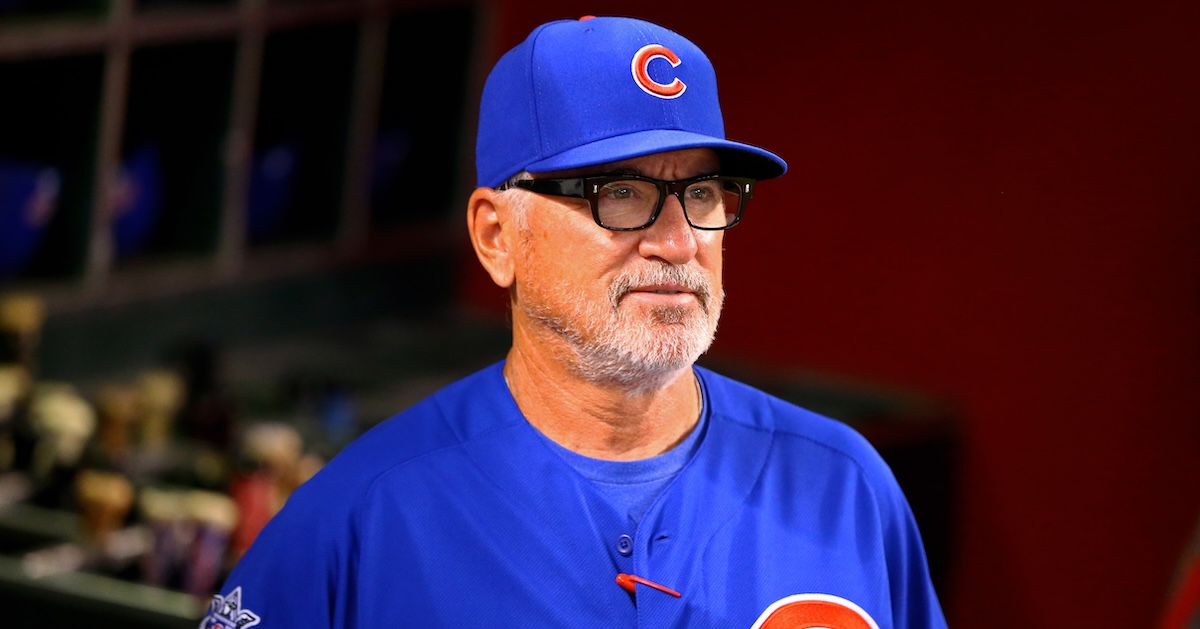
Mark J. Rebilas-USA TODAY Sports This post is part of a series covering the 2027 Contemporary Baseball Era Committee Managers/Umpires/Executives ballot, which includes candidates in those categories who made their greatest impact from 1980 to the present. You’ll find an introduction to the ballot here. The eight candidates will be voted on in San Diego on December 6, and anyone receiving at least 75% of the vote from the 16 committee members will be inducted in Cooperstown on July 25, 2027 along with any candidates elected by the BBWAA. Joe Maddon was the right manager at the right time more than once. A former minor league catcher who never reached the majors as a player, and who spent over three decades in various capacities within the Angels’ organization, Maddon didn’t get his first major league managerial job until he was 52 years old. As part of a new regime that took over a Tampa Bay team that had never won more than 70 games in the franchise’s eight-year history, Maddon clicked with a cutting-edge front office and helped mold a young squad into an American League powerhouse seemingly overnight. The Devil Rays won 66 games in 2007, Maddon’s second season, then — after a nominal exorcism that made them the Rays — 97 games and the AL pennant in ’08 before losing to the Phillies in the World Series. Maddon led the Rays — a team that generally ranked near the bottom of the league in both attendance and payroll — to the playoffs four times in a six-season span from 2008–13, winning AL Manager of the Year honors twice. With his horn-rimmed glasses, his varied interests beyond baseball, and his understanding of statistical analysis, he emerged as an icon, a hip and literate nerd who could lead the game’s Davids into battle with Goliaths, or just recommend a nice merlot. From a 2008 Sports Illustrated profile by Stephen Cannella: Maddon is a voracious reader who keeps a wine rack in his Tropicana Field office, bikes five to 10 miles most days and can hold forth on a seemingly endless array of topics: James Michener novels, gardening, self-help psychology and the best cycling routes in every American League city, for starters. On an off night in New York City before a crucial September series against the Yankees, Maddon planned not an evening of tinkering with lineups or poring over scouting reports, but of rocking out at a show by the B Street Band, a Springsteen cover band fronted by an old friend from high school. And he keeps things light enough that his team, the sixth youngest in the majors this season, sometimes forgets that the silver-haired man on the top step of the dugout is 54. Name another manager who has gotten a Mohawk after a game, as Maddon did last month when his players were getting shorn in a show of team unity. “He has the personality of a teenager,” says 24-year-old rotation ace Scott Kazmir. “He fits in well with us.” After general manager Andrew Friedman left the Rays to become the Dodgers’ president of baseball operations following the 2014 season, Maddon exercised an opt-out clause in his contract and joined the Cubs, who were ready to shift towards contending after three years of rebuilding under president of baseball operations Theo Epstein. Maddon guided the Cubs to their first postseason berth in seven years in 2015, winning Manager of the Year honors again. In 2016, he led them to their first World Series triumph since 1908, ending the longest championship drought in major league history. In all, he took the Cubs to four postseasons in five years before returning to the Angels to finish his managerial career. A native of Hazleton, Pennsylvania, Maddon played baseball and football at Lafayette College — the alma matter of current major leaguer David Bednar — about an hour and a half away in Easton, Pennsylvania. Undrafted out of college, he signed with the Angels in 1975 and spent four seasons (1976–79) as a catcher in their minor league system, though he never progressed above A-ball. Upon retiring as a player, Maddon spent the next 27 seasons wearing a variety of hats for the Angels: scout, field coordinator, instructional league coordinator, minor league manager (1981–86), roving minor league hitting instructor (1987–93), director of player development (1994), and major league coach (mid-1994–2005). One of his earliest player development successes came at Rookie-level Idaho Falls in 1981, when he was involved in the decision to move 18-year-old third baseman Devon White to the outfield; White would go on to win seven Gold Gloves as one of the best center fielders of his time.You Aren't a FanGraphs MemberIt looks like you aren't yet a FanGraphs Member (or aren't logged in). We aren't mad, just disappointed. We get it. You want to read this article. But before we let you get back to it, we'd like to point out a few of the good reasons why you should become a Member. 1. Ad Free viewing! We won't bug you with this ad, or any other. 2. Unlimited articles! Non-Members only get to read 10 free articles a month. Members never get cut off. 3. Dark mode and Classic mode! 4. Custom player page dashboards! Choose the player cards you want, in the order you want them. 5. One-click data exports! Export our projections and leaderboards for your personal projects. 6. Remove the photos on the home page! (Honestly, this doesn't sound so great to us, but some people wanted it, and we like to give our Members what they want.) 7. Even more Steamer projections! We have handedness, percentile, and context neutral projections available for Members only. 8. Get FanGraphs Walk-Off, a customized year end review! Find out exactly how you used FanGraphs this year, and how that compares to other Members. Don't be a victim of FOMO. 9. A weekly mailbag column, exclusively for Members. 10. Help support FanGraphs and our entire staff! Our Members provide us with critical resources to improve the site and deliver new features! We hope you'll consider a Membership today, for yourself or as a gift! And we realize this has been an awfully long sales pitch, so we've also removed all the other ads in this article. We didn't want to overdo it. In case you didn't read all that, here's the short version. Membership includes:✓Ad-free browsing✓Unlimited FanGraphs & RotoGraphs articles✓Historical & platoon projections✓Leaderboard & player-page stat heatmaps✓One-click data exports✓Customizable player-page dashboards✓Dark & Classic site modes✓Weekly Members-only mailbag✓FanGraphs Walk-Off, your year in review✓Optional homepage photo removal✓Gift articles to non-Members✓Full postseason coverage After manager Buck Rodgers was fired by the Angels in mid-May 1994, Maddon joined the staff of successor Marcel Lachemann as the bullpen coach. He took over as first base coach in 1995, then as bench coach in ’96, and went 8-14 as interim manager after Lachemann was fired and interim manager John McNamara hospitalized due to a blood clot in his right calf. Maddon spent the 1997–99 seasons as the bench coach under Terry Collins, but the Angels’ September 1998 collapse — they went 9-15, squandering a three-game AL West lead — and then a dreadful ’99 season led to Collins’ resignation in early September of the latter year. As interim manager, Maddon guided the Angels to a 19-10 record as they played out the string. Though incoming general manager Bill Stoneman interviewed him for the managerial opening, Stoneman instead chose Dodgers Triple-A manager Mike Scioscia. Maddon spent six seasons as Scioscia’s right-hand man, a span during which the Angels reached the postseason three times, as many as they had during their first 40 seasons of existence (1961–2000). In 2002, they won 99 games, claimed the AL Wild Card spot, then went on to win a seven-game World Series over the Giants (managed by fellow candidate Dusty Baker). After the 2003 season, Maddon was a finalist to succeed Grady Little as the Red Sox manager, but lost out to Terry Francona, for whom things worked out quite well. Still, Maddon impressed Epstein, then the Red Sox GM. Ahead of the 2016 World Series — which pitted the Cubs against Francona’s Cleveland team — Epstein recalled, “He was unique among managerial candidates at that time, with how loose he was, his sense of humor, his creative take on a lot of different parts of the game. He had so many years of bench coaching in the big leagues and managing in the minor leagues that he had strong convictions about the ways he wanted to do things. His personality was really entertaining, charming and offbeat.” In November 2005, the 51-year-old Maddon beat out Tampa Bay bench coach John McLaren for the job to succeed Lou Piniella as the Devil Rays’ manager. To that point, the team had escaped the AL East cellar and reached 70-win mark only once in eight seasons, in 2004, Piniella’s second season; in his third and final one before being bought out of his contract, they backslid to 67-95. While it didn’t look like a promising situation for a first-time manager, the Devil Rays had just changed hands from original owner Vince Naimoli to Stuart Sternberg, a Goldman Sachs options trader willing to embrace the type of analytically-driven principles that had caught on in places like Oakland, Boston, and the Bronx. Sternberg brought in 29-year-old Goldman Sachs colleague Matthew Silverman to be team president and promoted the 28-year-old Friedman, the team’s director of baseball operations, to be executive vice president and GM. Friedman replaced Chuck LaMar, the team’s original GM, who prior to the 2005 season had proclaimed, “The only thing that keeps this organization from being recognized as one of the finest in baseball is wins and losses at the major league level.” Widely ridiculed at the time, those words would prove prophetic. Draft picks such as Carl Crawford (second round, 1999) and B.J. Upton (no. 2 overall, 2002) had already reached the majors, and more talent was on the way. The Devil Rays won just 61 games in Maddon’s inaugural season, during which 2003 overall no. 1 pick Delmon Young and 2000 16th-round pick James Shields debuted; Kazmir, a mid-2004 trade acquisition, made his first All-Star team. The team improved to 66 wins in 2007, as Crawford, Upton, Shields, and scrapheap pickup Carlos Peña all blossomed, with the last of those hitting 46 home runs. Still, nobody was prepared for what transpired in 2008. Fueled by the arrival of rookie third baseman Evan Longoria (the third pick of the 2006 draft), as well as a six-player blockbuster that sent the OBP-challenged Young and two other players to Minnesota for a package that netted starter Matt Garza and shortstop Jason Bartlett, the Rays rocketed to 97 wins and a division title. The 31-win improvement is still tied for the third-largest of the division play era (since 1969). Bartlett helped the team set a record with a 56-point improvement in defensive efficiency, which helped the pitching staff take a massive leap forward. Maddon drew media attention for his wit and wisdom, as well as unorthodox tactics such as using four-man outfields and issuing an intentional walk to Josh Hamilton with the bases loaded in order to face Marlon Byrd. Rays players appreciated that he was a better fit for them than Piniella. “He’s a young team’s manager. He allows us to have fun,” Upton told the New York Times’ Alan Schwarz in August. “He’s very calm, quiet and trusting,” said Shields. “He allows us to police ourselves. Sometimes, you have a manager who yells at you every night, but he doesn’t do that. He’ll sit you down and talk to you and teach you.” The Rays began their first postseason appearance by beating the White Sox in a four-game Division Series — making them the first team to improve by at least 30 wins and then win a playoff series — and then they outlasted Francona and the defending champion Red Sox in a seven-game ALCS during which they’d hit 16 homers, with Upton and Longoria clubbing four apiece, and Peña three; Garza’s two strong outings earned him the series MVP. The World Series didn’t go as well, as the Phillies dispatched the Rays in five games, the last of which was suspended after the top of the sixth inning in Philadelphia due to rain and not resumed until two days later. Like so many other teams that take a big step forward in one year, the Rays lost ground in the next, sinking to 84 wins and a third-place finish in the AL East. Notably, that season was a breakout one for Ben Zobrist, who led the majors with 8.7 WAR while playing every position but pitcher and catcher and mainly splitting time between right field and second base. In the coming years, his versatility would enable Maddon and the Rays to plan around multiposition platoons to get better matchups. Maddon and the Rays remained on the cutting edge in other ways. They began deploying infield shifts to take away hits, particularly against pull-happy hitters. From 2010–13, 1,440 batters hit into shifts against the Rays according to data from Sports Info Solutions — 310 more than any other team — and they hit for a major league-low .256 average on those occasions, 13 points lower than the next most-frequent shifting team, the Orioles. That strategy helped the Rays win at least 90 games annually over those four years, making the playoffs three times. From the New York Times’ Hunter Atkins in 2012: “None of it’s by the seat of our pants,” Maddon said last Friday in St. Petersburg. Supplied with the scrupulous details of every hitter’s tendencies and engineered with precision, the Rays are doing what other teams are increasingly doing, just more of it. …“As a hitter, when you look up and you see the field presented differently to you than it’s been since you were 5 or 6 years old, that could matter,” he said. “All of a sudden you pause and think, ‘Do I actually hit the ball like that?’ You don’t even realize it sometimes. Anytime you can raise the level of doubt, it’s always a good thing.” The Rays won the AL East with a 96-66 record in 2010, with Crawford, Longoria, and lefty David Price — the overall no. 1 pick of the 2007 draft — putting together big seasons, but they were bounced by the Rangers in a five-game ALDS, scoring just one run over the first two games before recovering to make things competitive. In 2011, they went 91-71, winning six of their final seven games to snatch the Wild Card berth away from the Red Sox, who went 7-20 in September. On the seasons’ final night, the Rays rallied from a 7-0 deficit against the division-winning Yankees with a six-run eighth followed by Dan Johnson’s pinch-hit solo homer when they were down to their final strike in the ninth. They won in the 12th on Longoria’s walk-off solo homer, his second homer of the game. Alas, for the second season in a row, the Rays were ousted in the ALDS by the Rangers, who beat them in four games. Despite the addition of a second Wild Card in each league, a 36-22 record after July 31, and a Cy Young-winning season by Price, they missed the playoffs in 2012; their 90 wins was three short of landing them a spot. They eked out a Wild Card berth in 2013 by winning a Game 163 tiebreaker over the Rangers, then beat Cleveland in the AL Wild Card Game before falling to the Red Sox in a four-game ALDS. In 2014, the Rays slipped to 77-85. When Friedman left for the Dodgers in mid-October, Maddon — who had one year remaining on his contract — exercised an opt-out clause tied to Friedman’s departure after he and the team couldn’t hammer out an extension. Initial speculation suggested he could eventually join Friedman in Los Angeles, but instead Maddon headed to Chicago. After the Red Sox’s infamous 2011 collapse, Epstein had resigned to become the Cubs’ president of baseball operations, then embarked upon a multiyear rebuilding program in an effort to end the championship drought. In his first three seasons in Chicago, the team had climbed from 61 wins to 66 to 73 while youngsters like Anthony Rizzo, Starlin Castro, and Kyle Hendricks found their footing in the majors, with rookie manager Rick Renteria drawing praise for his guidance in the last of those seasons. Epstein planned to go into 2015 with Renteria at the helm, but Maddon’s unanticipated availability shook up the Cubs’ plans, and in the end they signed the free agent skipper to a five-year, $25 million contract despite the awkward situation. “Rick deserved to come back for another season as Cubs manager, and we said as much when we announced that he would be returning in 2015,” wrote Epstein in a statement to announce the change. “We saw [Maddon’s availability] as a unique opportunity and faced a clear dilemma: be loyal to Rick or be loyal to the organization. In this business of trying to win a world championship for the first time in 107 years, the organization has priority over any one individual. We decided to pursue Joe.” At his introductory press conference, Maddon spoke of his managerial philosophy as well as his goals. From NBC Chicago: “Don’t ever permit the pressure to exceed the pleasure,” he said. “That’s on the top of my lineup card every night. This is baseball. It’s a game. When we’re playing games in September and October, I want them to play like it’s March 15. Never change the way you play the game. If you train yourself to play the game the same way regardless of the date on the calendar, you can play well in pressure moments.” In that same press conference, Maddon said, “I don’t know exactly when it will happen, but in my mind’s eye, we’re going to make the playoffs next year,” a statement that proved prescient. Fueled by Cy Young winner Jake Arrieta and the arrivals of NL Rookie of the Year third baseman Kris Bryant, shortstop Addison Russell, and catcher-outfielder Kyle Schwarber, plus free agents Jon Lester and Dexter Fowler, the Cubs won 97 games, their highest total since 1945. In an ultracompetitive NL Central, that was still good for only third place behind the 100-win Cardinals and 98-win Pirates, but they did secure a Wild Card berth, then beat the Bucs 1-0 in the NL Wild Card Game behind Arrieta’s five-hit shutout and Fowler’s solo homer. The Cubs also beat the Cardinals in a four-game NLDS, with rookies Bryant, Schwarber, Javier Báez, and Jorge Soler, accounting for six of their 10 homers. Alas, they were swept by the Mets in the NLCS, with second baseman Daniel Murphy homering in all four games. After the season, the Cubs signed Zobrist, Jason Heyward, and John Lackey as free agents, and in 2016, they won a major league-leading 100 games; Bryant won NL MVP honors while Lester and Hendricks finished second and third in the NL Cy Young race. The team beat the Giants in a four-game NLDS, then overcame a two-games-to-one deficit to beat the Dodgers in the NLCS. The Cubs fell behind three games to one in the World Series against Cleveland, which itself hadn’t won a championship since 1948, but they rallied to even the series. In an epic Game 7, the Cubs squandered a 5-1 fifth-inning lead, as Lester and closer Aroldis Chapman, both working in relief of Hendricks, proved to be out of gas. With Chicago four outs away from a long-awaited championship, Cleveland scored three runs in the bottom of the eighth inning to tie the game. The Cubs got the go-ahead run as far as third base with one out in the ninth but couldn’t capitalize. After the ninth, the game went into a 17-minute rain delay, during which Heyward called a players-only meeting. The Cubs scored two run in the top of the 10th and held on to win, 8-7. The moment reflected Maddon’s willingness to trust in his players. “I’m not a meetings guy,” said the manager afterwards. “I love when players have meetings, I hate when I do. So they had their meeting and the big part of it was, we don’t quit. We don’t quit.” Events that happen less than once in a century generally prove difficult to follow up, and the Cubs’ championship was no exception. Maddon’s team did win the NL Central with a 92-70 record in 2017, then won a five-game NLDS against the Nationals. In an NLCS rematch, the Dodgers avenged their 2016 defeat, outscoring the Cubs by a combined score of 24-8 in a five-game series to win their first pennant since 1988. Though the Cubs won 95 games in 2018 and owned at least a share of the NL Central lead from July 14 onward, they went just 12-10 from September 8–30, and finished the regular season tied with the Brewers. A Game 163 tiebreaker loss to Milwaukee forced the Cubs into the winner-take-all Wild Card Game, which they lost to the Rockies — who themselves had lost a Game 163 tiebreaker to the Dodgers — in 13 innings. It was downhill from there. With Epstein labeling the 2019 season “a year of reckoning” after the Cubs’ early exit, Maddon worked without an extension. Cued by Epstein, he expressed a desire to be more hands-on with regards to instructing young players, harkening back to his days as a minor league instructor, and didn’t blanch at his lame-duck status. But near the end of an 84-78 season, Maddon and the team agreed to part ways. Three weeks later, he went home, agreeing to manage the Angels after signing a three-year, $12 million deal with an option that would vest if they won the pennant, something they’d failed to do since 2002. The Angels had crashed to 72 wins in 2019, Brad Ausmus’ lone season after succeeding Scioscia, despite an MVP-winning season from Mike Trout and a strong offensive showing from Shohei Ohtani as he rehabbed from Tommy John surgery. Unfortunately, the COVID-19 pandemic disrupted the late stages of Ohtani’s rehab, and he strained his flexor pronator after just two pitching appearances; meanwhile, his performance at the plate completely collapsed. Incoming free agent Anthony Rendon was good — the only time that would happen in his Angels career — but Albert Pujols remained in his late-career funk. The team went just 26-34 and missed the playoffs. Ohtani rebounded in a big way in 2021 as both a hitter and pitcher, but a severe right calf strain limited Trout to 36 games, while hamstring and hip injuries limited Rendon to 58 games. The Angels finished fourth in the AL West at 77-85. To the surprise of the baseball world, the Angels started the 2022 season 27-17, but amid a perfect storm that included slumps by Trout and Ohtani, and injuries to Rendon and Taylor Ward, they lost 12 in a row. In early June, the 68-year-old Maddon was fired, replaced on an interim basis by Phil Nevin. The move caught Maddon off guard. “We were the best thing since 2002 sliced bread up until a couple of weeks ago and now we’re not, so that’s the part that just doesn’t make sense, but I can live with it,” he said. He did hint at friction with the front office, saying, “I’m into analytics, but not to the point where everybody wants to shove it down your throat… You’re unable to just go to the ballpark and have some fun and play baseball. It’s too much controlled by front offices these days.” The Angels, who finished with 73 wins after firing Maddon, have yet to improve upon that total while burning through three more managers. Maddon never managed again, though he has continued to sound off about the encroachment of analytics. “It gets to the point where the pregame is a meeting every day… players don’t need all this information, quite frankly. They need nuggets. They don’t need dissertations,” he told The Athletic’s Starkville podcast in 2022. Last month, on the Foul Territory podcast, he complained about front offices turning managers into middle managers, saying, “Front offices don’t want the guy that may have a solid opinion or a thought based on experience, that is frowned upon. The game today would rather lose analytically than win based on feel because they think based on feel or experience is ethereal.” … Hall-wise, Maddon’s biggest obstacle might be the length of his career, at least relative to the competition on this ballot. Baker, Piniella, and Bruce Bochy all spent at least 21 full seasons in the dugout, but due to Maddon’s comparatively late start, the pandemic, and his midseason firing, he completed just 15 full seasons. He’s 31st in games managed (2,599) and 32nd in wins (1,382), whereas Baker and Bochy are in the top eight in both categories, with over 4,000 games managed and over 2,100 wins. I threw the basic managerial stats of all four of this ballot’s managerial candidates into a table, along with those of the three managers besides Piniella who were on the 2024 version, including Jim Leyland, who was elected. I also added the five enshrined AL/NL managers who managed fewer games than Maddon during careers that began or crossed over into the 20th or 21st centuries. Taken all together, I think they help situate Maddon’s case: Some Managerial Comps for Joe Maddon Manager Status* Games Wins Losses Win% G > .500 Playoff Pennant WS Bruce Bochy 2027 4518 2252 2266 .498 -14 9 5 4 Dusty Baker 2027 4046 2183 1862 .540 321 13 3 1 Lou Piniella 2027 3548 1835 1713 .517 122 7 1 1 Jim Leyland HOF 3499 1769 1728 .506 41 8 3 1 Joe Maddon 2027 2599 1382 1216 .532 166 8 2 1 Miller Huggins HOF 2570 1413 1134 .555 279 6 6 3 Earl Weaver HOF 2541 1480 1060 .583 420 6 4 1 Ned Hanlon HOF 2530 1313 1164 .530 149 0 5 0 Davey Johnson 2024 2445 1372 1071 .562 301 6 1 1 Al Lopez HOF 2425 1410 1004 .584 406 2 2 0 Whitey Herzog HOF 2409 1281 1125 .532 156 6 3 1 Cito Gaston 2024 1731 894 837 .516 57 4 2 2 Source: Baseball-Reference * HOF = managers already in the Hall of Fame, with shorter AL/NL careers than Maddon. 2024/2027 = years on Contemporary Era ballot. Maddon managed for longer than either Gaston or Johnson, both of whom received five or fewer votes on the 2024 ballot while Piniella fell one vote short. Those results, including the election of Leyland, suggest voters value longevity, but beyond that, even the overlooked candidates from that ballot have advantages over Maddon. Gaston won two World Series, while Johnson has a winning percentage 30 points higher than Maddon’s, and he’s nearly twice as many games above .500. Likewise, each of the enshrined short-career managers has credentials that Maddon doesn’t. Lopez, Weaver, and Huggins all have much higher winning percentages, more wins, and more than double the number of games above .500. All four besides Lopez won at least three pennants. Lopez caught a break from sympathetic Veterans Committee voters not only on that front, but also as the only enshrined 20th or 21st-century manager who never won a championship (Hanlon won five NL pennants from 1894–1900, before the World Series existed). He won at an impressive .584 clip and piloted the only two AL teams to break through the Yankees’ 1949–63 dynasty, namely Cleveland (1954) and the White Sox (1959), though he lost both World Series. In terms of raw records and career length, the manager whose numbers Maddon’s most resemble is Herzog, who completed just 12 full seasons between 1973 and ’90 but made the playoffs — two teams per league per year — in half of those. Like Maddon, Herzog was an innovative and influential skipper in his time, one whose emphasis on pitching, speed, and defense defined a brand of baseball during the turf-saturated 1970s and ’80s. He additionally served short stints as a GM for the Cardinals (1980–82) and Angels (1993–94); most notably, his wheeling and dealing brought in 1985 MVP winner Willie McGee and perennial All-Star/Gold Glove winner and future Hall of Famer Ozzie Smith, prominent players on the Cardinals’ 1982 championship team as well as their ’85 and ’87 pennant winners. Against this backdrop of short-career Hall of Fame managers and competitors for precious ballot space, it’s hard to see what gives Maddon a leg up. His numbers are more than respectable, but they don’t glow here. Subjective considerations about his style and influence count, of course. He was a maverick who deftly combined the analytics provided by his front offices with an exceptional ability to connect with his players, to lead them and to foster an environment in which they could succeed. But as impressive as that is, it didn’t give him a monopoly on winning. In short, I think it’s very possible Joe Maddon will wind up in the Hall of Fame… someday. Among this crop of candidates, however, I see more managers and executives with strong arguments for election than a voter can cram onto a ballot. Maddon’s candidacy may have to age like his wine collection.
2027 Contemporary Baseball Era Committee Candidate: Joe Maddon
Full Article
Original Source
Read the full article at Blogs →KhanList aggregates and links to publicly available news content. We do not host full articles from third-party sources. Always verify important information with original sources.