
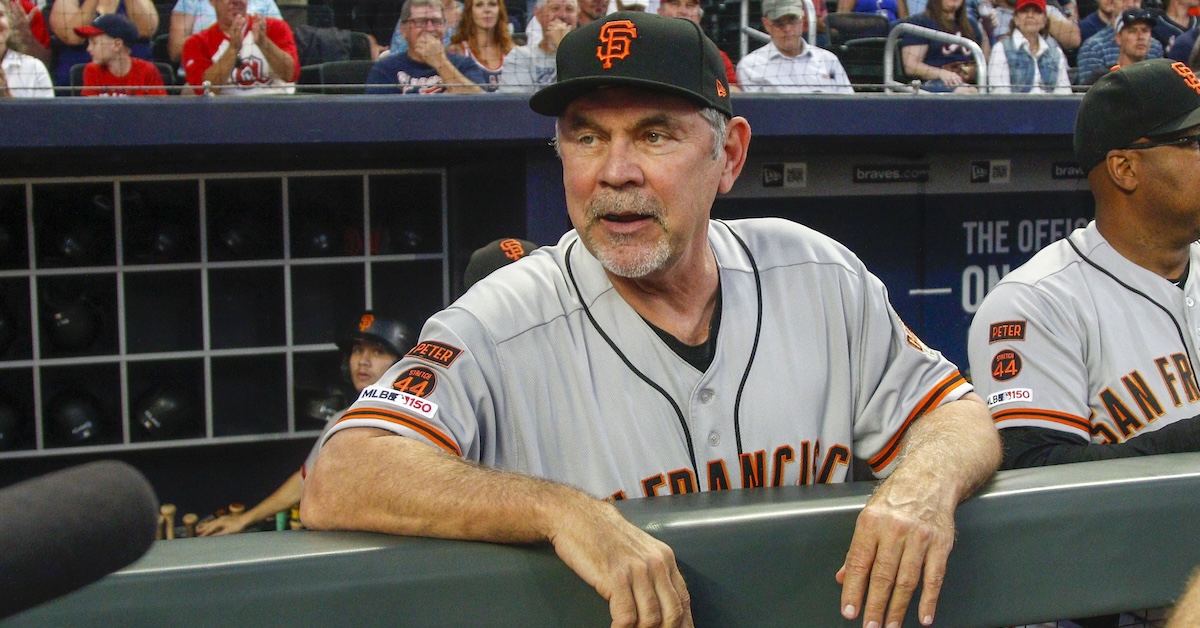
Brett Davis-USA TODAY Sports This post is part of a series covering the 2027 Contemporary Baseball Era Committee Managers/Umpires/Executives ballot, which includes candidates in those categories who made their greatest impact from 1980 to the present. You’ll find an introduction to the ballot here. The eight candidates will be voted on in San Diego on December 6, and anyone receiving at least 75% of the vote from the 16 committee members will be inducted in Cooperstown on July 25, 2027 along with any candidates elected by the BBWAA. 2027 Contemporary Baseball Candidate: Manager Bruce Bochy Manager G W-L W-L% G>.500 Playoffs Pennants WS Bruce Bochy 4518 2252-2266 .498 -14 9 5 4 AVG HOF Mgr* 3636 1943-1673 .537 270 7 5 2.5 Source: Baseball-Reference * Average based on the careers of 22 enshrined AL/NL managers from the 20th and 21st centuries The list of managers who have won at least four World Series is a short one that’s mostly rooted in the distant past. A’s manager/owner Connie Mack won three with his “$100,000 Infield” from 1910–13, then, after tearing down and rebuilding, two more in 1929 and ’30. Joe McCarthy won seven with the Yankees between 1932 and ’43 — including four straight from ’36–39 — as the team’s centerpiece shifted from Babe Ruth to Lou Gehrig to Joe DiMaggio. Casey Stengel matched McCarthy’s total of seven, including five in a row from 1949–53, as the DiMaggio era gave way to the Mickey Mantle one, with additional championships in ’56 and ’58. Walter Alston led the Boys of Summer Dodgers to their lone championship in Brooklyn in 1955, then won three more within the team’s first eight seasons in Los Angeles (1959, ’63, and ’65). Joe Torre won four with the Yankees between 1996 and 2000, capped by the game’s last threepeat. Only one manager besides Torre has broken through in the era of division play and postseasons that multiply the potential pitfalls for powerhouses and opportunities for upsets, namely Bruce Bochy. Bochy piloted the Giants to a trio of even-year championships in 2010, ’12, and ’14, then after a three-year sabbatical from managing, led the Rangers to their first championship in franchise history in 2023. He’s the only one of the six managers whose total was compiled with multiple teams. Bochy’s nine years in the majors as a backup catcher from 1978 to ’87 gave him plenty of time in dugouts to absorb lessons from his managers, particularly the Astros’ Bill Virdon and the Padres’ Dick Williams. Virdon greatly influenced his even-keeled temperament. “He’s the guy I’ve most tried to emulate,” Bochy told ESPN’s Steve Wulf in 2015. “He was fair, but he was firm, and while he demanded that we play the game the right way, he never embarrassed anybody. He took you into his office and set you straight.” Williams taught him the importance of the job’s smaller details. “[He was] very demanding of the fundamentals, of execution. He knew that the little things win ballgames,” he told the Bay Area News Group’s Andrew Baggarly after being named Giants manager in October 2006. “He was strong but fair, and very honest.” Bochy transitioned seamlessly from player to coach and manager in the minors and then in the majors, quickly working his way up San Diego’s organizational ladder, his talent for the job so apparent that he was just 39 when Padres general manager Randy Smith promoted him from third base coach. From a 2023 profile by ESPN’s Buster Olney: Smith thought that Bochy possessed an unusually advanced understanding of pitching, and how to run a pitching staff, and he was very comfortable dealing with players. He had been a part-time player, spending a lot of time with pitchers in the bullpen, and seemed to connect to all corners of a roster, to players of all backgrounds. “A natural leader,” Smith recalled. “He knew what buttons to push — when to pat someone on the back, when to kick someone in the butt. And he could defuse situations with his humor. He has inner confidence, but he’s not arrogant.” Despite his reputation as a go-with-your-gut throwback, Bochy didn’t survive 28 seasons without being able to incorporate 21st-century philosophies into his famously large head. As pitcher-turned-GM Chris Young, who hired him in Texas, said in 2023, “I thought he was a great manager in 2006 when I played for him. But the game has changed immensely since then, and Boch is keeping up with that and absorbing information… He’s a great manager because he’s continued to grow and evolve and be open-minded. When we hired him, a lot of people asked about an old-school manager. I feel the exact opposite. I think that if you’re stuck in your ways, you don’t last.” Bochy led the Padres to four division titles and a pennant from 1995 to 2006; along with Tony Gwynn, he’s a link to the franchise’s only two World Series appearances thus far, in 1984 (he singled in his lone plate appearance) and ’98 (when they were swept by Torre’s Yankees). From 2007 to 2019, Bochy managed the Giants to two division titles and two Wild Card berths, with three of those four appearances ending in championships. At both jobs, he endured stretches of sub-.500 seasons without losing the respect of his players or the confidence of the general managers and owners above him; not once in 28 seasons, including 13 with losing records, was he fired midseason. While he finished his career 14 games below .500, he’s fourth all-time in games managed and sixth in wins. There’s ample precedent for managers with losing records being elected to the Hall of Fame. Mack, the all-time leader in wins, losses, and games managed, and Bucky Walters, who won championships with the Senators (1924) and Yankees (1947) but suffered through 16 losing seasons, most of them in Washington, are both enshrined. Also in the Hall but with unremarkable winning percentages are Stengel (.508, 62 games above .500), Jim Leyland (.506, 41 games above .500), and Wilbert Robertson (one game above .500), the last of whom is one of two enshrined 20th- or 21st-century AL/NL managers who didn’t win a World Series. Those managers could attest that if you stick around long enough, you’ll occasionally end up with rosters that have no shot. It’s what you do when you have the horses that counts the most. … Bruce Douglas Bochy was born on April 16, 1955, at Landes de Bussac, a United States Army base near Bordeaux, France. His father, Sergeant Major Gus Bochy, had joined the military as an alternative to following his own father into a life of mining coal in West Virginia. Gus met his wife Melrose (née Williams), the daughter of a tobacco farmer, while stationed at Fort Bragg in North Carolina. They had four children, of which Bruce was the third. The oldest, Joe Bochy (b. 1951), was drafted by the Twins in the 22nd round in 1969, and spent a season in their organization as a catcher and another as a pitcher; he later became a scout for the Padres, most notably signing Corey Kluber and Mat Latos. The Bochy children grew up as Army brats, bouncing from France to the Panama Canal Zone to South Carolina, Virginia, and finally Melbourne, Florida, where the family settled after Gus retired. As a child, Bruce played Little League in the Panama Canal Zone. “That’s where I developed my passion for baseball,” he told the Los Angeles Times in 2023. “You could play all year. It was warm. On the [Army] base, we had our team, and we’d go to another base [for games]. It was like being in the minor leagues… It probably prepared me for what I do now.” At Melbourne High School, Bochy was teammates with future Saturday Night Live performer Darrell Hammond. At Brevard Community College (later known as Eastern Florida State College), Bochy was an an All-American catcher. Drafted by the White Sox in the eighth round of the now-bygone January amateur draft in 1975, he chose not to sign; he had a letter of intent to play for former major leaguer Eddie Stanky at South Alabama. After he led Brevard to the Florida Community College state championship in 1975, the Astros chose him in the first round of the secondary phase of the June amateur draft. Bochy signed, and while he didn’t climb above A-ball until 1978, after just a half season at Double-A, he was called up. The 23-year-old Bochy made his major league debut on July 19, 1978 in the nightcap of a doubleheader, going 2-for-3 against the Mets with a pair of singles off Craig Swan. The next night, in another doubleheader nightcap, he homered off the Mets’ Kevin Kobel; that game featured three other future major league managers in Art Howe (who homered twice for the Astros), Bobby Valentine, and Lee Mazzilli. Bochy quickly took over from the light-hitting Luis Pujols as the Astros’ regular catcher, hitting .266/.311/.377 (99 OPS+). Bochy spent two more seasons in Houston, playing sparingly. He made a brief appearance in Game 4 of the 1980 National League Championship Series against the Phillies, taking over for Pujols in the eighth inning. In the top of the 10th, he was positioned to tag Pete Rose out at the plate trying to score on a Greg Luzinski double to left field, but the one-hop throw deflected off Bochy, and Rose bowled him over while scoring the go-ahead run; the Phillies won that game and Game 5 as well. Traded to the Mets in February 1981, Bochy spent all of that season and most of the next at Triple-A Tidewater, though in his 17-game stint in the majors in 1982, he homered twice — including on September 18 off the Cardinals’ Jim Kaat — and slugged .550. Released in January 1983, he caught on with the Padres, and split both that season and the next between Triple-A Las Vegas and San Diego, serving as a backup to Terry Kennedy. In changing teams so often during that stretch, Bochy had to deal with a unique problem: his size-8 head. “Having a big head is a problem. I had one [batting] helmet I had to carry with me everywhere, when I was traded or sent down or played winter ball. It probably has 15 coats of paint on it. It was a special-order helmet,” he told the San Farncisco Chronicle’s Henry Schulman in 2007. “One day I snapped and threw it down and broke it. I realized what I did, and it crushed me. It took a couple of weeks to get a new helmet.” In San Diego, the lefty-swinging Kennedy, a four-time All-Star, was one of the game’s most durable backstops, making at least 140 starts in both of those seasons, but Dick Williams sometimes replaced him for platoon purposes in the late innings. The righty-swinging Bochy was well-suited as the backup, being much better against lefties during his career (.253/.311/.434 with 18 homers) than righties (.225/.283/.339 with eight homers). In 1984, the Padres — featuring a young Gwynn and veteran stars such as Steve Garvey, Graig Nettles, and Rich Gossage — won their first division title and pennant in franchise history. Kennedy caught every postseason inning in both the NLCS against the Cubs and the World Series against the Tigers, but Bochy did collect a ninth-inning pinch-hit single in Game 5 off reliever Willie Hernandez, that year’s MVP and Cy Young winner. Two outs later, the Tigers were world champions. Bochy spent three more seasons with the Padres, two behind Kennedy and one backing up Benito Santiago, the 1987 NL Rookie of the Year. Bochy hit a career-high eight homers in 142 plate appearances in 1986 while batting an impressive .252/.326/.512 (130 OPS+), but he struggled the next season after fracturing his hand while warming up a pitcher on Opening Day. When he hit free agency after the 1987 season and found no takers, he agreed to serve as a player-coach for the Padres’ Las Vegas affiliate, where he could mentor 22-year-old prospect Sandy Alomar Jr. Bochy finished his major league career with a .239/.298/.388 (92 OPS+) line, 26 homers, and 2.3 WAR. At Las Vegas, an injury to Alomar led to Bochy playing 53 games, far more than expected. “Next thing I know, I’m the everyday catcher. This isn’t what I signed up for,” he recalled in 2019. “It’s 115 degrees. I haven’t really worked out like a player would. I’m throwing batting practice every day. I’m hitting fungos. All of a sudden, I’m behind the plate.” After the season, Padres general manager Jack McKeon hired Bochy to manage the team’s Low-A Spokane affiliate, and named his Las Vegas teammate, a 27-year-old righty named Kevin Towers — a 1982 first-round pick who battled elbow injuries during his brief career — to be his pitching coach. The team went 41-34 and won the Northwest League championship, and Bochy bonded with the man who would serve as the Padres’ GM during nearly all of his San Diego run. “It was the first year we both got on the coaching side and so just really had a lot of laughs on the bus rides and on the field,” recalled Bochy in 2022. “But also, your first year managing is similar to being a first-year player. It was a tremendous learning experience.” Bochy moved up to manage the Padres’ High-A affiliate in the California League, first in Riverside (1990), where his team went just 64-78, and then in Adelanto, where he guided the High Desert squad to a 73-63 record and the 1991 league championship. After winning a third championship at Double-A Wichita in 1992, he became the Padres’ third base coach under manager Jim Riggleman. It wasn’t a great time; with the team 15 games below .500 in late June, owner Tom Werner traded Gary Sheffield to the Marlins in a deal that at least brought in rookie reliever Trevor Hoffman. The trade of Fred McGriff to the Braves a month later didn’t yield much in return, but the trade of Bruce Hurst and Greg Harris to the Rockies brought in righty Andy Ashby and catcher Brad Ausmus. The Padres went 61-101, then 47-70 before the strike hit in 1994. When the team only offered Riggleman a one-year-plus-an-option contract for 1995, he declined it and instead took over the Cubs. Smith promoted the 39-year-old Bochy, making him the NL’s youngest manager. “To me, the two most important factors were continuity, stability, and with the strength of this organization being pitching, someone who can handle a pitching staff,” said the GM. “In my mind, he’s the best managerial prospect in the game.” With Werner in the process of selling a majority interest in the Padres to John Moores, Smith only gave Bochy a one-year-plus-an-option contract, but just after the All-Star break, the option was reworked into a two-year extension. Boosted by a 12-player trade with the Astros that brought in third baseman Ken Caminiti and center fielder Steve Finley, the Padres improved to 70-74 in Bochy’s first season. Smith, reportedly unhappy working for Padres president Larry Lucchino, resigned at the end of the season to take the Tigers’ GM job; he was replaced by Towers, their scouting director for the previous two years. With Caminiti winning MVP honors (aided, he later admitted, by the use of anabolic steroids), Finley having a big season, and Gwynn winning his sixth batting title, the Padres won the NL West with a 91-71 record, sweeping the Dodgers in the season’s final three games to win the division by one game. They were promptly swept in the Division Series by the Cardinals, but Bochy was voted the NL Manager of the Year, the only time he would win the award. He also signed another two-year extension, covering the 1998–99 seasons, with an option for 2000. With their rotation taking a step back in 1997, the Padres slipped to 76-86, but a trade for ace Kevin Brown amid the Marlins’ post-championship fire sale and a 50-homer season by Greg Vaughn, who had struggled the previous year, helped fuel a 98-win season in ’98, setting a franchise record that still stands. The Padres won the NL West by 9.5 games, then beat the Astros in a four-game NLDS while holding them to a single run in all three San Diego wins. The Padres won the first three games of the NLCS against the Bobby Cox-led Braves, but couldn’t close things out until Game 6, when series MVP Sterling Hitchcock and four relievers combined for a shutout. In the World Series, the Padres proved no match for the 114-win Yankees, at least after what looked like an apparent inning-ending called third strike on a knee-high fastball from Mark Langston to Tino Martinez was called a ball. On the next pitch, Martinez hit a grand slam to cap a seven-run rally and break a 5-5 tie. The Yankees swept the Padres in four games. With Brown, Caminiti, and Finley departing in free agency and Vaughn traded to the Reds in a deal for Reggie Sanders, the Padres dipped to 74 wins in 1999. The 39-year-old Gwynn collected his 3,000th hit on August 6 at Montreal’s Olympic Stadium, but that season began a lean streak in San Diego. The team finished below .500 in each of the next four seasons, hovering near .500 in 2000 (76-86) — the first year of a new four-year deal for Bochy — and ’01 (79-83), but bottoming out in ’02 (66-96) and ’03 (64-98). The reality is that the Padres were spending less on payroll than all but a small handful of teams, as they looked towards reaping the benefits of leaving Qualcomm Stadium for Petco Park. According to Cot’s Contracts, they ranked 25th, 26th, and 27th in Opening Day payroll from 2001–03, not long after the majors had expanded to 30 teams. The new venue was originally scheduled to open in 2002, but legal and political issues, as well as complications regarding the landmark status of the Western Metal Supply Co. building that was incorporated into its footprint, delayed its opening for two years. Moores knew he had to bide his time, and Towers and Bochy had his support. With the 2004 move into Petco Park, the Padres quickly surged back into contention. In his third major league season, Jake Peavy, a 1999 15th-round pick, broke out to lead the NL with a 2.27 ERA and emerge as staff ace. Third baseman Sean Burroughs and shortstop Khalil Greene, their first-round picks from 1998 and 2002, respectively, made promising showings, and right fielder Brian Giles (a mid-2003 trade acquisition) and second baseman Mark Loretta (a free agent signed after 2002) turned in big seasons. The team went 87-75, spending time in first place or near it from late April through mid-July before fading to third place. In 2005, just about all of the aforementioned players except Giles and Peavy regressed, but a trade for Red Sox postseason hero Dave Roberts helped, as he would turn in the best two seasons of his career in San Diego. The Padres’ 82 wins made them the only .500-or-better team in the NL West, though they were swept by the Cardinals in the NLDS. In April 2005, former A’s general manager Sandy Alderson joined the Padres as CEO after spending over six years in the commissioner’s office, as the executive vice president for baseball operations. In June, Bochy signed a two-year extension, covering the 2006–07 seasons. Spurred by the rejuvenation of 37-year-old free agent Mike Piazza, and trades that brought in center fielder Mike Cameron from the Mets, and the right-handed Young and first baseman Adrián González from the Rangers, the 2006 Padres won 88 games, their highest total since 1998. Led by González, waiver period acquisition Russell Branyan, and Peavy, they went 22-9 after August 28, and while they finished with the same record as the Dodgers, a 13-5 season series advantage gave them their fourth division title under Bochy. Unfortunately, as in 2005, the Cardinals ousted them in the NLDS. Bochy had one year remaining on his contract, but after the season, he learned over lunch with Alderson and Towers that other teams had inquired about his availability and was told the Padres wouldn’t stand in his way, but that an extension wasn’t forthcoming. Reportedly, Alderson felt the Padres needed younger leadership than the 51-year-old Bochy, believing that he was overly loyal to veteran players. The team let Giants GM Brian Sabean — also a candidate on this ballot — pursue him to replace Felipe Alou. The irony was that Giants owner Peter Magowan sought a manager younger than the septuagenarian Alou to oversee a shift towards a youth movement and away from an over-reliance on aging veterans. “If we have players we expect to see around for three, four, five, six years, it would just make sense to have a manager we think might be there for that kind of period of time as well,” said Magowan. Bochy agreed to a three-year deal worth around $6 million. His first year was dominated by Barry Bonds’ pursuit of Henry Aaron’s all-time home run record and the PED controversy that surrounded the slugger. Recognizing that the youth movement wouldn’t happen overnight, Sabean added several free agents, including former American League Cy Young winner Barry Zito (on a record-setting seven-year, $126 million contract), ex-Padres Roberts and Ryan Klesko, and Bengie Molina. The team won just 71 games, as several of those free agents were over the hill, but strong seasons from a trio of homegrown pitchers, all first-round picks — Noah Lowry (2001), Matt Cain (2002) and Tim Lincecum (2006) — suggested the Giants were on the right track. Lincecum, an undersized righty whose understanding of biomechanics enabled him to pump fastballs in the mid-90s, won back-to-back Cy Youngs in 2008 and ’09 while making the All-Star team in both seasons. The Giants went just 72-90 in 2008 but improved to 88-74 and a third-place finish in ’09 as Cain made his first All-Star team and converted catcher Pablo Sandoval established himself at third base. In September, two other first-round draftees, catcher Buster Posey (the fifth pick in 2008) and lefty Madison Bumgarner (the 10th pick in 2010) would debut; both would have an outsized effect on Bochy’s Giants. With a rotation featuring Bumgarner, Cain, Lincecum, and Zito, a bullpen led by two other draftees, closer Brian Wilson and setup man Sergio Romo, and a lineup led by Posey (the NL Rookie of the Year), free agents such as Pat Burrell, Aubrey Huff, Edgar Renteria, and Andres Torres, and August waiver addition Cody Ross — a cast that Bochy affectionately termed “a bunch of misfits” — the Giants overcame a 41-40 start, overtaking the Padres in the season’s final week and winning the NL West with a 92-70 record. While going 6-1 in one-run games, the team beat the Braves in the NLDS and the Phillies in the NLCS, with Ross’ three homers netting him series MVP honors. In the World Series, the Giants rolled over the Rangers in five games to win their first championship since 1954, with Renteria, who hit just three homers during the regular season, homering twice and being named MVP. While being lauded for mixing and matching with regards to his lineup and bullpen, Bochy praised his role players, saying, “I’m not sure they were happy with me [regarding] playing time, guys were used to going out there every day. But they stayed ready, and they had one thing on their mind and that was to do this.” The Giants dipped to 86 wins in 2011; the loss of Posey, who suffered a season-ending fractured left fibula and ligament damage on a collision at the plate in late May, likely cost them a Wild Card berth. Fortunately, the 25-year-old Posey returned from his injury in 2012 and won both the NL MVP award and the batting title (the latter thanks to an absurd sequence of events involving teammate Melky Cabrera’s 50-game PED suspension), while two homegrown infielders, first baseman Brandon Belt and shortstop Brandon Crawford, took big steps forward after debuting in 2011. Half a game out of first place at the All-Star break, the Giants finished 94-68, winning the NL West by eight games. In the postseason, the Giants became just the second team to go 6-0 in elimination games, after the 1985 Royals. They overcame a two-games-to-none deficit in the NLDS against the Reds, led by former Giants manager Dusty Baker, and a three-games-to-one deficit in the NLCS against the Cardinals before sweeping Leyland’s Tigers in a comparatively anticlimactic World Series. The team had no shortage of unlikely heroes, such as Zito, whose 7.2 shutout innings helped stave off elimination in Game 5 of the NLCS; Ryan Vogelsong, who was brilliant throughout the postseason for the team that drafted him 14 years earlier; Lincecum, whom Bochy deployed effectively in a multi-inning relief role after a dreadful regular season; and deadline acquisition Marco Scutaro, the NLCS MVP. “This is a special group, and they have that never-say-die attitude,” said a jubilant Bochy after the NLCS. Sandoval, who tied a single-game record with three homers in the World Series opener, won MVP honors. With the victory, Bochy joined John McGraw as the only Giants manager to win multiple championships. He also earned himself another extension, this one covering the 2015–16 seasons. The Giants sank to 76 wins in 2013 as the rotation aside from Bumgarner collapsed, but the team rebounded to win it all again in ’14. Posey, Sandoval, Crawford, and right fielder Hunter Pence, a mid-2012 acquisition, led the lineup, while the 25-year-old Bumgarner led a rotation in which Lincecum and Cain had slipped to replacement level. With the latter additionally sidelined by surgery to remove bone chips in his elbow, Sabean acquired Peavy in a late-July trade with the Red Sox, providing a much-needed boost. On September 13, with the Giants being routed 14-0 by the Dodgers, Brett Bochy — the younger of the manager’s two sons, a 20th-round 2010 pick — debuted for the Giants. His sixth-inning relief appearance, one of six he would make for the team in 2014–15, made them the majors’ first father-son manager-pitcher combination. “It’s kind of surreal, really,” said the elder Bochy. “Here’s your son, and you’re bringing him into the big leagues. It’s a moment that — you’re nervous, but at the same time, you’re very proud.” While the Giants’ 88 wins only netted a Wild Card berth, Bumgarner spun a four-hit, 10-strikeout shutout against the Pirates in the Wild Card Game. The team outlasted the Nationals in a four-game NLDS that felt like five, as Game 2 lasted 18 innings; all three Giants wins were by one run. Bumgarner then became just the fourth pitcher to win MVP in both the NLCS and World Series. He made two strong starts in a five-game victory over the Cardinals and then allowed just one run in 21 innings in a seven-game victory over the Royals. After throwing another four-hit shutout in Game 5, he returned on two days of rest to toss five shutout innings out of the bullpen, earning a save in a 3-2 win that ended with the potential tying run on third base. “I was staying away from him every inning [in the dugout] because I was hoping he wouldn’t go, ‘I’m starting to get a little tired,’ because there’s no way I would have taken him out unless he would have told me that,” said Bochy after Game 7. “We just got on his horse and rode it.” The 2015 season brought change to the Giants, as Sabean, the majors’ longest-tenured GM at 18 years, was promoted to president of baseball operations, with assistant GM Bobby Evans replacing him; meanwhile, Bochy signed yet another three-year extension. Sticking to their even-year bit, they missed the playoffs with 84 wins in 2015 but made it as the second Wild Card with 87 wins in ’16, though a 30-42 second half cost them a 6.5-game lead in the NL West. Bumgarner threw another four-hit shutout in a Wild Card Game, this time against the defending NL champion Mets, but the Giants lost a four-game NLDS to the Cubs, managed by this ballot’s Joe Maddon. That turned out to be the team’s final playoff appearance under Bochy. The 62-year-old manager underwent two heart procedures in 2017 to address arrhythmias, one in April and another in October; in between, the Giants went an NL-worst 64-98. They improved only to 73-89 in 2018, as Posey was hampered by an impingement in his right hip, and shut down for surgery in late August. Evans was fired, with former Dodgers GM Farhan Zaidi named the team’s president of baseball operations, and Sabean nudged into an executive VP role. Shortly after the Giants’ camp opened in 2019, Bochy announced that the season would be his last; the team went 77-85. A September 18 win over the Red Sox made him the 11th manager to reach 2,000 wins. Upon stepping down, Bochy clarified that he intended to take a sabbatical from managing rather than retire. He spent 2020–22 as a special advisor to the Giants, and in September 2022 managed France’s unsuccessful bid to qualify for the next year’s World Baseball Classic. The experience planted the seed for his comeback. In August 2022, when it was clear the Rangers were headed for their sixth straight sub-.500 finish, president of baseball operations Jon Daniels and manager Chris Woodward were both fired. The team finished 68-94. In October, Young — who originally joined the Rangers front office as executive VP and GM in December 2020 and was promoted on Daniels’ firing — invited the 67-year-old Bochy to consider managing again. Bochy was amenable, agreeing to a three-year contract. Things couldn’t have gone much better at the outset. With shortstop Corey Seager and second baseman Marcus Semien turning in seasons that led to second- and third-place finishes in the AL MVP voting (behind Shohei Ohtani), and right fielder Adolis García and designated hitter Mitch Garver additionally powering the offense, the Rangers scored an AL-best 5.44 runs per game. The pitching staff lost incoming free agent Jacob deGrom to his second Tommy John surgery in June, though fellow free agent Nathan Eovaldi and deadline acquisitions Jordan Montgomery and Max Scherzer picked up the slack. The team went 90-72, claiming the top Wild Card spot. Montgomery, Eovaldi, and the bullpen held the Rays to one run in a Wild Card Series sweep, and the Rangers swept the Orioles in the ALDS as well. The ALCS against the Astros — the defending champions, managed by Baker — was a seven-game epic in which the road team won every game. Down three games to two as the series shifted back to Houston, the Rangers won the next two games by a combined score of 20-6. García hit five home runs, drove in an LCS-record 15 runs, and was named series MVP. In the World Series against the Diamondbacks, Seager’s two-run ninth-inning homer sent Game 1 into extra innings, and García’s solo shot won it in the 11th. After a 9-1 trouncing in Game 2, Bochy and the Rangers had to navigate around the losses of both García and Scherzer in Game 3, the former due to an oblique strain, the latter due to back spasms. They won that one and the next two, giving the Rangers their first championship in franchise history, and elevating Bochy into the small group of managers with four championships. Bochy’s final two seasons in Texas were less successful: 78-84 in 2024 and 81-81 in ’25. In late September 2025, he and Young met and agreed it was time for a change. “It’s as much fun as I’ve had in the game,” Bochy said prior to the announcement of the decision. “You have a deeper appreciation when you’re out, especially for three years and you realize what you have, how blessed you are to be doing what you’re doing. It’s been a lot of fun, and I still love it, and enjoy it.” … While Bochy ranks even higher on the all-time leaderboard in terms of losses (2,266, third) than wins (2,252, sixth) or games managed (4,518, fourth), all of the top 15 in that last category are enshrined save for Baker (who’s also on this ballot), the still-active Terry Francona, and Gene Mauch, who finished 135 games below .500 and never won a pennant. Bochy not only outranks those three in the aforementioned categories, he has more championships than they do combined. Even with the benefit of 162-game schedules, Bochy’s teams never reached 100 wins in a season, and only his 1998 Padres and his 2012 Giants won more than 92. Yet his teams generally weren’t regarded as underachievers. More often, they seemed to win at the right times, eking out some close races with late surges and shining in October. Bochy’s 57 postseason victories are, of course, a product of a career managing in the Wild Card era; he’s tied with Baker for fifth in that category behind Torre (84), Roberts (72), Tony La Russa (71), and Cox (67). His .606 winning percentage in that context really stands out, ranking fourth among those with at least 30 postseason games managed: Managers With Highest Postseason Winning Percentage Manager G Post Wpost Lpost W-L%post Playoff Pen WS Ned Yost 31 22 9 .710 2 2 1 Joe McCarthy+ 43 30 13 .698 9 9 7 Sparky Anderson+ 55 34 21 .618 7 5 3 Bruce Bochy 94 57 37 .606 9 5 4 Joe Torre+ 142 84 58 .592 15 6 4 Casey Stengel+ 63 37 26 .587 10 10 7 Dave Roberts 125 72 53 .576 11 5 3 Charlie Manuel 51 29 22 .569 6 2 1 Earl Weaver+ 46 26 20 .565 6 4 1 Connie Mack+ 43 24 19 .558 8 9 5 A.J. Hinch 65 36 29 .554 6 2 1 Rob Thomson 38 21 17 .553 4 1 0 Terry Francona 80 44 36 .550 12 3 2 Miller Huggins+ 33 18 15 .545 6 6 3 Tony La Russa+ 132 71 61 .538 15 6 3 Joe Girardi 52 28 24 .538 6 1 1 Cito Gaston 34 18 16 .529 4 2 2 Ron Washington 34 18 16 .529 3 2 0 Dusty Baker 108 57 51 .528 13 3 1 Jim Leyland+ 84 44 40 .524 8 3 1 Source: Baseball-Reference Minimum 30 postseason games managed. + = Hall of Famer. The only manager besides Bochy who’s at least 20 games over .500 in the postseason — again, a very era-dependent stat, but nonetheless impressive — is Torre (26), though Roberts (19) is almost there. And hey, if you combine Bochy’s regular season and postseason records together, he’s six games over .500 after all. Also noteworthy: Even with his sub-.500 regular season record, Bochy’s teams fared especially well in one-run games. His Padres teams went 304-253 (.546) in one-run contests, ranking second in that context in both winning percentage and win total in that span. His Giants teams went 347-312 (.527) for the seventh-highest winning percentage and second-highest win total during that timeframe. His Rangers were less successful in that area (61-71, .462), but the only teams that matched or beat Bochy’s .528 winning percentage in one-run games over the 1995–2005 span were the Yankees (.546), Angels (.531) and Dodgers (.528). Bochy didn’t have the good fortune to manage powerhouses, but in Kevin Towers, Brian Sabean, and Chris Young, he had GMs with whom he meshed well as they presided over their franchises’ most successful stretches in the past half-century. Even on a crowded Hall of Fame ballot, his achievements stand out. So far in this series I’ve judged Baker, Sabean, and Bill White all to be worthy of votes, and I still have two candidates to cover, but however it shakes out, I expect that Bochy’s four championships will carry him into Cooperstown.
2027 Contemporary Baseball Era Committee Candidate: Bruce Bochy
Full Article
Original Source
Read the full article at Blogs →KhanList aggregates and links to publicly available news content. We do not host full articles from third-party sources. Always verify important information with original sources.