
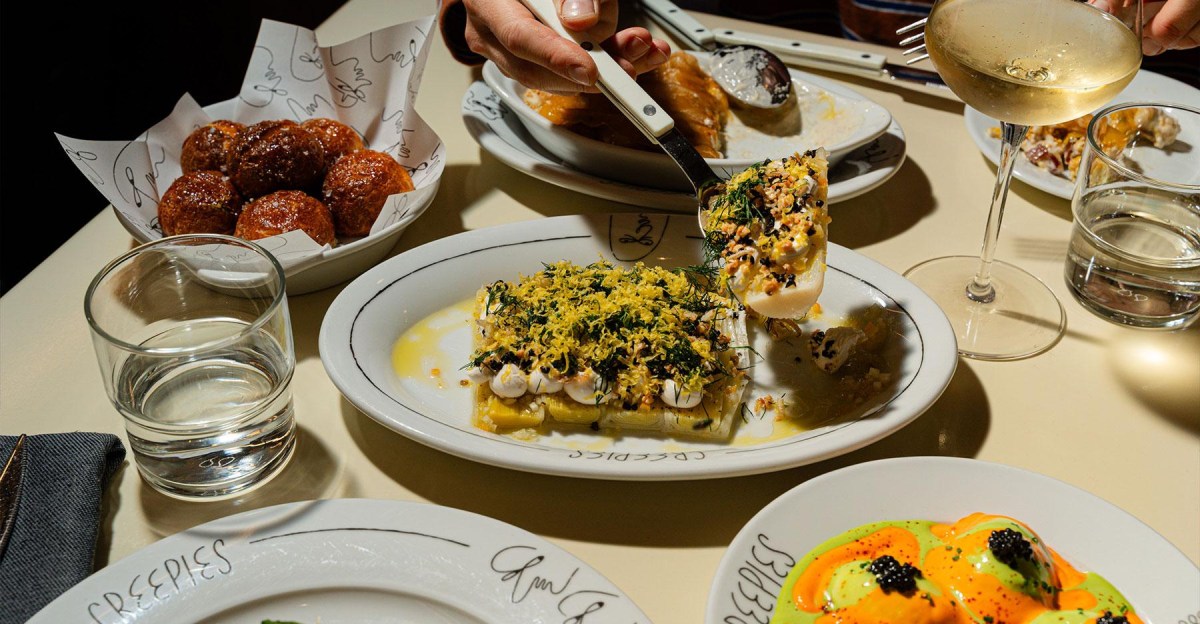
This is an excerpt from Pre Shift, our newsletter for bartenders, restaurant workers and the hospitality industry. Subscribe for more perspectives like this in your inbox. At Kyle Knall’s Milwaukee restaurant Cassis, the showstopper dish is ravioli Dauphiné, a sheet of 24 tiny squares stuffed with the Wisconsin cheese Pleasant Ridge Reserve. Topped with glazed seasonal veggies, kernels of sweet corn in summer and sliced honeynut squash in late fall, it speaks to Knall’s Midwestern-meets-French approach—one of the reasons why his restaurant earned a slot on Eater’s 2026 list of the Best New Restaurants in America.The Eater Awards, presented by Capital One, feature serious Midwest representation. The Best New Restaurants list includes Chicago’s Creepies, which also digs into that Midwest-French mashup, and Kansas City’s Akoya Omakase, which brings a distinct viewpoint to the omakase experience. Meanwhile, the pickled walleye cheeks at Rosy in Cleveland and the puffed grain toast at All Well in Chicago are among the Restaurant Dishes of the Year, and Chicago’s Bad Butter, a place best-known for its croissant take on a Chicago-style hot dog, is one of the Best New Bakeries. It even includes drinks—Culebra, a Puerto Rican spot that draws on the Latinx influences of its Chicago neighborhood, is on Punch’s Best New Bars list. Between these accolades and other national recognition, all eyes are on the Midwest right now. And that’s even before we get into the impact of the Chicago-set show The Bear, which put Italian beef on everyone’s radar, and the rise of tavern-style pizza around the country.The Midwest has always had great restaurants, of course, but it’s undeniable that something has shifted. “People are flying into these cities rather than flying over them,” says Vinnie Cimino, the Cleveland chef who co-owns Rosy and Cordelia. “I think that word is getting out about these smaller pockets of culture and cuisine.” Some of this is attributable to diners being more willing to explore outside big coastal cities, but it’s also due to chefs returning home to the region. “Post-pandemic, a lot of folks moved out of larger cities and back home,” says Cimino. “Now they’re setting up shop and creating great things in the spaces that they grew up in.” David Posey, chef and co-owner of Creepies and Elske in Chicago, agrees, adding: “For a long time, it felt like we were playing catch-up with trends on the coasts. Now I think we’re less quick to follow trends and are more confident in having our own voice of what the Midwest is.”One of those chefs who left New York is Knall, a Birmingham, Alabama, native who cooked at Gramercy Tavern in New York before moving to his wife’s hometown of Milwaukee in 2020. Another is Peter Hoang, who worked at his father’s Kansas City, Missouri, sushi restaurant before gaining experience in Chicago and New York restaurants. When he returned to open Akoya Omakase, he crafted menus with the audience in mind, with two omakases, priced more affordably than many at $85 and $165, as well as an à la carte menu. “My sushi is honed by Japanese techniques and sourcing,” he says. “But I interpret what I think is best for the fish, whether that’s highlighting the textures and flavors through different garnishes or using aging or salting techniques.”It’s not simply that these are good restaurants located in the Midwest—these restaurants are deeply Midwestern in ethos. In Chicago, David and Anna Posey, who run the Michelin-starred Elske, wanted to open a French bistro for their second venture. But as they developed Creepies with chef de cuisine Tayler Ploshehanski, David Posey says they began expanding its focus: “We started taking flavors and adapting them to things that we’re a little more familiar with.” This means dishes that draw on the traditions of Michigan, Wisconsin, and Illinois—think tarte flambée on a tavern-style pizza crust and mussels with giardiniera. And it’s not just the food at Creepies that reflects the Midwest: “We told our designer that our inspiration board was a Midwest basement with wood paneling and low ceilings meets a bistro in the French countryside.”At Cordelia, Cimino leans into the traditional cuisine of Northeast Ohio, with offerings like raw-beef cannibal sandwiches and kielbasa with cabbage salad. “It’s the familiar flavors that we grew up eating, rethought into this more modern light,” he says. Meanwhile, Rosy “is a deeper dive into the culture of our region” and features dishes like Balkan cevapi and Italian cotechino cooked over live fire. The approach is drawing a wide range of Cleveland diners, from 20-somethings there for the cool, candlelit vibe to grandparents there to taste the food they grew up with. “I think that’s what the Midwest is,” Cimino says. “Being able to be that transgenerational space everybody feels welcome in.”That welcoming community sensibility is a key component of Midwestern restaurants. Knall counts several farmers and shoppers at the West Allis Farmers Market, where he sources for Cassis, as some of his regulars. “To me, it shows that’s really what Midwest food is: supporting those communities,” he says.Perhaps more than anything, it’s hospitality that sets these spots apart. “Hospitality is our biggest focus between both restaurants and maybe even more of a focus than the food,” Knall says. “To me, the way that our team makes you feel in the restaurants is such a Midwest thing.” And at Cordelia, where the slogan is “Midwest Nice,” Cimino says: “It’s welcoming you into our proverbial home.”
2026 Was the Year Restaurants Went Full Midwest
Full Article
Original Source
Read the full article at Eater →KhanList aggregates and links to publicly available news content. We do not host full articles from third-party sources. Always verify important information with original sources.