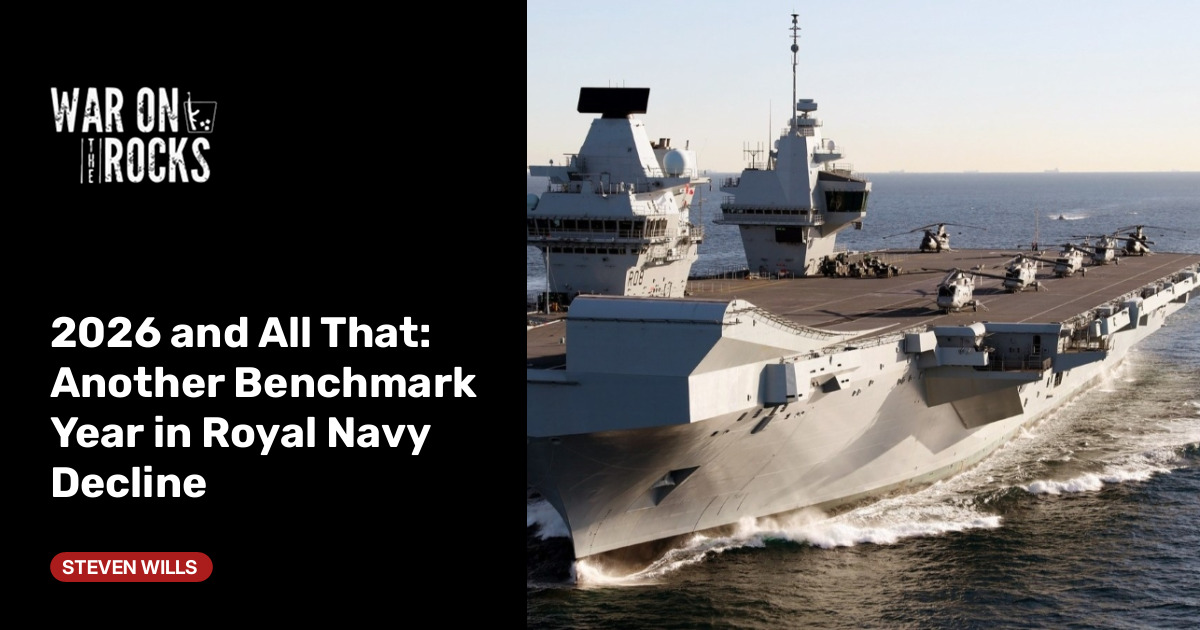
The 1930 comic history, 1066 and All That, made famous the British habit of reducing national history to a sequence of memorable dates. The modern Royal Navy has its own unhappy version of that calendar. Since 1945, a series of ostensibly practical political decisions has steadily reduced Britain’s ability to sustain a globally relevant fleet: the 1956 failed Suez expedition, the 1966 retreat from “East of Suez,” the 1981 Nott Review, the 1998 Strategic Defence Review, and the 2010 review that further reduced the fleet even as Britain moved toward operating the long-desired Queen Elizabeth-class aircraft carriers. The year 2026 may now join that list. The apparent abandonment of the Type 83 destroyer in favor of a still-unproven hybrid fleet risks marking another step away from a balanced blue-water navy and toward a smaller regional force. For other navies, including the U.S. Navy, the Royal Navy’s experience offers a blunt warning: When naval leaders rely on political leadership to preserve fleet size, industrial capacity, and force design, decline can arrive by increments and then suddenly become irreversible.A Sad Series of Dates: 1956 to 2026The end of World War II brought deep reductions to all the victorious Allied navies, but Britain’s position was especially difficult. The country faced enormous wartime debt, substantial damage at home, and — for the first time in centuries — no immediate peer maritime threat. Sir Stanley Goodall, the Royal Navy’s director of naval construction, accepted the need to shed old and worn-out vessels. In March 1945, he complained that the navy was “doing a lot of repair work in Royal dockyards on old junk,” and in August called for “junking Renown and Valiant,” aging battleships from World War I. The deeper question, however, was whether Britain could replace that wartime fleet with ships affordable enough to build and maintain, yet capable enough to sustain global commitments. Over the next eight decades, that question would be answered largely in the negative. Again and again, governments chose cheaper, smaller, or deferred naval solutions that reduced both present capacity and future options.The Suez Crisis was the first unmistakable postwar warning. The failed Anglo-French attempt to retake the Suez Canal after Egyptian leader Gamal Abdel Nasser nationalized that maritime choke point was ultimately more a political failure than a military one. The 1957 defense review that followed preserved Britain’s carrier and emerging amphibious forces, but accelerated the decline of larger surface combatants, especially cruisers. Britain’s remaining reserve battleships were also to be scrapped, unlike their U.S. Navy contemporaries, which were preserved in mothballs with the prospect of later reactivation. This choice presaged other British government reviews of naval strength that dumped a previous generation of ships for a hopeful new order that did not always materialize as planned.Figure 1: Excerpt from Defence: Outline of Future Policy, 1957At the time, this seemed an understandable response to postwar austerity. Air and missile power were clearly displacing gun-armed surface combatants as the measure of naval effectiveness. Yet the review also encouraged a dangerous habit: the belief that small numbers of advanced systems could safely replace larger numbers of conventional ships. Combined with an increasingly narrow focus on NATO contingencies, that habit left Britain less prepared for short-notice crises beyond Europe.The 1966 decision to withdraw British forces from “East of Suez” — including Singapore and other Pacific commitments — deepened the trend. The 1966 Defence Review, led by Labour Defence Secretary Denis Healey, refocused British defense planning almost entirely on NATO. It called for the end of the fixed-wing carrier fleet by 1975, cancelled the CVA-01 replacement carrier program and its Type 82 destroyer escort, and accepted major reductions in Royal Navy strength outside anti-submarine warfare forces assigned to NATO roles. Healey was openly skeptical of carriers, describing them to ordinary sailors as “floating slums” and judging them “vulnerable” to modern weapons. The Conservative government that returned to power in 1970 slowed but did not reverse the decision, extending the active service of the carrier HMS Ark Royal only to 1979. At best the Royal Navy was fighting a game of bureaucratic survival through the 1970s. The logic was familiar: A smaller fleet, equipped with missiles and underwritten by nuclear deterrence, would supposedly meet Britain’s essential defense needs.Figure 2: Excerpt from Defence Review, 1966Conservative governments proved no more immune to this pattern. Before the Falklands War, Prime Minister Margaret Thatcher’s Defence Minister John Nott produced the 1981 The United Kingdom Defence Programme: The Way Forward, which proposed another round of major naval reductions in the name of savings. The destroyer and frigate force would fall to “about 50” ships. HMS Invincible, the new through-deck cruiser that functioned as a light carrier, was to be sold to Australia. Even more consequentially, the amphibious ships HMS Intrepid and HMS Fearless were slated for retirement before the mid-1980s. Had Argentina waited only a few more years before invading the Falkland Islands, Britain might have lacked the carrier and amphibious capacity needed to retake the islands. It had already scrapped nearly all of its legacy gun-armed ships and had no gun in the fleet larger than 4.5 inches to conduct shore bombardment. The Royal Navy examined two of its ancient Tiger-class cruisers, then awaiting disposal, to see if they could be reactivated for Falklands service, but the war ended before serious work could be done. HMS Tiger and HMS Blake were sent back to the disposal fleet, and the Royal Navy did not get a shore bombardment weapon.Figure 3: Components of the United Kingdom Defence Programme: The Way Forward, 1981The Falklands War delayed, rather than ended, the downward pressure. The 1998 Strategic Defence Review reduced the destroyer and frigate force from 35 to 32 ships — already far below the 1981 benchmark — and cut the nuclear submarine force from 12 to 10 boats. The review endorsed the two future Queen Elizabeth-class carriers, but did so amid reservations and under financial assumptions that would haunt later decisions. In retrospect, the surprise is not that the ships were expensive and politically controversial, but that they were built at all. Both ships were expensive at 2 billion pounds sterling ($3.2 billion) even before the addition of aircraft. Combined with additions to the amphibious fleet in the helicopter carrier HMS Ocean and amphibious landing ships HMS Bulwark and HMS Albion, it was unclear if the United Kingdom could afford to support these units over time. As the report stated, “It is also open to question whether Britain should place so many of its financial and weaponry eggs in one carrier basket, which may be vulnerable to attack from mines, missiles, and aircraft.” While the 1998 Strategic Defence Review was commendable in fairly stating the potential challenges in maintaining this larger fleet, its somewhat pessimistic outlook may have promoted future reductions in fleet size.The 2010 Strategic Defence and Security Review pushed the fleet size still lower, reducing the destroyer and frigate force to just 19 ships. The nuclear attack submarine force was limited to the seven Astute-class boats then under construction, and only one carrier would be available for operations at any given time. The amphibious force also contracted through early retirements. By this point, Britain still described itself as a global naval power, but its order of battle increasingly suggested a navy stretched between ambition and arithmetic. Major personnel cuts also occurred, with over 4,000 sailors removed from active duty roles to save money. The aircraft carriers were retained, but it became clear that only one could be operational at any time. Advanced technology — in the form of the Tomahawk cruise missile embarked in the Astute class — was again used as a substitute for size and capacity, with the report stating the submarines would provide “the protection of the nuclear deterrent and maritime Task Groups and provide global strategic intelligence and Tomahawk Land Attack Missile strike capability.” The review also foreshadowed yet more reductions: “Alternatively, we might sell one of the carriers, relying on cooperation with a close ally to provide continuous carrier-strike capability.”The 2020 Integrated Review of Security, Defence, Development and Foreign Policy adopted a more optimistic, almost American style of strategic communication. It emphasized what the government intended to build rather than what the fleet could no longer sustain. Although the review stated that the Royal Navy would continue to operate globally, its language also pointed toward a more constrained reality, noting that “the Royal Navy will remain active in the U.K.’s territorial sea and Exclusive Economic Zone.” That formulation hinted at a fleet increasingly oriented toward home waters, even as other parts of the document stated that the United Kingdom would “deploy more of our naval assets across the world to protect shipping lanes and uphold freedom of navigation.” The Pacific Ocean and the Strait of Hormuz were listed as particular locations where British naval presence would be maintained. While this review did not spell out cuts as in past such reports, it equally did not describe what naval or military investments would be required to support its goals of strategic risk reduction in British policy.The 2026 Defence Investment Plan may now represent the next decisive step. By moving away from the planned Type 83 destroyer — the kind of high-end air and missile defense ship a carrier strike group requires in a hostile environment — the government appears to be betting instead on a “hybrid” fleet of crewed and drone vessels. This new force design includes a manned combatant called the Common Combat Vessel — a floating command center for the drone fleet — with a number of drone platforms for anti-surface/anti-air combat, anti-submarine warfare, an unmanned extra-large underwater vehicle, and a sensor platform vessel.Like the comparable U.S. Navy DDG(X) program, the Type 83 destroyer concept has remained undefined, and its cost is estimated by one source to be 250 percent that of the preceding Type 45 destroyer program, which cost 6.46 billion pounds sterling ($10.8 billion) in 2013 numbers. Like its lineal predecessor, the Type 82 destroyer, this ship would have been a large, cruiser-sized vessel with significant cost to build and retain in service. Given the fate of the Type 82, the Type 83’s end was perhaps predictable.Some of these changes are driven by the sheer cost of new manned combatant ships, but also by a lack of personnel. Royal Navy and Marines’ end strength has considerably dipped in the last decade. While Royal Navy recruiting saw an uptick during the COVID-19 pandemic, post-pandemic civilian jobs with attractive salaries and benefits have poached potential future Royal Navy sailors. Even small personnel shortages can have deep impacts on getting warships to sea.Such a fleet may eventually prove valuable, but the concept as presented looks more suited to coastal and economic zone defense than to the Royal Navy’s traditional blue-water mission: defending British interests at home, across the Atlantic, and beyond. The proposed timeline is especially doubtful. Given the slow construction and long refit periods associated with Type 45 destroyers and the Type 26 frigates, and the poor readiness of existing Royal Navy combatants, a rapid transition to a capable hybrid force seems optimistic at best. At worst, it risks becoming another paper fleet: cheaper in theory, delayed in practice, and less capable than the force it replaces.The Audacious Hybrid FleetCan the Royal Navy make such a radical shift in force design given this history of decline over the last eighty years? The last time the Royal Navy undertook such a significant force design change was in the lead-up to and during World War I. That change was driven primarily by the costs of maintaining a global force compared to rising British domestic spending, conditions not unfamiliar in 2026. Iconoclast British Adm. Sir John Fisher was the driving force behind this effort that included the dreadnought battleship, battlecruiser, light cruiser, heavy destroyer, and submarines of all sizes, replacing the 19th-century formations of battleships, armored cruisers, and torpedo boats. Fisher was specifically enjoined by the U.K. political leadership of the time to build a more capable fleet for less cost, a demand that echoes today in recent parliamentary discussions. Some of those new vessel types proved very useful in combat, while others were ahead of their time in concept but not supported by the concurrent technology.The ghost of Fisher might admire the audacity of the hybrid fleet proposal. Fisher, after all, was no defender of naval orthodoxy when he drove the Royal Navy toward HMS Dreadnought and other disruptive designs in the first decade of the 20th century. Yet even Fisher’s record offers a warning. His Courageous-class “large light cruisers,” mocked as “Outrageous, Spurious and Uproarious,” were poorly suited to fleet needs. The steam-driven K-class submarines — remembered in one account as “K is for Katastrophe” — were technologically premature and sometimes deadly to their own crews. Fisher’s instinct for rapid innovation was real, but innovation did not always equal combat utility. One British flag officer said of Courageous, “We have had Courageous here for months, she is indeed a rotten freak — draws 2 feet more water now — and I trust she won’t break up in the first breeze of wind.”Courageous and her sisters eventually found second lives as useful aircraft carriers, but the K-class submarines were retired because their mission exceeded the technology of their time. That distinction matters. The Royal Navy’s proposed hybrid fleet may also mature into something valuable, but the key question is whether it can do so on the Defense Investment Plan’s accelerated timeline and within Britain’s constrained naval budget. Recent Royal Navy history counsels skepticism. Since 1945, British warship programs have often begun as ambitious designs and emerged as smaller, cheaper, or less capable compromises. Notable examples of that challenge were in the Royal Navy’s carrier and destroyer classes, both in capability and in the number of ships. The British government decided to essentially retire the big deck aircraft carrier in the 1966 Defence Review, only to later return it 35+ years later. British guided missile destroyers from the 1960s County class, the 1970s Type 42 ships, and the Type 45 Daring class were all compromises with less capability and often fewer units than desired. Ship type First design Less costly/capable design Final product Observations Missile Cruiser 1947-1957 CG Guided Weapon Cruiser, 1949, with 6 inch guns and 84 surface to air missiles. Cancelled due to cost. Guided Weapon Fast Escort, 1954, with 4.5 inch guns and 12 surface to air missiles (SAM) County class guided missile destroyer. 1957, with 4.5 inch guns and 24 SAM. Relatively short service lives of less than 20 years. Fleet Carrier 1966-1980 CV CVA-01, 1966, 60,000 tons displacement, 50 combat aircraft. Cancelled due to govt decision to move away from carrier aviation. Escort cruiser with helicopters and 28 SAM for antisubmarine work Invincible class “through deck cruiser” with 12+ aircraft (helicopters and Harrier jets) and 22 SAM. Eventually operated as a light carrier with more aircraft. Successful design, but not a full carrier. Guided Missile Escort/Destroyer (1966-1980) DDG Type 82 destroyer created as an escort for CVA-01, multiple antiair and antisubmarine systems. Only one unit, HMS Bristol built. Cancelled due to cancellation of CVA-01. A series of single-purpose (antiair or antisubmarine warfare) frigates with common hull that were less costly. Type 42 destroyer. A weaker overall version of the Type 82. Of this class Sheffield and Coventry sunk during Falklands war. Real cost savings was realized (12m pounds for Type 42 verses 16.5m for Type 82,) and 100 fewer crew, but less capable ships. Guided Missile Frigate 1981-2002 FFG Type 23 light antisubmarine warfare frigate with helicopter hanger and basic defenses at 70m pounds (1980 cost) N/A Type 23, post Falklands War design with added gun, missiles, more sailors (185 vice 167,) more robust construction with modular components, cost now 110m pounds. A rare example of a basic British design becoming more, and not less capable, with the Falklands war being the key driver in the improved and more capable design. Nuclear attack submarine SSN SSN20 1990. An advanced sub with integrated sensors and weapons. Cancelled at Cold War’s end. A second group of the Trafalgar class SSN’s then building. Nearly a decade of studies to determine best and least costly solution Astute class SSN finally began building in 2001. Only 5 of 7 planned boats were built and operational in 2026. Long construction time due to maritime industrial base degradation As with many Western nations, the loss of maritime industrial base capacity and attempts to achieve the most cost effective design massively slowed construction. Guided Missile Destroyer DDG Horizon project. 1996, Anglo-Italian French antiair destroyer escort project. UK planned to build 12 ships. A UK national design with better wide area antiair and anti-missile system desired. Type 45 DDG, Reduced in number from 12, to 8, and then later 6 ships due to cost issues. Engineering challenges in the class limited warm-water operations and planned service life less than comparable US designs (20 vice 30 years) Table 1: Author-generated, and sourced primarily from: Rebuilding the Royal Navy, Warship Design Since 1945To be fair, the Royal Navy is not alone. Since 1945, most Western navies have struggled to balance ship cost, lifecycle maintenance, manpower, industrial capacity, and combat capability. The British case is distinctive because the cumulative effect has been so severe. Cost-effectiveness became not merely a design discipline, but a strategic substitute for capacity. The result is a fleet arguably too small for an island seapower state that — even after empire — retained global interests, overseas territories, alliance commitments, and nuclear responsibilities. Too often, supposedly economical warship choices delivered less operational flexibility than promised. The Falklands War exposed the danger of such assumptions. More recent challenges — such as difficulty deploying even a single destroyer during crisis conditions — show that the problem has not disappeared. One notable exception was the Type 23 frigate, whose post-Falklands improvements demonstrated the opposite lesson: Survivability and combat capability cost money, but underinvestment can cost more.This does not mean Britain should reject drone systems, modular construction, autonomy, or AI-enabled naval warfare. It should embrace them. Fisher’s HMS Dreadnought showed how decisive a leap-ahead design can be when backed by industrial urgency, operational clarity, and fleet-wide integration. But new technologies rarely erase the need for legacy capacity overnight. The pre-Dreadnought battleships were not scrapped the day HMS Dreadnought was commissioned. Likewise, drone vessels may reduce some risks at sea, but they do not eliminate crews, logistics, command and control demands, maintenance costs, or the requirement for robust manned combatants in contested waters.A Warning to the U.S. Navy The U.S. Navy has also suffered cuts to its size and capacity since the halcyon days of World War II, when it numbered in the thousands of ships and submarines. The U.S. Navy assumed many of the British Royal Navy’s deployed missions, notably its Middle East one, as the British withdrew from nearly all of their imperial positions. The U.S. Navy surged from countering first the Soviets and later bad regional actors, to now opposing Chinese and resurgent Russian maritime ambitions. These deployments, often extended in regional combat, are hard on ships and sailors alike. Like the United Kingdom, the United States would like to perform these missions at a lower cost and with less threat to people and manned warships.So far, in the case of the U.S. Navy, the drone fleet is designated as a hedge force and not a replacement for manned combatant warships. The cost of the proposed battleship BBG(X) or the DDG(X) at $17.6 billion and $4.4 billion, respectively, might, however, convince some U.S. officials that something like the U.K. Common Combat Vessel is a less costly and more capable choice. Given the cost of these new ships and the costly setbacks in the Littoral Combat Ship program, the Zumwalt-class destroyer, and the cancelled Constellation-class frigate, a move to a larger number of drone vessels outside the hedge force might seem desirable.The point often lost in advocacy for drone units over — not in concert with — manned ships is that the people costs are in some cases much higher than with traditional crewed vessels. The Littoral Combat Ship’s minimum manning aboard and maintenance structure ashore proved in many ways incapable of keeping those ships — with their myriad of nascent automated systems — at sea for extended periods of time. A drone ship not operating in close proximity to a manned counterpart is even more challenged in getting repairs when needed, which could lead to higher overall costs. Like the K-class submarines of World War I, more drone missile barges and anti-submarine warfare sloops could be adrift and unable to fight as they await costly, shore-based maintenance to come to their rescue.Also, what works for drone ships in the littoral waters of the Black Sea and the Strait of Hormuz may not work equally in the North Atlantic or High North operating areas where the Royal Navy intends to use these units. Former U.S. Naval Forces Europe commander Adm. Stuart Munsch acknowledged that drone ships have proven valuable in the Black Sea, but cautioned that “those circumstances include limited mission sets, the limited size of the sea, mostly within reach of the shore against an adversary that operates in certain ways,” where sea denial was “enough to achieve the desired ends.” He concluded that “a traditional navy still requires multi-mission platforms to achieve sea superiority.” Given the low number of manned vessels it intends to operate in this new construct, the Royal Navy appears to turn this advice on its head. It’s a risky choice and one the U.S. Navy should not follow until some baseline of operating both the hedge force of small drone units and Medium Unmanned Surface Vessels as adjuncts to crewed ships is developed.The King’s Ships Will Be at Sea — but How Many?Winston Churchill spoke proudly after World War I of his role as First Lord of the Admiralty — roughly the British equivalent of the U.S. Secretary of the Navy position — in terms of ensuring Royal Navy readiness at the start of hostilities. Churchill said,We may now picture this great Fleet, with its flotillas and cruisers, steaming slowly out of Portland Harbour, squadron by squadron, scores of gigantic castles of steel wending their way across the misty, shining sea, like giants bowed in anxious thought … The King’s ships were at sea.The Royal Navy’s descent from the world’s second-most powerful fleet in 1945 to a force increasingly constrained by regional and coastal requirements might raise the question today of how many of the King’s warships might actually be at sea to defend the United Kingdom at home and its interests abroad in the immediate future. By the 2030s, the Royal Navy surface fleet may consist of just thirteen Type 26 and Type 31 frigates, an unknown number of legacy Type 45 destroyers, and perhaps the first Common Combat Vessel. Will the Royal Navy again scramble to reactivate a decommissioned Type 45 as it did HMS Tiger and HMS Blake in 1982?A credible hybrid force could still help arrest this decline, but only if Britain treats it as an addition to naval power rather than a budgetary escape from manned combatants. That would require sustained funding, industrial discipline, experimentation at scale, and cross-party political commitment — far more than a promising concept and an ambitious delivery schedule. In practical terms, Britain would need something approaching the seriousness of the Naval Defence Act of 1889: a national decision that seapower remains essential and must be paid for accordingly. That legislation provided the United Kingdom with over sixty new vessels over the next decade, including ten capital ships. Without such a similar commitment to robust naval capability, 2026 may be remembered not as the year the Royal Navy entered the future, but as the year Britain accepted the sunset of its last genuine means of projecting combat power at range.Britain needs to act quickly in its application of hybrid fleet concepts and in the requirement to staunch the bleeding out of its current ship and submarine capacity.Steven Wills is a navalist at the Center for Maritime Strategy at the Navy League of the United States. He holds a Ph.D. in military history from Ohio University. A former career U.S. Navy surface warfare officer, his interests include U.S. Navy strategy and policy, as well as shipbuilding and force design.Image: Dave Jenkins via Wikimedia Commons
2026 and All That: Another Benchmark Year in Royal Navy Decline
Full Article
Original Source
Read the full article at Warontherocks →KhanList aggregates and links to publicly available news content. We do not host full articles from third-party sources. Always verify important information with original sources.