
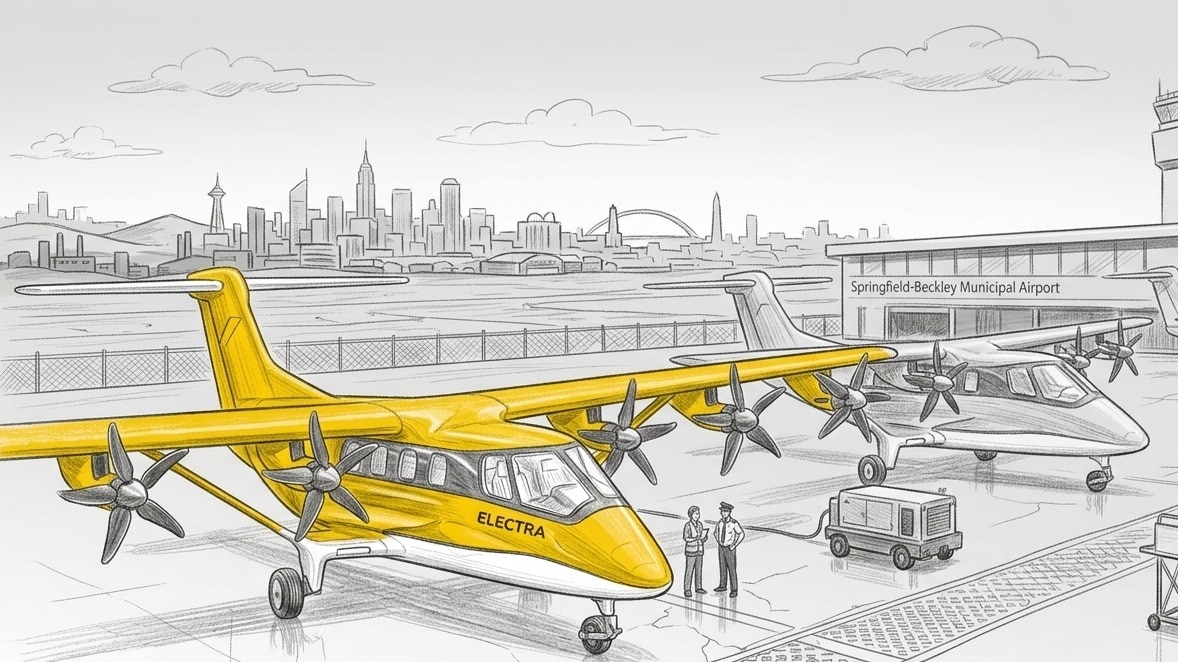
Electra, which began as an MIT class project, is now pursuing an $850 million aircraft manufacturing plan in Ohio, with production expected to create 1,975 jobs and scale its nine-passenger hybrid aircraft.Electra: MIT class project becomes 850 Million USD aircraft manufacturing plan (AI generated image)What began as a graduate student project at the Massachusetts Institute of Technology (MIT) is now turning into a USD 850 million effort to manufacture a new kind of aircraft in Ohio.Electra, a company founded around the idea of a hybrid-electric aircraft, started with a simple question: Could a fixed-wing plane take off and land on much shorter runways while still travelling farther and faster than an all-electric aircraft?The idea has since grown from a classroom project into an aviation company preparing to scale production, as reported by the Massachusetts Institute of Technology (MIT).A HYBRID AIRCRAFT DESIGNED FOR SHORTER RUNWAYSElectra's fixed-wing aircraft is designed to make air travel more accessible, particularly for people who live far from major airports. The aircraft combines a smaller and more efficient engine with batteries that provide additional power during takeoffs and landings. According to MIT, the design could allow the aircraft to operate from much shorter runways than traditional airplanes.The plane is expected to have a range of around 1,200 miles and a cruising speed of about 200 miles per hour. Its shorter runway requirements and quieter operation could also allow it to use unconventional takeoff and landing locations, including barges, parking lots, and soccer fields, as reported by MIT. The aircraft could potentially be used for a variety of trips while also reducing fuel consumption.AN IDEA THAT BEGAN IN AN MIT CLASSROOMThe origins of Electra can be traced back to 2017, when a group of graduate students worked on a project in MIT's Class 16.886, Air Transportation Systems Architecting.At the time, electric vertical takeoff and landing (eVTOL) aircraft were attracting considerable attention. The students, however, wanted to explore how alternative aircraft designs could work.The group proposed combining batteries and small electric motors with a fixed-wing aircraft. The additional electric power could help reduce the runway and landing space required, while the aircraft's conventional propulsion system could provide greater range than a fully electric aircraft.The concept was later developed through several senior design classes co-taught by MIT professors Mark Drela and John Hansman.FROM STUDENT PROJECT TO FLYING AIRCRAFTChris Courtin SM '19, PhD '24, Electra's director of technology development, has been involved with the concept since its early days.Courtin initially worked on the aircraft as part of the MIT class project. He later continued developing the idea as a teaching assistant and eventually explored parts of the concept as part of his PhD thesis, as reported by MIT.During the senior design classes, student teams built a subscale version of the aircraft to demonstrate that the concept could work. The model was tested in MIT's Wright Brothers Wind Tunnel and through flight testing.Electra was officially formed in 2019 after John Langford, who had been running aircraft company Aurora Flight Sciences, became involved. Langford is an MIT alumnus, while Drela and Hansman serve as the company's founding technical advisors, according to MIT.ELECTRA PREPARES FOR LARGE-SCALE PRODUCTIONThe company has already built and flown a two-seat version of its aircraft. Now, Electra is preparing to move towards large-scale manufacturing.Last month, the company announced an $850 million investment to scale production of its nine-passenger aircraft in Springfield and Clark County, Ohio. The investment is expected to create 1,975 new jobs, as reported by MIT.Construction of Electra's 96-acre manufacturing facility in Ohio is scheduled to begin next year.The first phase of the facility is expected to have the capacity to produce 400 nine-passenger aircraft annually. A second phase could eventually increase production capacity to around 800 aircraft each year.- EndsPublished By: Karan YadavPublished On: Sep 2, 2026 12:55 IST
2017 MIT class project turns into 850 million USD aircraft manufacturing plan
Full Article
Original Source
Read the full article at Indiatoday →KhanList aggregates and links to publicly available news content. We do not host full articles from third-party sources. Always verify important information with original sources.