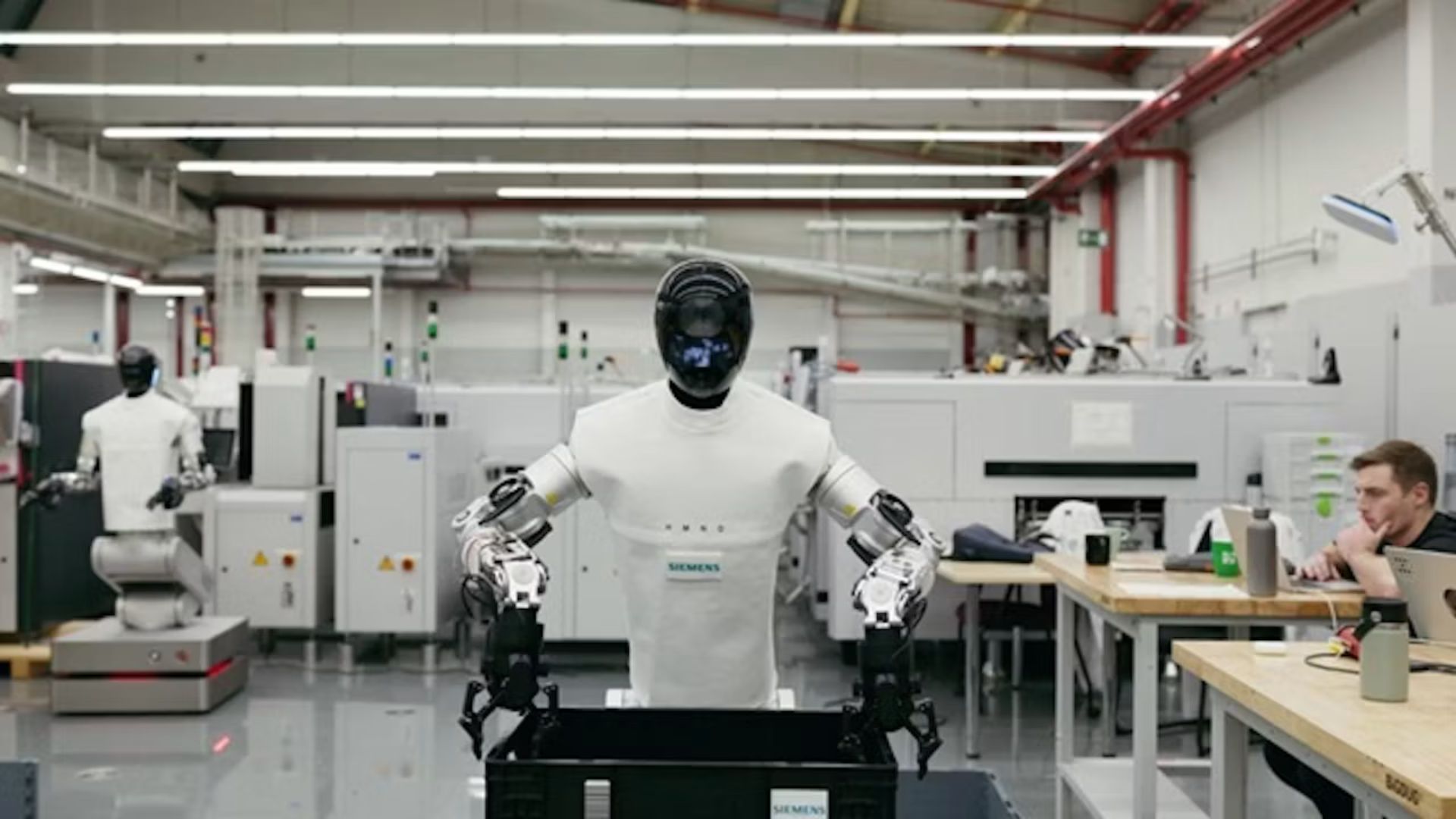
The textile industry is moving closer to large-scale automation as humanoid robots begin taking on labor-intensive manufacturing tasks. China-based industrial sewing machine maker Jack Technology is working with Siemens to integrate AI, digital engineering, and humanoid robotics into apparel production. The company aims to boost manufacturing efficiency by at least 30 percent while responding to shorter lead times, customized consumer demand, and rising cost pressures. As part of the push, Jack Technology has ordered 2,000 humanoid robots tailored for apparel manufacturing, marking what the company describes as one of the first major deployments of humanoid robots in the sector. Humanoid robot handles crates Humanoid robots are gaining traction in industrial environments because they can operate in spaces designed for people, using existing tools, equipment, and workstations without requiring major modifications. Unlike traditional industrial robots that are typically fixed in one position, humanoids replicate human-like movement and can adapt to changing surroundings. This flexibility could make them particularly useful in addressing labor shortages while working alongside human employees. A recent trial at Siemens’ electronics plant in Erlangen, Germany, demonstrated how this approach could work in practice. British humanoid robotics startup Neura Robotics deployed its wheeled Alpha humanoid robot, HMND 01, for a two-week trial. Powered by NVIDIA’s physical AI technology, the robot autonomously handled crates, placing them on a conveyor belt before moving them to a designated handoff point for human workers. During the trial, HMND 01 moved 60 crates per hour and handled two different crate sizes without requiring manual intervention. The robot operated for more than eight hours a day, while its fully autonomous grasping and placement tasks achieved a success rate exceeding 90 percent. The demonstration highlights how humanoids could take over repetitive material-handling tasks while fitting into existing industrial workflows. Four-legged inspectors Humanoids are not the only type of mobile robot being deployed in industrial environments. Four-legged robotic systems are also being developed to perform inspection and maintenance tasks in facilities where conditions can be hazardous for human workers. ANYbotics’ ANYmal, for example, is designed to inspect large chemical and energy facilities where workers may face high temperatures, chemical hazards, fire risks, and difficult-to-access areas. Using Siemens solutions alongside Roboverse Reply’s platform, the robotic dog can autonomously collect data from hundreds of inspection points and create detailed 3D models of industrial sites. ANYmal can navigate dark environments, multi-story facilities, and staircases using AI-based mobility. Its sensors also allow it to perform detailed inspections, including measuring the temperature of pumps and motors with infrared cameras. Acoustic sensors can detect frequencies beyond human hearing, helping the robot identify potential gas leaks. The data collected by these robots can be filtered and transmitted to operators in real time, allowing companies to identify problems earlier and shift from reactive repairs toward predictive maintenance. However, deploying robots at scale requires more than advanced hardware. Humanoid and mobile robots must be integrated with production systems, autonomous guided vehicles, machines, and human workers. Siemens aims to provide this underlying infrastructure through digital twins, AI-enabled sensing, robot and PLC interfaces, fleet management, industrial communication networks, and drive systems.Together, these technologies can turn individual robots into connected components of a wider automated factory, enabling them to coordinate with other systems and respond dynamically to changing production conditions.Recommended ArticlesGet the latest in engineering, tech, space & science - delivered daily to your inbox.Jijo is an automotive and business journalist based in India. Armed with a BA in History (Honors) from St. Stephen's College, Delhi University, and a PG diploma in Journalism from the Indian Institute of Mass Communication, Delhi, he has worked for news agencies, national newspapers, and automotive magazines. In his spare time, he likes to go off-roading, engage in political discourse, travel, and teach languages.
2,000 humanoid robots to be introduced in textile plants for faster, leaner production
Full Article
Original Source
Read the full article at Interestingengineering →KhanList aggregates and links to publicly available news content. We do not host full articles from third-party sources. Always verify important information with original sources.