
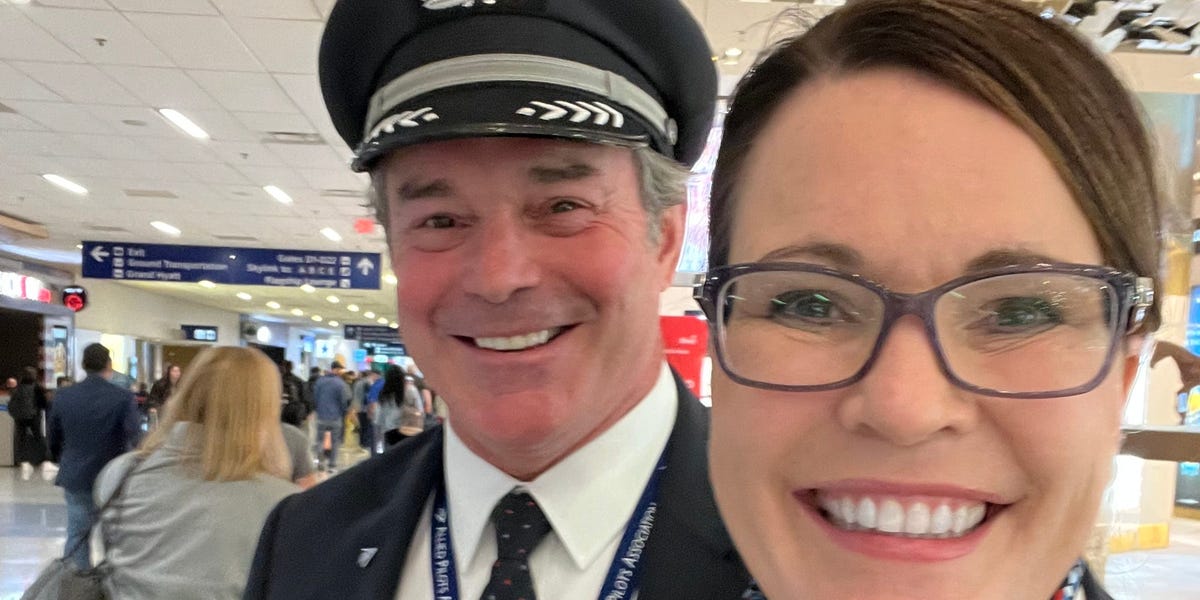
2 pilots bought 7 RVs, and are turning their 'Airbnb on wheels' business into a retirement plan Brian and Carrie Smith are full-time pilots who run an RV rental company on the side. Carrie and Brian Smith Carrie and Brian Smith rented an RV in July 2023 while participating in RAGBRAI, an annual seven-day bicycle ride across Iowa.Their accommodations weren't cheap — or particularly nice.The bath towels were "kids' old swimming towels," Carrie told Business Insider. "The seats had cuts in them, and the upholstery was dried out. It was just kind of junky."The couple, who both fly for a major airline and met while working for the pilots' union, thought they could offer travelers a more polished experience.They were also looking for a business they could continue operating after their flying careers ended. Federal rules require airline pilots to retire at 65. Brian is about six years from mandatory retirement, while Carrie has about a decade remaining.They skipped the trial run and bought seven RVsThe Smiths — who are accustomed to juggling demanding careers, unpredictable travel schedules, and a blended family of seven children — moved quickly. A few months after the bike ride, they came up with a name for their company: Suite Glamping Adventures. By the end of 2023, they had formed an LLC and bought seven new, Class C RVs."We went all in," Carrie told Business Insider. The Smiths got the idea to start an RV rental company during RAGBRAI, an annual seven-day bicycle ride across Iowa. Carrie and Brian Smith Purchasing the vehicles, which they financed through several lenders, was only the beginning, she added: "When you buy an RV, you're not buying a fully furnished RV. You're buying an empty apartment."They stocked each one with sheets, towels, kitchen supplies, toiletries, first-aid kits, and other items a traveler might need.Starting with seven RVs, which they named after their seven children, rather than testing the business with one, was intentional."We didn't want to park it in our driveway and see what happened," Carrie said. "We wanted to give this a go."A larger fleet allowed them to offer several vehicle sizes and keep backup RVs available when one needed repairs. It also helped them establish themselves as a rental company rather than an individual owner renting out a personal vehicle."We thought if we could do it on a scale that would result in more rentals and get us out there as an actual business quicker, then it would work well," Brian said. "And it really did. We were sold out in our first week that it opened in February of 2024."The complexities that come with owning and renting RVsThe Smiths encountered their first major problem before they even received their fleet.They had requested that all seven RVs be delivered winterized, but only three were. Dallas then experienced an extended stretch of temperatures below 20 degrees, causing approximately $16,000 in freeze damage.It became evident quickly that "it wasn't going to be a cakewalk," Brian said. One of the Smiths' RVs served as a mobile studio for a Dutch public radio crew covering the 2026 FIFA World Cup. Courtesy of Carrie and Brian Smith Other challenges have included keeping up with maintenance, difficult renters, vehicle damage, and finding a place to store their fleet, which has expanded to nine RVs. Business Insider verified their ownership by reviewing the insurance identification cards for all nine.They initially paid about $2,000 a month for covered parking at a public-storage facility. It was expensive and inconvenient, as the facility generally did not allow them to perform repairs or oil changes on-site.As Brian saw it, paying for storage meant "you're just throwing the money away." So in late 2025, the couple purchased 2.5 acres where they could store and maintain the RVs. They're now building covered storage that they plan to rent to other RV owners, turning a recurring expense into another potential revenue stream.The Smiths have also learned to outsource. They now pay contractors to handle cleaning, laundry, and some maintenance rather than attempting to do everything themselves between flights. They've also started using Wheelbase, a management platform to centralize bookings and vehicle information. They list their rentals on a platform called Outdoorsy.The work is unpredictable and, "it generally takes more time than you think," Brian said.The business is part of their long-term financial planThe business is not yet producing substantial profit, but the Smiths said it has already helped them financially through tax deductions and the accumulation of assets. As high-earning W-2 employees with several children in college, they were looking for ways to invest their money in a business rather than continue to face a growing tax bill."If we start the business and put the money that we would be throwing into taxes into RVs, we can get something to produce cash flow," Brian said, noting that their strategy depends in part on depreciation deductions tied to the RVs. The Smiths initially bought seven RVs for about $782,000. They put roughly $127,000 down and financed the rest. Courtesy of Carrie and Brian Smith The Smiths said the fleet was around breakeven during its first year. They believe it could eventually generate $150,000 to $175,000 in annual revenue, and potentially $200,000 to $250,000 as they improve operations and pursue more corporate and event bookings.But revenue is not the same as profit. Loan payments, maintenance, insurance, cleaning, platform fees, and other expenses still have to be deducted. For now, the Smiths are using their airline salaries to absorb the early costs and build the operation before Brian is required to stop flying. They hope that by retirement, the company will provide both income and a new way to spend their time."It's kind of the next phase," Carrie said. "We took care of our kids for a long time, and now here we are taking care of our RVs that are named after our kids." Read next Kathleen is a correspondent at Business Insider, covering investing and the path to financial freedom. She's been writing about personal finance for BI and other publications, including CNBC, since 2015.Her coverage includes the Financial Independence, Retire Early (FIRE) movement, real estate investing, and side hustles. She also occasionally covers small businesses and enjoys writing personal narratives about her own experiences navigating the world of money.Elkins graduated from Williams College in 2014 and resides in Los Angeles. Outside work, she trains for marathons and triathlons in the Santa Monica Mountains.Follow her on LinkedIn.Popular articles:All smoke and no FIRE: Early retirees open up about the struggles of ditching their paychecks in exchange for freedom and the new ways they're generating extra incomeA couple that owns more than 100 units and earns over $100,000 per month in rental income explains how they used real-estate investing to retire in their 40sA tennis center owner in Santa Monica changed his entire business to capitalize on the pickleball surge in America. It was a 'huge risk' but his revenue numbers have doubled and his court has never been busier.A 50-year-old retiree says his 'biggest mistake' was saving too much in his 401(k). He explains what he would do differently and his work-around for being illiquid when he retired.I rolled over my 401(k) because I thought it was the smart financial move. Several delays and 5 months later, I regret even starting the process.I spent over $5,000 to race an Ironman. I have no regrets whatsoever — and experts suggest it was a good way to spend my money.Padel is more fun than pickleball. But can the pricey racket sport enjoyed by America's top 1% win over the whole country? RV side hustles
2 pilots bought 7 RVs, and are turning their 'Airbnb on wheels' business into a retirement plan
Full Article
Original Source
Read the full article at Businessinsider →KhanList aggregates and links to publicly available news content. We do not host full articles from third-party sources. Always verify important information with original sources.