
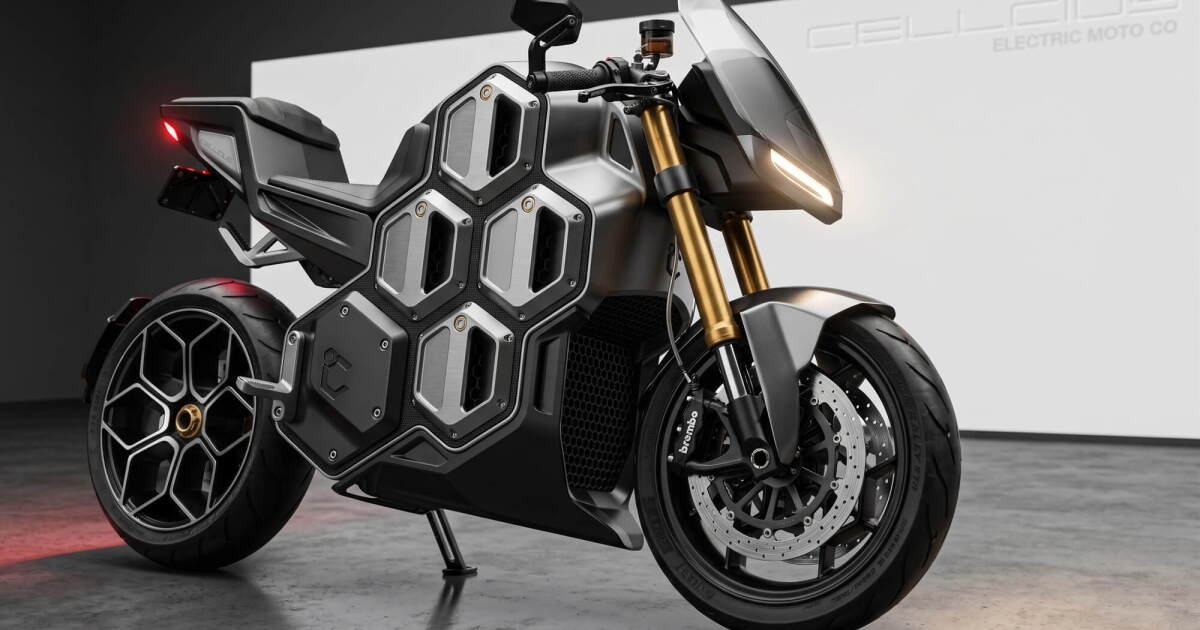
I’ve seen many concept bikes over the years, but few have genuinely earned my long-term attention. Many look futuristic or hit impressive bench figures, but they are often just designer exercises with little real-world utility. This one, however, takes aim at one of the biggest hurdles facing modern electric motorcycles: weight.Want enough battery capacity to make a serious sportbike useful beyond short rides? You're likely looking at a bigger, heavier machine. Prefer something light and nimble for city commutes? You'll likely have to settle for less energy on board.Australian design studio Clandestine Design Group thinks there's a way around that compromise, and its Cellcius C-01 Hypersports concept has a rather unusual solution: make the battery pack modular, removable, and useful even when it's not powering the motorcycle.The C-01 is built around a system called Hex-Core, comprising eight removable battery modules, each with a capacity of 3 kWh. That means you could choose how much battery capacity to install based on the day's plans, instead of carrying the entire pack everywhere. The Hex-Core system comprises eight removable battery modulesClandestine Design Group The idea behind it is fairly simple: why should a motorcycle's weight and performance be dictated by a battery pack sized for every possible journey? Most riders don't need maximum range every time they leave home, and hauling around unused battery capacity means carrying additional weight for no immediate benefit.Two modules would configure the motorcycle for lighter urban use, while all eight would provide the full 24-kWh capacity for longer rides and high-performance riding. With the complete battery complement installed, the concept is claimed to produce 195 hp and weigh 485 lb (220 kg).Remove six modules, and the proposed weight drops to 353 lb (160 kg). That's a substantial 132 lb (60 kg) difference. And as you can imagine, one that would drastically change how the motorcycle feels and behaves.The C-01's eight hexagonal modules are arranged along the sides of the bike, making the battery system an obvious part of its design rather than something hidden inside the chassis. Each module weighs roughly 22 lb (10 kg), making individual units potentially manageable enough to carry indoors. With two modules fitted, the bike has a nominal capacity of 6 kWh; all eight increase that to 24 kWh. The Cellcius C-01 runs on a carbon-composite shaft driveClandestine Design Group Don’t forget charging is a key part of the problem when it comes to EVs. For people living in apartments, charging an electric motorcycle can be a logistical headache. Not everyone has a garage, a private parking space with an electrical outlet, or convenient access to public charging infrastructure.Clandestine's proposed solution is a home-charging ecosystem built around removable batteries. A wall-mounted docking station would allow modules to be charged and swapped at home, while a purpose-designed backpack would let riders transport individual batteries indoors and plug them into a conventional wall outlet.But – and that’s a big “but” – these are just design specifications, rather than independently verified performance figures from a production motorcycle. That’s because the C-01 remains a concept, with no announced production plans for now.There are obvious trade-offs to this idea, of course. Two modules might make the motorcycle considerably lighter, but the smaller battery would also mean less energy available for riding. And while a 130-lb reduction sounds appealing, the concept doesn't establish how much range either configuration would deliver. Nor does it provide independently verified acceleration, top-speed, or track-endurance figures.Intricacies like battery weight, safe handling, charging time, fire protection, and the availability of suitable electrical connections are all variables that would further influence whether the system works as well outside a design presentation as it does on paper. Thanks to vehicle-to-load (V2L) functionality, the batteries can power your electronic devices as wellClandestine Design Group What’s particularly interesting is how useful the motorcycle would be even when you're not riding it. The battery modules also double as portable power stations through vehicle-to-load (V2L) functionality. Removed from the motorcycle, they could potentially provide electricity for your electronic devices. Think camping, outdoor work, or powering accessories at a track day.It's a neat way to make an expensive battery pack useful beyond its primary purpose. Rather than leaving spare capacity sitting unused in the motorcycle, owners could potentially put those modules to work elsewhere. The concept also suggests purpose-designed luggage that fits into the spaces left vacant when batteries are removed, making the system more versatile without requiring the bike to look unfinished.And it’s not like the folks at Clandestine Design Group drew some sketches and called it a day. The concept runs on a carbon-composite shaft drive as opposed to a traditional chain. A shaft drive can reduce routine maintenance associated with chain lubrication and adjustment, while the proposed carbon construction aims to keep weight down.Elsewhere, the cooling arrangement is equally ambitious. Rather than relying on a bulky conventional liquid-cooling system with heavy hardware, the concept uses a flow-through tail designed around the Venturi effect. The idea is to channel air through the motorcycle and draw heat away from the chassis as the bike moves. The design aims to reduce the need for heavy cooling fans and associated equipment, particularly when the electric drivetrain is working hard. The Cellcius C-01 produces 195 hp and weighs all of 485 lbClandestine Design Group Up front, chunky inverted forks and beefy Brembo brake hardware suggest serious stopping power, while the fully adjustable Öhlins suspension adds some credible track-day intent. The bodywork channels air through prominent front intakes toward a sharply sculpted tail, where the Venturi-style exhaust is designed to draw heat out of the chassis.Even the lighting is integrated into the angular bodywork, with slim LED elements keeping the silhouette clean. It's a fascinating mix of exposed utility and exotic-bike hardware.As for the styling, it follows what the design team calls Technical Brutalism, with visible mechanical elements and the battery modules becoming part of the motorcycle's visual identity. While the styling may likely divide opinion, it does give the C-01 a clear identity in a market where many electric motorcycles lean heavily on familiar superbike styling.The Cellcius C-01 has been recognized at the Tokyo Design Awards, where it was listed as a Platinum Winner in the 2026 professional transportation-design category. Additionally, the firm won six Australian Good Design Awards in early October.But awards and attractive renderings don't necessarily translate into a viable production motorcycle. The C-01 would need to overcome a whole lot of questions before it could even reach the production stage. The Cellcius C-01 is only a concept at this stageClandestine Design Group And even then, there would be the question of price. A 195-hp electric hypersport with eight modular batteries, carbon-composite drivetrain components, and sophisticated thermal management is unlikely to be a bargain-basement proposition. So it’ll be interesting to see if it even manages to find enough buyers at that point.Regardless, the C-01 raises a useful question for electric motorcycle makers: does every ride really need the biggest battery the owner can afford? A system that allows riders to leave unnecessary weight at home, charge batteries away from the motorcycle, and repurpose them as portable power sources could offer a more flexible approach to electric mobility.The Cellcius C-01 may never make it to a showroom. But if modular battery technology becomes practical, the idea of choosing how much motorcycle you need for a particular ride could be the most viable solution.Source: Clandestine Design Group
195-hp electric hypersport's swappable batteries double as power banks
Full Article
Original Source
Read the full article at Newatlas →KhanList aggregates and links to publicly available news content. We do not host full articles from third-party sources. Always verify important information with original sources.