
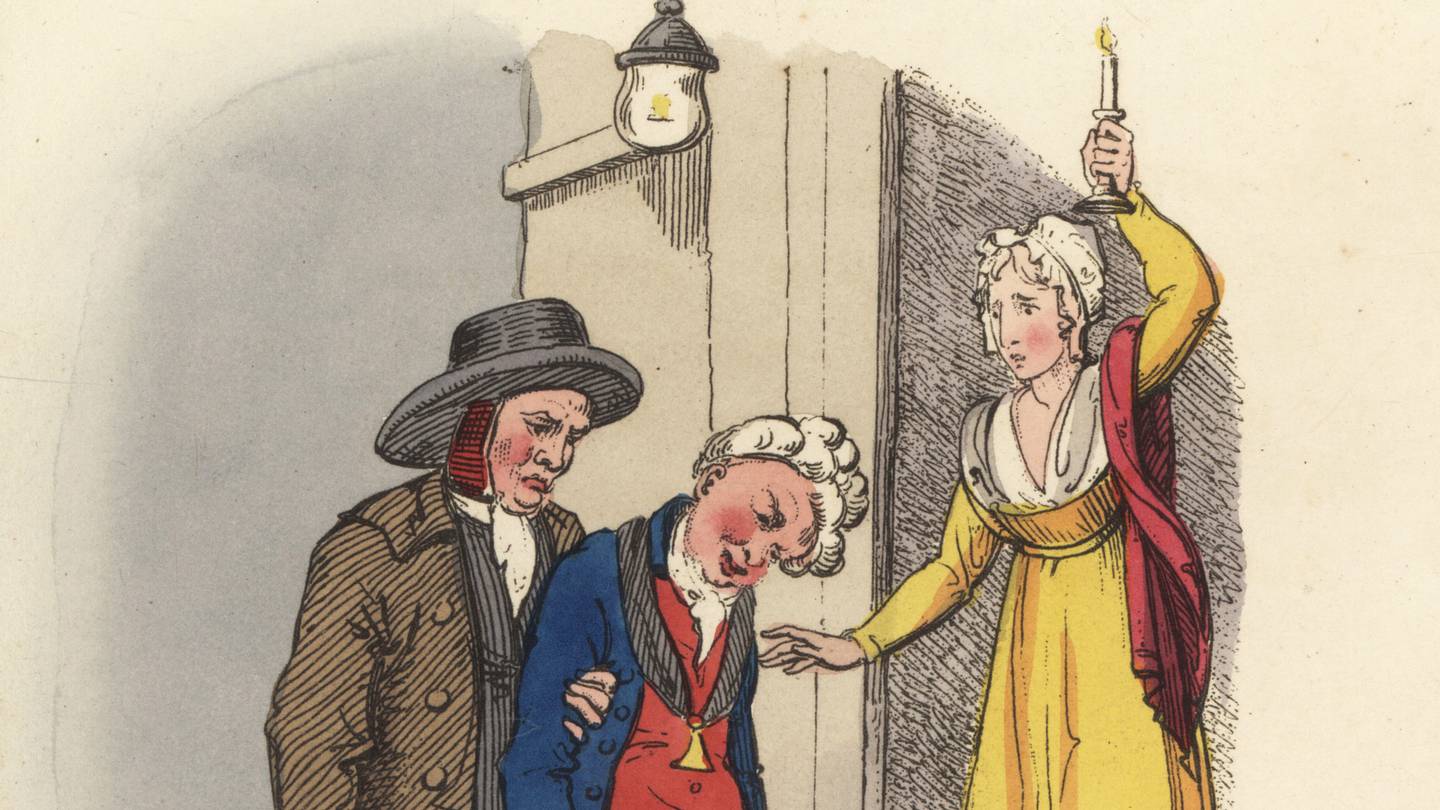
In 1737, Benjamin Franklin published a “Drinkers Dictionary” in the Pennsylvania Gazette. Although precisely who wrote the article is unclear, the dictionary listed a grand total of 229 quirky synonyms and other expressions—from “addled” to “water-soaken”—for describing someone who is drunk. As exhaustive as Franklin’s list was, it by no means tells the entire story. In fact, when it comes to words for drunkenness, the English language has several thousand words and phrases to fall back on, dating from the days of Old English to the present day. Not all of them remain in common use, unfortunately, but next time you want to drop something a little more obscure into the conversation down at your local bar, any one of these old-fashioned expressions will do.BANG-UP In Victorian maritime slang, being bang-up meant to be drunk. As a more general intensifier, bang-up was also used in a bunch of longer phrases—like “bang-up to the mark”—to mean absolutely, fully, or first-rate. BARREL-SICK In olden times, you could be barrel-sick and pot-sick if you were drunk, while crop-sickness is a recorded Tudor-period phrase for the queasy aftereffects of a night of hard drinking. BOTTLENOSED Inebriated company, illustration | Sepia Times/GettyImagesIn 17th-century English, a bottlenose or bottlenozzle was someone with a noticeably large, swollen, or bruised nose, while the older term bottlenosed has meant large-nosed since the 1500s. But perhaps partly in reference to someone with a drunkard’s swollen nose—or perhaps in a more straightforward reference to a drunkard holding a bottle to their face—bottlenosed has also meant drunk since the early 1700s. CORKY If you’re corky-headed, then you’re flighty or empty-minded—but if you’re just straightforwardly corky, then you’re half-drunk. CUP-SHOTTEN One of the earliest recorded synonyms for being drunk in the Oxford English Dictionary, cup-shotten is recorded as far back as the 14th century; a simpler and more modern-sounding form, cup-shot, is recorded from the late 16th century. FOX-DRUNK Flemish proverb, c1558-1560. Artist: Pieter Bruegel the Elder | Print Collector/GettyImagesIn the 1500s, the English writer Thomas Nash published a satirical pamphlet in which he jokingly identified eight types or levels of drunkenness, each one named after an animal. The first is ape-drunk, in which a man “leaps and sings” and “danceth for the heavens.” A man who is lion-drunk becomes courageous or rageful with drink, and “is apt to quarrel with any many that speaks to him.” Someone who is swine-drunk is “heavy, lumpish and sleepy.” A man who is sheep-drunk is “wise in his own concept,” and struggles to remain clear-headed. Someone who is maudlin-drunk will “weep for kindness.” A Martin-drunk person will keep drinking until they’re sober again. Someone who is goat-drunk becomes uncontrollably lecherous when drunk. And, lastly, a fox-drunk person becomes characteristically wily and cunning when drunk, and “will never bargain but when they are drunk.” GROGGED Grog has been an old word for liquor since the 1700s, in particular among sailors. Grogged is just an adjectival extension of that, dating from the mid-19th century. HAVEY-CAVEY Another dialect term from the 19th century at least, havey-cavey is a fanciful extension of “half” that emerged in the dialects of northern and central England. In literal terms it describes something that is in a trembling or precariously balanced position—like something teetering over the edge of a table, in the sense that something could go either way. In the late 19th century, it also came to be used to mean drunk. HOOPED Probably in reference to the metal hoops that encase a barrel, hooped came to mean drunk in 18th-century English. (In later years, it was nonsensically expanded to the even better expression hoopsy-coopsy.) MOCCASINED Man drinking, Paul Verlaine, 1907. | David Nathan-Maister/GettyImagesIn 19th-century American slang, “bitten by the snake” was apparently a means of saying that someone was drunk—and this specific extension of that relates particularly to the aftereffects of a moccasin snake’s bite. MORTAGIOUS A jokey mishmash of “mortal” and “contagious” (or else perhaps based on an earlier dialect word, mortacious, used as a general intensifier), mortagious is recorded in Scots in the late 1800s. OVERFLOWNA lot of old-timey words and phrases referring to drunkenness allude to some sense of going too far or too long, and overflown is another example of that dating from the 1500s. You can also be overseen, overcome, overshot, or oversparred if you’ve had one too many. OWL-EYED Being owl-eyed meant intoxicated in the 1600s, whereas before then, you could also be “as drunk as a boiled owl.” Phrases like these perhaps allude to the wild staring eyes of a drunkard, or else to the notion of a blustering drinker who feigns intelligence and talks long-windedly about subjects he actually knows little about. RAMSQUADDLED In 19th-century U.S. slang, you could be ramsquaddled. Exactly where that word comes from is a mystery, but “ram–” is an old Scots prefix used as an intensifier, so perhaps there’s a link to Scotland hidden somewhere in the mix here. ROZZLED Two Maids Drinking And Smoking | Heritage Images/GettyImagesThe dialect word rozzle means to warm oneself by the fire, but if you’re rozzled, or rozzelt, then you’ve warmed yourself by imbibing liquor (and are now suffering from doing so to excess). SACK-SOPPED Sopped here means thoroughly soaked, while sack isn’t the fabric bag but a general name for a kind of Spanish white wine popular in England in the 1500s (which is when this phrase dates back to). SHOT IN THE NECK “Shooting the cat” meant vomiting from drinking too much in 18th-century slang, and may have evolved into “shot in the neck,” another slang term with the same meaning that emerged in America in the 1800s. SNUG UNDER THE TABLE WITH THE DOGS The American writer Parson Weems, also known as ML Weems, wrote in 1818 that at first a drunkard only has “a drop in his eye,” then is said to be “half shaved,” then “a little on the staggers,” and then progressively “quite capsized,” then “snug under the table with the dogs,” and lastly is able to “stick to the floor without holding on.” YOUR BLOODY FLAG IS OUT Scene from Shakespeare's 'Henry IV | Sepia Times/GettyImagesInspired by a line from Shakespeare’s Henry V, saying that someone’s “bloody flag is out” meant that they had become either red-faced with drunkenness, or else (more figuratively) that they were wild with a drunken rage.
19 Old-Fashioned Ways to Describe Being Drunk
Full Article
Original Source
Read the full article at Mentalfloss →KhanList aggregates and links to publicly available news content. We do not host full articles from third-party sources. Always verify important information with original sources.