
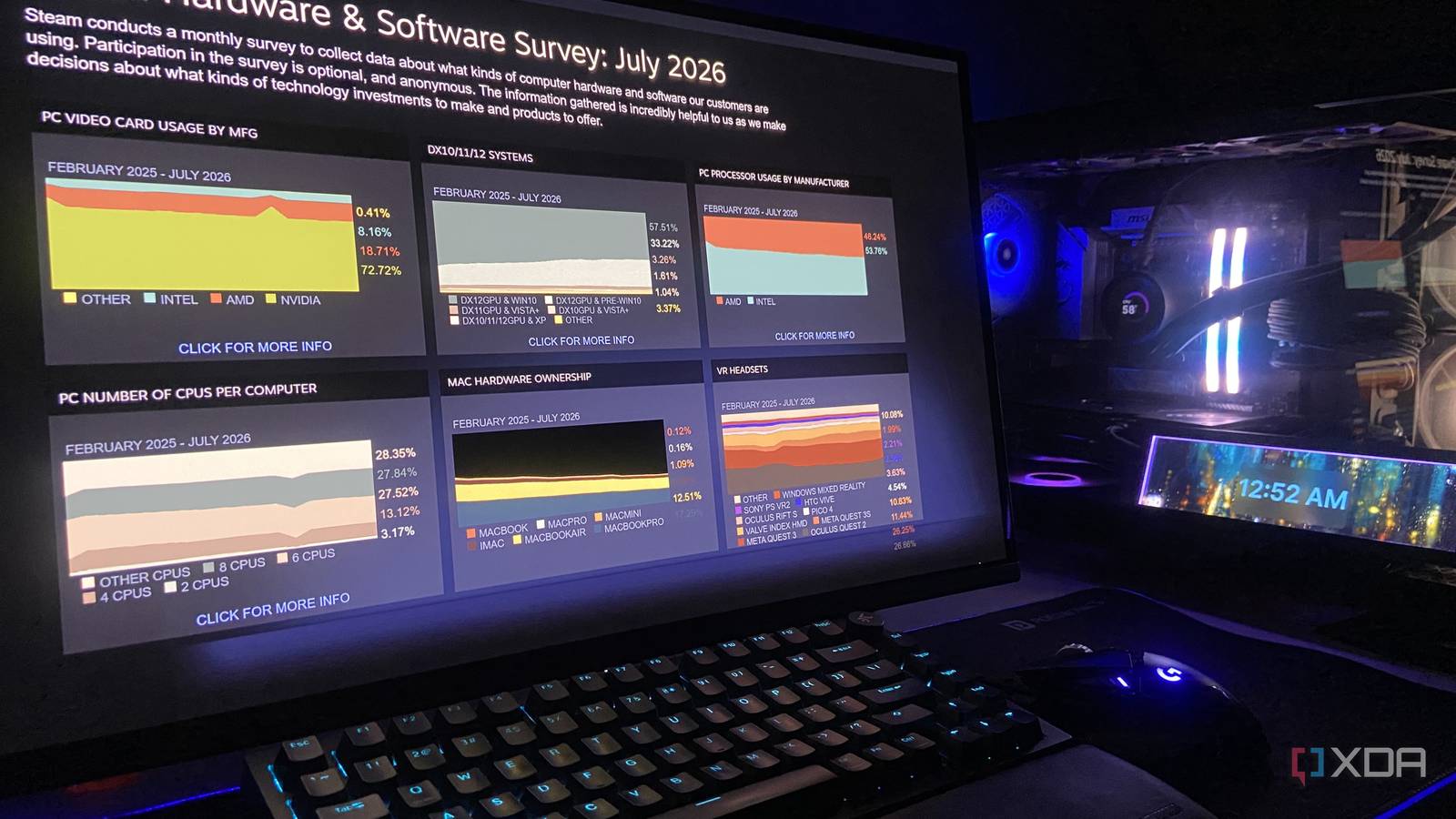
Published Aug 21, 2026, 12:00 PM EDT Abhinav pivoted from a career in banking to pursue his first love in writing. Even while working full-time, he continued contributing as an editor-at-large, a role he has held for more than 7 years. A lifelong tech enthusiast who has built three gaming and productivity powerhouse PCs since 2018, his passion for technology keeps him closely following the semiconductor industry, from NVIDIA and AMD to ARM. His MSc dissertation explored how artificial intelligence will reshape the future of work, reflecting his curiosity about the wider social impact of emerging technologies. The PC hardware market has been in a rather volatile and uncertain place since the beginning of the global memory crisis. Over the past year, DRAM costs, which underpin VRAM pricing, have almost tripled due to a massive, unprecedented demand from the AI industry. Naturally, this change arrived with ripple effects in the consumer market, pushing high-VRAM configurations of the RTX 50-series and Radeon 9000 series well above the intended launch MSRP. The latest Steam Hardware Survey, however, saw something unusual in its latest reporting. For the first time since Valve began breaking out video memory by tier, 16GB cards became the most common configuration on Steam. Almost every news outlet was convinced that gamers are finally walking away from 8GB as the dominant VRAM configuration, but there's far more going on than what meets the eye, and consumer choice may have little to do with it after all. What does the latest Steam Hardware Survey say about GPUs? More gamers on 16GB VRAM than 8GB, but only by a sliver Credit: Valve Corporation. The July 2026 Steam Hardware Survey reported that 16GB graphics cards are the most common configuration on Steam across surveyed systems. The survey put 16GB GPUs at 25.9%, a whisker ahead of 8GB cards at 25.32%, with more than half of surveyed players now sitting on at least 10GB of VRAM. The numbers are, indeed, right, but the prevailing insights that used them as a basis warrant a careful re-evaluation. Tech outlets were quick to capitalize on the 0.58% percentage point gap and run headlines stating that gamers are finally switching to higher-VRAM GPUs, snapping up high-end Nvidia and AMD cards, and reading this as evidence that the upgrade cycles are starting to catch up. Needless to say, most of this is, at best, unadulterated optimism in an otherwise dysfunctional hardware market with nothing but a month's worth of data backing the claim. A singular data point does not signal a consistent forward-moving trend, and a crossover that's this thin is sensitive to how the survey is assembled, and the two things that moved in July have nothing to do with anyone upgrading. There's a lot more to the story besides this one-dimensional angle, and that requires looking into the specifics of what the survey reported, and the hardware the participants are running on their machines. Have gamers finally started to move on from 8GB graphics cards? There's more than what meets the eye when it comes to the survey There are several problems with the narrative surrounding the latest Steam Hardware Survey. The first aspect that needs consideration is the fact that Valve has started to improve its reporting on AMD cards, and RDNA 4 parts, like the RX 9070 XT and RX 9060 XT, are now counted properly, and their respective VRAM allocation attributed under the right category. Now, this certainly lifts the 16GB tier and trims the ranks below it without a single new GPU being sold to anyone. The next aspect that's absent from most hardware trend analysis is the dynamics of the secondary markets. On the very same survey, it's reported that older SKUs like the RTX 3070 and RX 6800 have both gained market share. The RX 6800, most notably, offers 16GB of GDDR6 memory, and its movement debunks the narrative that gamers are investing in the newer offerings from AMD. While it still implies a movement from 8GB of VRAM to 16, it hardly implies that there are any signs of the market's upgrade logic "healing". GPU Share change Release year Nvidia GeForce GTX 1070 +0.01% 2016 Nvidia GeForce GTX 2080 Ti +0.01% 2018 Nvidia GeForce RTX 3070 +0.02% 2020 AMD Radeon RX 5700 XT +0.01% 2019 AMD Radeon RX 6800 +0.01% 2020 AMD Radeon RX 550 +0.01% 2017 Then, there's also the matter of data aggregation, or the lack thereof. In its current state, Steam's chart presents a combined view of operating systems across Linux, Windows, and macOS, grouping the datasets together. The Linux side now includes SteamOS, and by extension, devices like the Steam Deck alongside other handhelds like Lenovo Legion Go S. Credit: Valve Corporation. MacOS, on the other hand, skews the VRAM data further as it uses Unified Memory Architecture since the release of the first Apple Silicon M1 chip in November 2020. On Windows systems, 8GB VRAM is still the dominant memory configuration, running on about 33.20% of all surveyed systems. It's clear that there is almost no indication of gamers collectively deciding to ditch their 8GB GPU and swapping them with one with double the VRAM, despite what it reads like. The era of 8GB graphics cards is far from over As much as gamers would like it to be Contrary to what most reporting would like you to believe, consumers aren't suddenly being able to purchase new, cutting-edge high-end cards with a beefy VRAM configuration. That proposition could not be further from truth, especially since the macroeconomic conditions haven't allowed for such a shift across global markets in any shape or form. The leading players in the industry are continuing to ship 8GB cards with newer architectures, and that much was clear AMD's introduction of the RX 9050 8GB. As a matter of fact, Nvidia has also taken a turn backwards and brought the older Ampere architecture back to life with the re-release of the RTX 3060 12GB, complete with its 2021 price tag. Meanwhile, 8GB Blackwell and RDNA 4 cards continue to ship as usual, while the fate of the refresh of the existing 50-series lineup hangs in balance due to prohibitively expensive and increasingly scarce GDDR7 memory. Don't be fooled, the VRAM nightmare is far from over What you'll realize is that, absolutely none of this can be construed as a sign of the market healing, or DRAM or VRAM contract prices going back to normal. Half a percentage's worth of shift could reverse by the time the next hardware survey comes around. This also cannot be seen as an absolute sign that gamers are leaving 8GB cards behind to chase 16GB GPUs en masse, which would've been a utopian shift in the state of affairs. Sadly, none of that is happening, at least not now, and at least, not anytime soon.
16GB GPUs finally overtook 8GB despite the memory crisis, but it isn't the good news everyone reported
Full Article
Original Source
Read the full article at Xda-developers →KhanList aggregates and links to publicly available news content. We do not host full articles from third-party sources. Always verify important information with original sources.