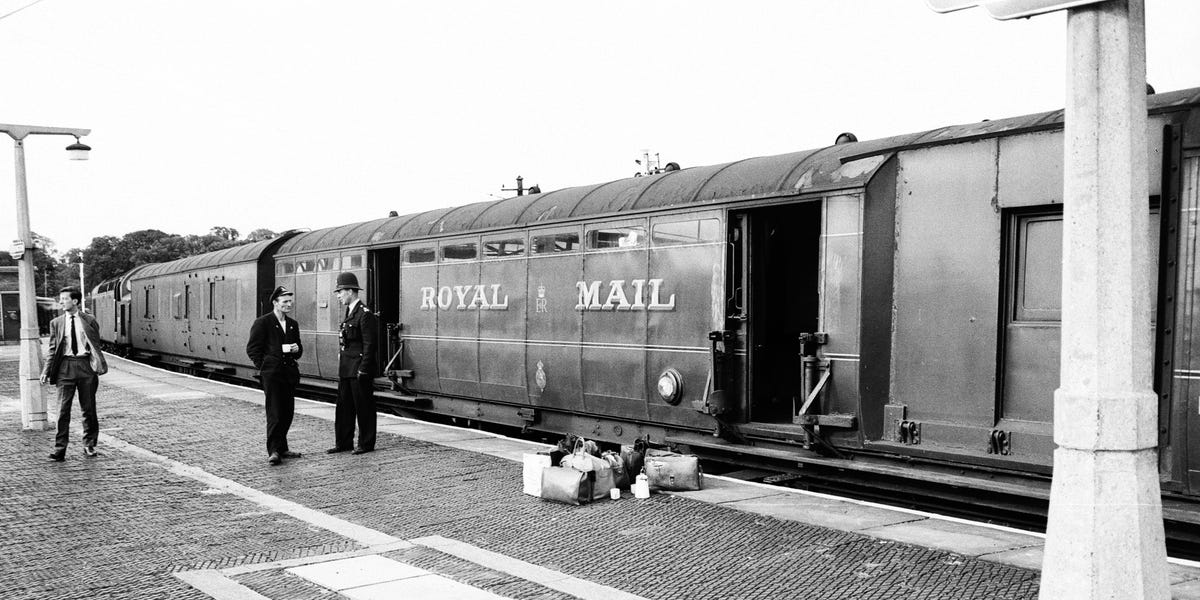
5 min readHere’s what you’ll learn when you read this story:When a postal train unexpectedly stopped on August 8, 1963, ski-masked gangsters climbed on board and snatched up bags of money totaling around $65 million.While some of the robbers were quickly apprehended and caught, others, including gang leader Bruce Reynolds, managed to slip out of investigators’ hands. Most of the fugitives eventually returned to London and were arrested, but one major aspect of the crime still remains a mystery. Beneath the glossy mod exterior of London in the early 1960s, a criminal underground was humming. Armed robberies seemed to happen at every turn. But while most outlaws held up banks like a movie stereotype, one man was dreaming of something far more audacious—something no one had ever attempted on British soil.Bruce Reynolds passed for a gentleman on the city streets. To him, crime was a glamorous affair that bought a life of fast escapes and faster cars, dinner parties, and fine Italian suits from the poshest shops on Savile Row. He had already done ten years in prison. A recent airport robbery had barely quickened his pulse. Reynolds wanted something that would make history.The opportunity arrived through two accomplices, Buster Edwards and Gordon Goody, who had come across insider information about a Royal Mail train headed from Glasgow to London. It would be traveling just after a bank holiday, and a weekend without deliveries meant the high-value package car would be swollen with cash. Potentially millions of pounds, all rolling through the dark English countryside in the dead of night, guarded by nothing more than a few unarmed postal workers.There was one problem. None of them had ever robbed a train.Reynolds scoured the criminal underworld for anyone who had. He found the South Coast Raiders, a gang boasting three veteran train robbers in Tommy Wisbey, Bob Welch, and Jim Hussey, along with a signal rigging expert named Roger Cordrey. Reynolds added more men: old prison mate Ronnie Biggs, getaway driver Roy John James, and Charlie Wilson. Sixteen men in all, each willing to risk everything.They had one extraordinary stroke of luck. Most high-value package cars had alarms, barred windows, and bolted doors. But the secured cars that should have been attached to this particular train were out of service. In their place were unprotected reserve cars that had no alarms and no bars. The train was a vault with its door hanging open—if they could make it stop.That was Cordrey’s job. On the night of August 8, 1963, he crept to the signal gantry along the main line and covered the green light with a black glove. Then he wired a battery to the red light. When head engineer Jack Mills and co-engineer David Whitby saw the signal change, they did exactly what any driver would do. They stopped.Figures in black ski masks materialized from the darkness.Mills fought back. A crowbar struck him over the head. Bleeding, he was ordered to drive another half mile to Bridego Bridge, then handcuffed to Whitby on the cabin floor. The robbers detached the first twelve cars—postal employees inside had no idea they were being hijacked—and swarmed the second car, where the real prize waited. Its unarmed guards were overwhelmed in seconds. One hundred twenty mail sacks, fat with banknotes, were flung down the embankment into waiting Range Rovers and a military truck. The entire operation took less than thirty minutes.Then they vanished.At Leatherslade Farm, a remote property they had purchased specifically for this night, the gang divided the U.S. dollar equivalent of nearly $65 million. Each man took home roughly $3 million. They were giddy, reckless. Someone pulled out a Monopoly board and they played using real money, flicking actual banknotes across the table as if the fortune were a joke. If any of them landed on “Go to Jail,” they laughed it off.They shouldn’t have laughed.The gang had a plan for the farm. An accomplice was supposed to burn it to the ground, destroying every trace of their presence. But at the last moment, he backed out. The farmhouse sat untouched, and inside it lay a forensic goldmine. When Scotland Yard’s Flying Squad—an elite unit specializing in armed robbery—arrived, they found emptied post office sacks, clothing, and surfaces covered in fingerprints. Leading the investigation was Detective Chief Superintendent Tommy Butler, a notorious workaholic whose relentless cunning had earned him the nickname “the Grey Fox.” Butler didn’t need a confession, just a fingerprint. And the farm gave him dozens.One by one, the names fell.Cordrey was caught first, despite not having been at the scene. Then the arrests cascaded. Goody, Biggs, Wisbey, Welch, Hussey—hauled before Aylesbury Crown Court in Buckinghamshire, where the judge handed down sentences of thirty years each. The severity stunned the country. These were sentences usually reserved for murderers. But the message was clear: Britain would not tolerate this kind of audacity.Yet some of the gang had already slipped through the net. Reynolds fled to Mexico with his wife and son. Edwards followed with his family. Wilson, still at large in England, eventually flew south to join them. For a time, the fugitives lived like kings in exile. But $3 million, spent lavishly and without income, doesn’t last forever.Edwards was the first to crack. Homesick and running low on funds, he returned to England and quietly surrendered. Wilson and Reynolds, nearly broke, drifted to Montreal. Biggs, who had managed a daring prison escape, surfaced in Australia before leaping to Brazil, where he took up with an exotic dancer and exploited a legal loophole that kept him from extradition for decades. Reynolds bounced from Vancouver to the French Riviera, always looking over his shoulder, always one step ahead of Butler—until he wasn’t. He returned to London, skulked in the shadows, and was finally run down by the Grey Fox himself.The captured men served heavy sentences, eventually reduced after years behind bars. Reynolds, ever the raconteur, wrote three books including Crossing the Line: The Autobiography of a Thief and sat for interviews for documentaries, seemingly unable to resist reliving the night that made him infamous. He was arrested again in 1983 for dealing amphetamines, a charge he denied, and released two years later, a diminished figure trading on old glory.But one thread of the story has never been pulled loose. The insider—the person embedded in the rail industry who told Edwards and Goody exactly which train to hit, exactly when it would be vulnerable—has never been identified. Investigators know only this: the informant had an Irish accent. A postman eventually surfaced as a suspect, but he was cleared of any gang connections. Whoever fed Reynolds’ crew the blueprint for the crime of the century walked away clean, their identity sealed behind six decades of silence.That mystery may never be solved.Elizabeth Rayne is a creature who writes. Her work has appeared in Popular Mechanics, Ars Technica, SYFY WIRE, Space.com, Live Science, Den of Geek, Forbidden Futures and Collective Tales. She lurks right outside New York City with her parrot, Lestat. When not writing, she can be found drawing, playing the piano or shapeshifting.
16 Thieves Engineered History’s Most Audacious Train Robbery. One Secret Remains.
Full Article
Original Source
Read the full article at Popularmechanics →KhanList aggregates and links to publicly available news content. We do not host full articles from third-party sources. Always verify important information with original sources.