
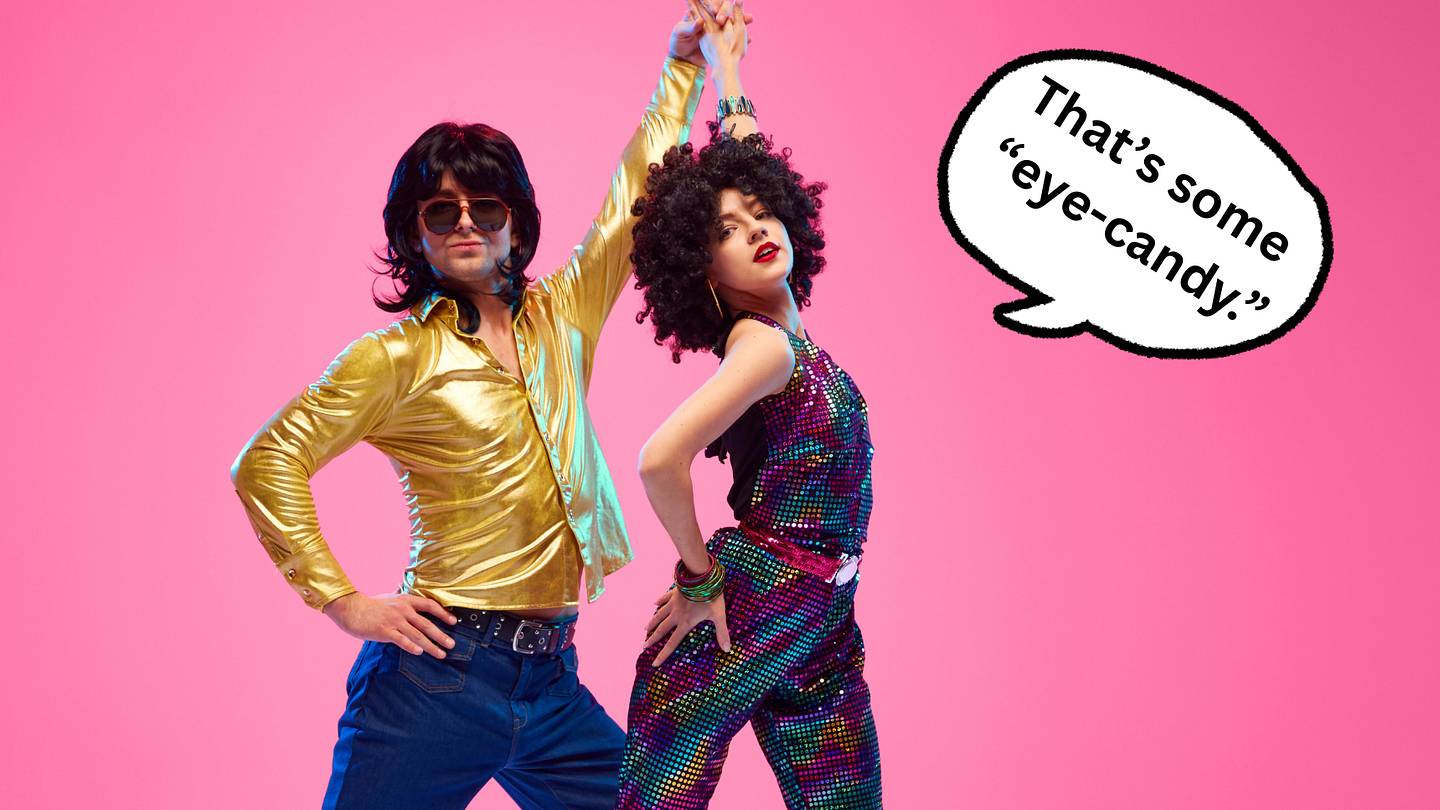
Every generation develops its own quirky slang terms and informal phrases, which often fall out of use as newer terms are coined and become fashionable, and the generation behind comes up with their own versions and vocabularies. But some slang sticks around, and becomes so established in our day-to-day language that it survives from one generation to the next. Fashionable, impressive, or just generally excellent things have been “cool,” for instance, since the 1930s. The 1970s—the era of disco music, flower power, and technological change—is no exception, with some of its slangiest and quirkiest turns of phrase still in use today. BANGED UP EYE-CANDYFIRST WORLD PROBLEMTHE FULLY MONTYGOTCHAGUILT TRIPHEADBANGERHURT LOCKEROFF-GRIDOUT-THEREPAGE-TURNERSHROOMSSKEEVYSPIT-TAKEUNCANNY VALLEYBANGED UP Banged up has meant imprisoned, especially in British English slang, since the mid 1900s, where it first emerged among criminals and the underworld. Popularized by the gangster movies of the ‘70s, it has since fallen into wider use to describe anything that is likewise locked away, locked up, or trapped. EYE-CANDYWoman with the hearts instead of her eyes | LiudmylaSupynska/GettyImagesAs modern sounding as it might be, the earliest record of eye-candy, meaning something or someone that is easy on the eye, dates from 1978. Earlier still, it was likely modeled on the 1930s equivalent, eye food.FIRST WORLD PROBLEMA first world problem is a relatively minor issue that is nonetheless enough to perturb someone living an otherwise perfectly pleasant or affluent life. It was coined way back in 1979. THE FULLY MONTYPerson walking full speed ahead | Bim/GettyImagesPopularized worldwide thanks to the success of the 1997 comedy of the same name, the chiefly British expression the full Monty is used to imply the absolute entirety of something, or an all-out, no-holds-barred approach or effort. No one is entirely sure where the phrase comes from, with theories ranging from card game parlance to references to World War II figurehead Field Marshall Montgomery. Either way, the phrase itself dates from 1979.GOTCHAAs a slangy running-together of “got you,” gotcha! first emerged as an exclamation in 1920s America, typically implying that you fully understand or have taken on board something someone has said (while earlier and slightly less ran-together version, got cher!, has been in use since the 19th century). In the 1950s, however, the expression came to be used as a noun for the first time, implying an embarrassing or revealing moment when someone is figuratively “got.” In that context, it seems to have been especially used in U.S. college slang in relation to pranks (and, in particular, a prank in which someone would moon someone else and shout “gotcha!” as they dropped their trousers). By the 1970s, however, the word had changed again and come to be used to refer to a moment in which someone is intentionally caught out doing something questionable, controversial, or foolish, and we’ve had these “gotcha” moments ever since. GUILT TRIPPerson feeling guilty | nemke/GettyImagesPeople have been experiencing guilt trips—that is, feelings of guilt or consternation caused by another person’s accusation— since 1970. HEADBANGERThe musical sense of a headbanger being a raucous hard-rock song that fans like to “bang” their heads to—or, along similar lines, a heavy metal fan themselves—dates from the 1980s. But in the 1970s, a headbanger was anyone with a fiery, unpredictable, or unruly temper, or a vocal protestor or opponent of something. HURT LOCKERClaustrophobic person in an elevator | AndreyPopov/GettyImagesLikening any situation involving intense distress, pain, danger, or anxiety—especially in a stressfully confined or claustrophobic environment—to a hurt locker dates back to 1972 according to Merriam-Webster. OFF-GRIDThe term off-grid was first coined in the context of mathematics and engineering, when it originally referred, quite literally, to any point located off the grid of a chart. Later, however, it came to refer more loosely to any real-world location not connected to a local or national supply of something, such as water or electricity, and ultimately to any similarly isolated or disconnected person or lifestyle. OUT-THEREAbstract design | aelitta/GettyImagesAs a two-word phrase, “out there” has been used somewhat vaguely to describe anything or anywhere outside of the usual realm, or far away from everyday life, since as far back as the 1790s. In the 1970s, however, a compounded version out-there came to be used more colloquially to refer to opinions, lifestyles, creative works, or anything similar that is not mainstream, or appears very avant-garde. PAGE-TURNEROddly, a page-turner was originally precisely that: a person or device used to quite literally turn the pages of a book (and in particular, the pages of a musician’s score as they play). In that literal sense, the word dates back to the 1950s—but the more familiar use of the term to describe a particularly engrossing or addictive book was coined in 1972 according to Merriam-Webster. SHROOMSPsilocybin mushrooms | Yarphoto/GettyImagesAs a shortened, slangy nickname for mushrooms (and in particular, the psychedelic ones), shrooms was first used in 1976. SKEEVYThought to be related to an Italian word meaning to disgust someone, something described as skeevy is unpleasant, sleazy, or morally upsetting. The term first emerged in U.S. slang in the mid-1970s. SPIT-TAKEAlso known as a “spit gag,” the spit-take joke of comically spraying a drink out of one’s mouth on hearing something shocking or hilarious has been popularly credited to a number of different entertainers over the years, including ‘50s favorites Danny Thomas and Desi Arnaz. The word’s history, however, tells a different story: to date, this one has not been found any earlier than 1971.UNCANNY VALLEYCoined by Japanese robotics specialist Masahiro Mori in 1970, the phrase uncanny valley originally referred to a point in a line graph Mori produced to illustrate people’s emotional response to humanoid robots. The more humanlike a robot became, Mori theorized, the more people became emotionally attached to it; but at the point at which the robot became almost too human, their attachment dipped noticeably, creating what he termed an “unhappy valley” in the graph. From Mori’s original theories, the term fell into broader use in the 1970s to refer any feeling of unease caused by something that is almost, but not quite, entirely human.
15 Slang Words From the 1970s We Still Use Today
Full Article
Original Source
Read the full article at Mentalfloss →KhanList aggregates and links to publicly available news content. We do not host full articles from third-party sources. Always verify important information with original sources.